

Don’t wait to be pushed
And in this week's Sydney Morning Herald: "The six retirement fears keeping Australians up at night"

In this edition
Feature: Don’t wait to be pushed
From Bec’s Desk: Starting new (hard) things
The Age and Sydney Morning Herald: The six retirement fears keeping Australians up at night
Prime Time: How to STOP cognitive decline before it starts with Prof. Henry Brodaty 2026 Senior Australian of the Year
Ad - Before we start — a big thanks to our newsletter supporter this week, Lifestyle Communities

Discover a Better Way to Live with Bec Wilson – Free Event at Lifestyle Deanside
Join Bec for a free, inspiring morning hosted by Lifestyle Communities in Deanside, Victoria. This event is designed to help you reimagine what your next chapter could look like. Bec will share practical tips, real-life insights and expert advice to help you make confident decisions about your future.
Plus, Discover how downsizing can free up time, money and energy, while upgrading your lifestyle with resort-style amenities, low-maintenance homes and a welcoming, like-minded community.
Enjoy complimentary refreshments, community tours and the chance to explore the beautiful display homes. Spaces are limited, so secure your free ticket and start imagining a lifestyle that truly works for you.

Don’t wait to be pushed
Anyone watching the stockmarket’s ruptures around the role of AI and the role of people in the workforce might be doing a double think right now.
You’ve worked for 30 or 40 years. You’ve built your skills, your reputation, your income, your super and hopefully your investment returns. You’ve paid the mortgage, raised the kids, carried teams, carried families and carried the mental load required to make everything function. And you’ve familiarised yourself with retirement enough to know that you have ‘enough’.
And then when it’s finally time to step into your Prime Time on your own terms, when you begin the conversation about reducing your days, reshaping your role or stepping out of the front line, something rather odd happens.
You hedge it and you downplay it. You call it temporary and you reassure everyone you’re not disappearing.
Why do you do that?
For many, it’s because you’re not only adjusting your hours – you’re adjusting your identity.
For decades work has been the spine most people’s adult life. It structured your weeks, shaped your conversations and anchored your sense of competence. When someone asked what you did, you had a clear answer. And that identity located you in the world. So even moving from five days to three, from executive to adviser, from operator to mentor or manager to casual worker, can feel like stepping away from something much bigger than a pay cheque. And if you haven’t built an identity outside work in the run up, that shift can feel destabilising.
But here’s the part we need to stop and think through.
If you don’t choose your glide path, sometimes the market or your health chooses your cliff.
Layoffs in your late 50s or early 60s are not just financial events. They are psychological events. Research suggests it can take up to two years to fully recover from involuntary job loss at that stage of life. That’s two years of rebuilding your confidence. Two years of identity repair and healing. Two years of trying to re-enter a market that may quietly prefer someone younger, someone hungry to learn new technologies, or someone who isn’t going to tell the middle manager how we did it in the year 2000. Or two years of accepting retirement happened to you and healing.
That is a very different experience from choosing your timing.
In your Prime Time, I don’t recommend a cliff edge exit from your workplace unless you need one. I recommend taking a glide path. A slower shift out of full-time work is a smart strategy. It allows your super to keep compounding at the highest balances you’ve ever seen. It protects you from sequencing risk if markets wobble. It keeps cash flow steady while you test the shape of your next chapter. And it gives your identity time to evolve instead of having to crash and rebuild.
Culturally, we celebrate grinding on and we celebrate big, dramatic retirement style endings.
We don’t celebrate deliberate transitions enough. So when you decline the next promotion, reduce your days or decide you no longer want the intensity, you can feel the need to justify it or apologise for it.
But, you don’t need to.
You are not stepping back because you are less capable. You are stepping differently because you have built yourself the powerful ability to choose.
For most of us, our super didn’t accumulate by accident. Our investments didn’t magically appear in our accounts. They are the result of decades of work. Of showing up, contributing and making deliberate decisions, year after year. The same is true of your career. Your credibility didn’t just land there either. All of that effort, over time, creates flexibility. And flexibility is not something you hoard. It is something you use.
Used well, it gives you the option of a glide path.
In my view, it is far better to step sideways on your own terms and reshape your sense of self at a time of your choosing than to be pushed out unexpectedly and left questioning your value.
I cover a lot more on this in both my books - How to Have an Epic Retirement and if you’re not ready for retirement, Prime Time: 27 Lessons for the New Midlife.

Starting new (hard) things
I’m writing this on a wet Saturday morning, having done my first ‘parkrun’ ever today. I might be late to the party but I’m here, looking after my health, trying new things and getting out there. My run time was far from epic, and I earned a wicked blister, but I did it. #1 is done and that, to me is important. Because starting things that are just outside your comfort zone can be something we put off, but not me, not this year! Now, #2 and #3 will feel easier I’m sure.
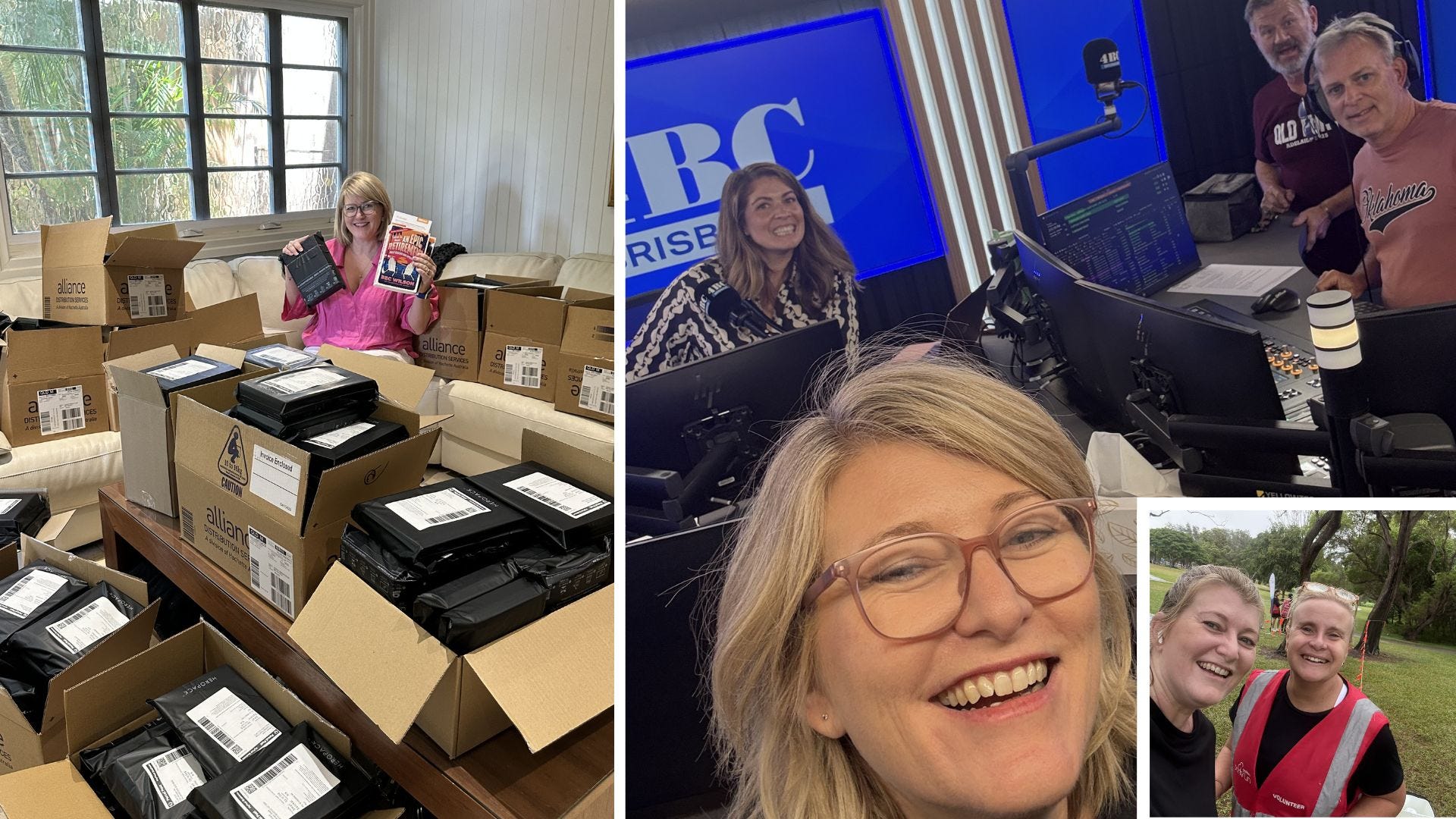
This week just gone was one of those chatty weeks that somehow disappears in conversations and tasks. The highlights? Nina and I packing a record number of Welcome Packs for the upcoming Aussie How to Have an Epic Retirement Flagship Course, and flying to Sydney to interview the fabulous Aussie Expat who now lives 9 months of her year in the UK - Kathy Lette for the Prime Time podcast. Her episode will land in your ears next week - keep a listen out. And be sure to listen to this week’s shows (there’s two actually) but the one with Dr Henry Brodaty is epic. And, again, I did some fun radio shows!
And lastly, we’ve just completed a full revision (and expansion) of the criteria for the Epic Retirement Tick ahead of the 2026 evaluation. We’ll be announcing the updated criteria in the coming weeks, giving funds plenty of time to improve ahead of the new evaluation which will be released in early October 2026. The Tick is designed as a practical assessment of funds you can use to see what your super fund is actually doing for you as you approach retirement — and to help you decide whether it’s enough. (And there’s some funds where it’s clearly NOT enough!) You can download the 2025/26 Epic Retirement Tick review of super funds here.
Next week is going to be big - so let’s dive in and tell you how you can get involved.
First of all, I’m doing brekky TV - Sunrise on 7 on Monday (tune in at about 7.20 AEDT), then we have two courses kicking off on Thursday 19th February:
The How to Have an Epic Retirement Flagship Course. Our six-week signature program. We cover the money — how much is enough, income planning, sequencing risk, super strategy. We cover the transition — part-time glide paths, identity shift, confidence. And we cover the life design — health, purpose, happiness and travel and what your next stage actually looks like. If you haven’t got your seat on the program yet - you can use this link to apply a 15% off coupon at the checkout. It’s only for our newsletter readers!
The HESTA Exclusive Epic Retirement Flagship Course — also six weeks, but designed specifically for HESTA members and offered to them by HESTA at no extra cost. That’s the official wording. In plain English? If you’re a HESTA member, it’s included in what you already pay each year. So yes, it’s essentially a course you can access at no additional cost. And it’s EPIC! You can register your place here - it’s only for HESTA members though!
And, on top of this, I’m heading to Melbourne and have a couple of events I’ll be speaking at…
I’ll be speaking in-person in Melbourne on Saturday 21st February, about ‘How to make your retirement EPIC’ at Lifestyle Communities Deanside. It’s a great way to see a community in real life too. It’s free but you need to RSVP to come along. More info here.
And, also on the 19th February I’ll be speaking at the Aware Super online event ‘Planning for Retirement for Couples’! This is an information-packed event, and it’s online, for Aware Super members. More here.
I’m also speaking at a terrific Ensombl event to help advisers focussed on improving their retirement offerings - but it’s all sold out.
So, until next week - Make it Epic!
Cheers
Bec xx

Author, podcast host, columnist, retirement educator, and guest speaker

The six retirement fears keeping Australians up at night
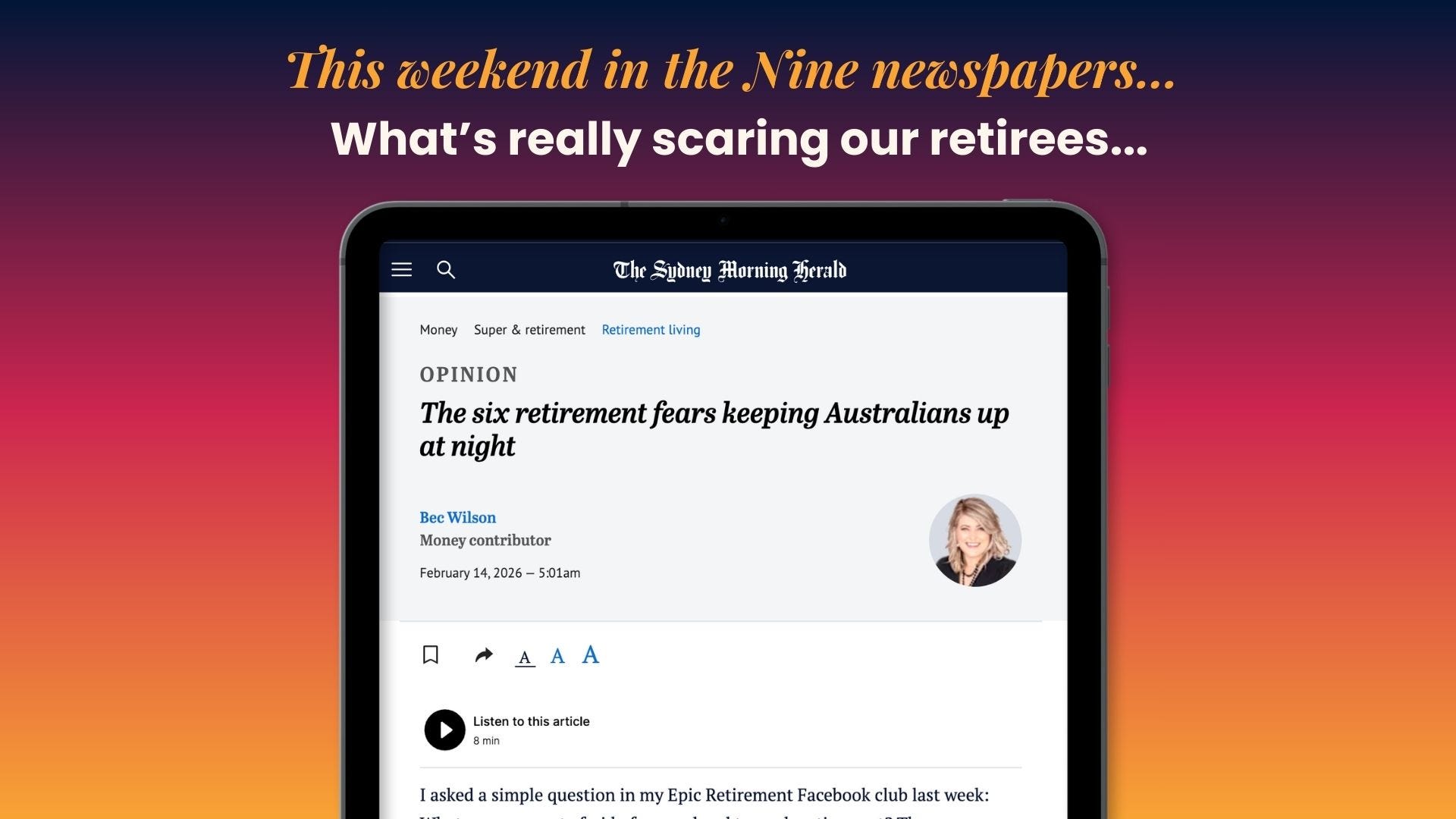
I asked a simple question in my Epic Retirement Facebook club last week: What are you most afraid of as you head towards retirement? The responses came flooding in, and what struck me wasn’t the fear itself. It was how consistent the answers were.
“Running out of money.” “Dying at my desk”, “Changing a lifetime of saving to spending”, “Boredom, identity and loss of purpose”, “Centrelink and the government changing the rules on super”, “Being alone”.
These aren’t irrational anxieties. They’re sensible questions asked by people who don’t want to sleepwalk into a phase of life that deserves more care and attention than that.
Dismissing them as benign helps no one. What does help is turning these vague fears into something they can measure and manage. Fear thrives on ambiguity. Give it structure, numbers and a plan, and it tends to shrink to a far more workable size or even get out of the way.
This article was published in The Age and The Sydney Morning Herald on Saturday 14th February 2026. Read the whole article here. Note - it has a sign-up gate but no paywall.

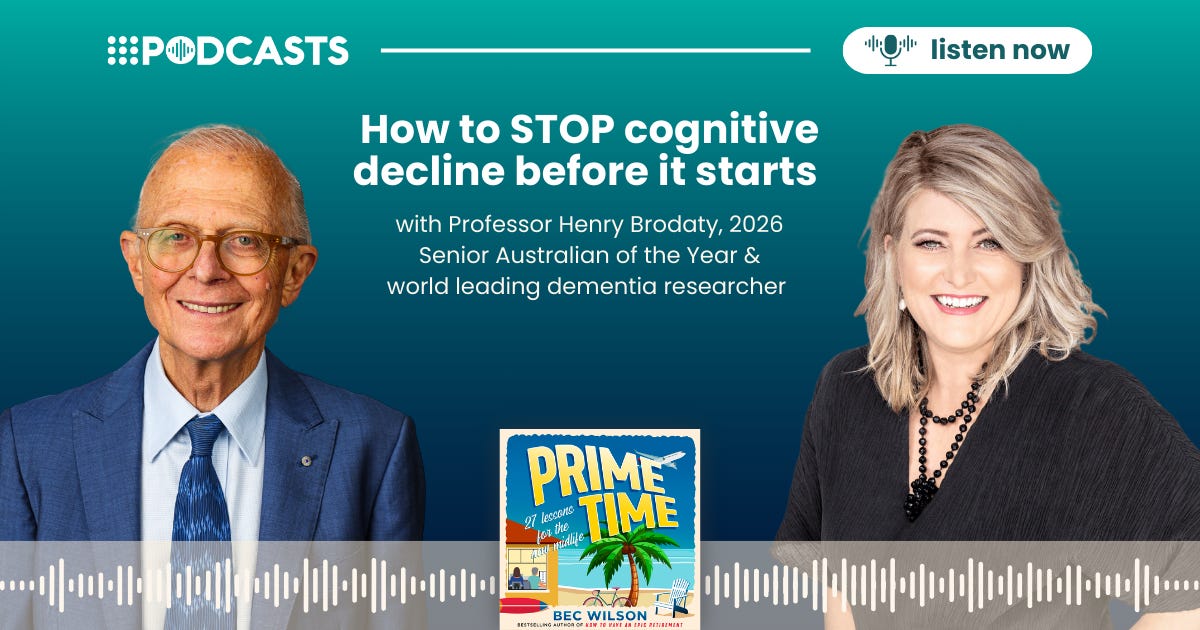
How to STOP cognitive decline before it starts
Is cognitive decline inevitable as we age, or is there actually something we can do about it?
That’s the question I wanted to explore in this week’s episode of Prime Time. Dementia and memory loss sit right at the top of the fear list for people over 50, and yet so much of what we hear is either alarmist or hopeless.
So I invited one of the world’s leading experts to the show.
I’m joined by Professor Henry Brodaty - 2026 Senior Australian of the Year, Professor of Ageing and Mental Health at UNSW Sydney, and Co-Director of the Centre for Healthy Brain Ageing. Henry has spent decades researching dementia, cognitive decline and, most importantly, what actually helps protect our brains as we age.
We discuss what’s within our control, what really matters for brain health, and why it’s never too early to start looking after your mind.
You can find out more about Henry’s work here.
LISTEN TO THIS EPISODE OF THE PODCAST HERE:
Becs is right. Don’t wait to be pushed. But I’d go further.
The real goal isn’t just a smoother exit from work. It’s building enough optionality that work becomes a choice much earlier.
One of the biggest fears isn’t money. It’s identity. Who am I without my title? How do I re-integrate into life after work? How do I rebuild routines, relationships and a social circle that isn’t anchored to the office? That transition can feel destabilising, but it doesn’t have to be abrupt. When you build financial flexibility early, you create space to reshape your identity gradually, strengthen relationships and build new communities before you fully step away.
That is where structure matters. Lower your cost base, optimise tax and build income-producing assets. When those levers work together, retirement stops being “Can I afford to stop?” and becomes “How do I want to live?”
Freedom isn’t a date. It’s a structure you build long before you need it.
Great article Bec, you are so right, your job is often your identity and not something you should suddenly step away from completely.
Unfortunately there is many a sad story of people going from full time working to complete retirement only to suffer sudden physical and often mental health.
A transition on your own terms, just like any new skill in life allows you to learn how to manage life after work in increments.
Carpe Diem 🙏