

‘Get some financial advice’ - why getting advice is just not that simple anymore
And in this weekend's Nine newspapers: "The social media trap that could cost you your retirement savings"

In this edition
Feature: ‘Get some financial advice’ - why getting advice is just not that simple anymore
From Bec’s Desk: Heading home
The Age and Sydney Morning Herald: The social media trap that could cost you your retirement savings
Prime Time: Before you switch your super, listen to this
Ad - Before we start — a big thanks to our newsletter sponsor this week, Viking

Enjoy 8-23 days in Europe with free flights and everything you need included*
Don’t miss out on incredible value with Viking’s Explorer Sale. Ending on 31 March, this is your chance to discover Europe’s most enchanting rivers from just $5,495pp, including return airfares, all onboard meals, Wi‑Fi, tours and port fees*. From the windmill‑studded banks of The Netherlands through to the historic castles and cathedrals of Germany, France, Switzerland and beyond, there’s a voyage for all interests.
Sail Europe’s great rivers in comfort with immersive itineraries and enriching experiences on Australia’s most trusted river cruise line. Use the code FFE25 to fly free up to $5,000 per couple on 2026-2028 river voyages.*

‘Get some financial advice’ - why getting advice is just not that simple anymore
“Get some financial advice.”
It is probably the most common line in Australian retirement commentary. Whenever markets move, super rules change, pension thresholds shift, or someone asks how they are meant to navigate the path from full-time work into retirement, the default response is to tell people in their 40s, 50s and 60s to go and get personal financial advice.
I have said it myself repeatedly over the past few years. It is not wrong. But I am beginning to think it is incomplete. A better version might be this: “learn how the system works first, and then look for the type of advice that suits your situation and goals”.
That distinction matters because advice is no longer a simple, uniform service.
When people walk into an advice firm seeking help to build or cross the bridge into retirement, they are often offered an ongoing arrangement where their super is moved onto a platform, invested in a model portfolio selected by the adviser or their firm, and reviewed each year for a percentage-based fee. That structure now sits at the centre of much of the professions ongoing service model. It provides continuity for clients and stable revenue for practices.
For some households, that is entirely appropriate.
But many Australians approaching retirement are not looking for someone to manage their money indefinitely. They are trying to answer very specific questions: Can I afford to retire? How much can I draw each year? How does the Age Pension fit in? What mistakes should I avoid in the early years?
Those are retirement design questions. They are not automatically investment management questions. And a lot of advisers don’t want to provide strategy without the ongoing relationship if they have such limited capacity to serve as they do today.
A significant number of ordinary superannuation holders are already in diversified, low-cost funds doing exactly what they were built to do. What they lack is clarity about the rules and confidence about the transition. In that context, handing over their super to a long-term investment management arrangement may not always be the most proportionate response.
The phrase “go and get advice” assumes that advice suited to these non investment centric questions is easy to access, simple to understand and consistent in what it delivers. It is none of those things. It is often expensive, shaped by regulation and influenced by how each firm earns its income. Yet we speak about it as though it were a single product sitting on a shelf, easy to find, navigate and buy.
When we tell people to just get advice, we skip an important step. Many approaching retirement do not yet know which problem they are trying to solve. Education gives them the ability to ask better questions and recognise whether what is being offered actually fits them and avoids them falling into the hands of unscrupulous operators (like we saw with Shield and First Guardian and with the lead generation issues flagged this week by the regulator).
Advice is important. What’s unhelpful is treating it as a one-size-fits-all solution every time something changes.
Think of advice as a choose-your-own-adventure exercise. The problem is that most Australians are handed the book without a guide to the chapters.
There are several very different types of advice, and they are rarely explained clearly. So let me give you the short-overview (there’s more in the new edition of epic).
There is general advice – information and education that helps you understand how super, tax and the Age Pension work, but does not take your personal circumstances into account.
There is intrafund or super fund advice – the limited advice many super funds provide to help members with contributions, investment options, insurance and basic retirement questions within that fund.
And then there is personal advice, which is where things become more complex.
Personal advice is often treated as a single category, but it isn’t. It can mean very different things. Some super funds now hold their own licences and provide personal advice directly to members. Others refer members to trusted external advice businesses that know their fund well.
Then there are other advice firms that don’t call themselves independent as much anymore, many of these are closely connected to investment management or do it inhouse. Their core service involves strategy first then setting up and managing portfolios for an ongoing percentage fee, so the advice process often results in assets being placed into that structure.
What is harder to find is advice that is purely strategic. The kind where an adviser reviews your whole household position, works through your retirement structure, and is entirely comfortable recommending that you stay in your existing super fund if that is the right outcome.
That can be more difficult to deliver when most of a firm’s ongoing income comes from managing assets. Not because advisers are acting improperly, but because businesses tend to organise themselves around how they are paid. (All businesses not just advisers).
There is also retirement strategy work — focused on timing, income planning, pension interaction and risk management — which does not automatically require your investments to be rebuilt. In fact, it might involve something far more practical: stepping back and asking whether you are in the right super fund for you, and if not, helping you navigate the superannuation market with clarity.
That means comparing funds properly. Understanding fee structures. Looking at long-term performance, insurance definitions, service models, product features, annuities and retirement functionality. It means evaluating whether a switch is justified and being equally comfortable concluding that it is not.
Strangely, that kind of fund-to-fund navigation – independent of moving assets into a proprietary investment structure and platform – is rare. I have yet to meet many advisers whose primary role is helping Australians assess and, where appropriate, switch within the superannuation system without simultaneously placing those assets into their own managed framework and chosen investments.
Yet for many people, that is exactly the help that might be required.
And then there are advisers whose core service is investment management. Even here, there are differences. Some build portfolios using direct shares, ETFs and bonds. Some implement pre-mapped model portfolios through managed accounts. Others design more customised portfolios. At the top end, some manage broader family wealth structures.
These are not interchangeable services.
Yet we use one phrase – “go and get advice” – as though they are.
If Australians are going to be encouraged to seek advice, they deserve a clearer map of what is actually on offer and how each type is paid for, so they can assess whether it is in fact what they need when they walk through the door. Firms, and advisers in turn, need a consistent and transparent language for explaining what they provide, properly disclosing their keeness for managed investing if that’s their model and any incentives they share because of that.
Without that shared understanding, it becomes difficult to tell whether the solution presented is genuinely solving your problem – or simply delivering the service model that firm is built around.
So if you’re thinking about advice, take the time to think about the kind of advice you are looking for. What problem is this advice designed to solve, and is that actually the problem you have right now? Then make sure you’re getting the right type of advice FOR YOU!
Maybe you agree? Maybe you disagree?
Leave me a comment here.
I cover a lot more on this in both my books - How to Have an Epic Retirement and if you’re not ready for retirement, Prime Time: 27 Lessons for the New Midlife.

This week we kicked off two Epic Retirement programs.
HESTA launched their exclusive Epic Retirement Program for members, and we opened the doors to our flagship How to Have an Epic Retirement course. That means thousands of people are online this weekend working their way through week one. I find that deeply energising.
Both programs combine self-paced video lessons and workbooks with live events to follow. It’s a powerful mix – flexibility for people to learn in their own time, alongside the shared momentum of learning with others. I’m incredibly grateful to HESTA for offering this to their members. And to everyone on the Epic Course who come to learn.
I also spent half the week in Melbourne, and remarkably, didn’t see a drop of rain. I spoke at the Ensombl Retirement Exchange for financial advisers about how retirement is no longer one long, flat chapter of life, but a series of distinct phases, and how advice needs to evolve to support people through each of them - up to 3 phases of prime time and up to 4 or 5 phases of retirement. Imagine if we had support for saving, lifestyling, part-timing, retiring, spending years, purposeful years, ageing years, care and anything else that comes along. I can see some advisers who are really leaning into this - and I’m excited for their clients who’ll enjoy the result.
From there it was an online session with Aware Super couples, and then out to Lifestyle Communities in Deanside, a stunning village in greater Melbourne.
While on the road the super-switching issue I’ve covered in the papers this weekend reared its head - something I’m passionate about stopping. The ASIC Commissioner, Alan Kirkland is taking this very seriously and so we interrupted our podcasting schedule to get him in and on the air straight away. Have a listen.
I have to say, I love the movement of it all on these busy weeks. The conversations. The rooms full of people thinking seriously about the second half of life. And I love coming home just as much.
I’m writing this from the airport on Saturday afternoon, waiting to head back for a proper night’s sleep – tired, grateful, and very aware that this work is doing something important - or at least I hope it is.
Until next week - make it epic! (And listen to the poddy!)
Cheers
Bec xx

Author, podcast host, columnist, retirement educator, and guest speaker

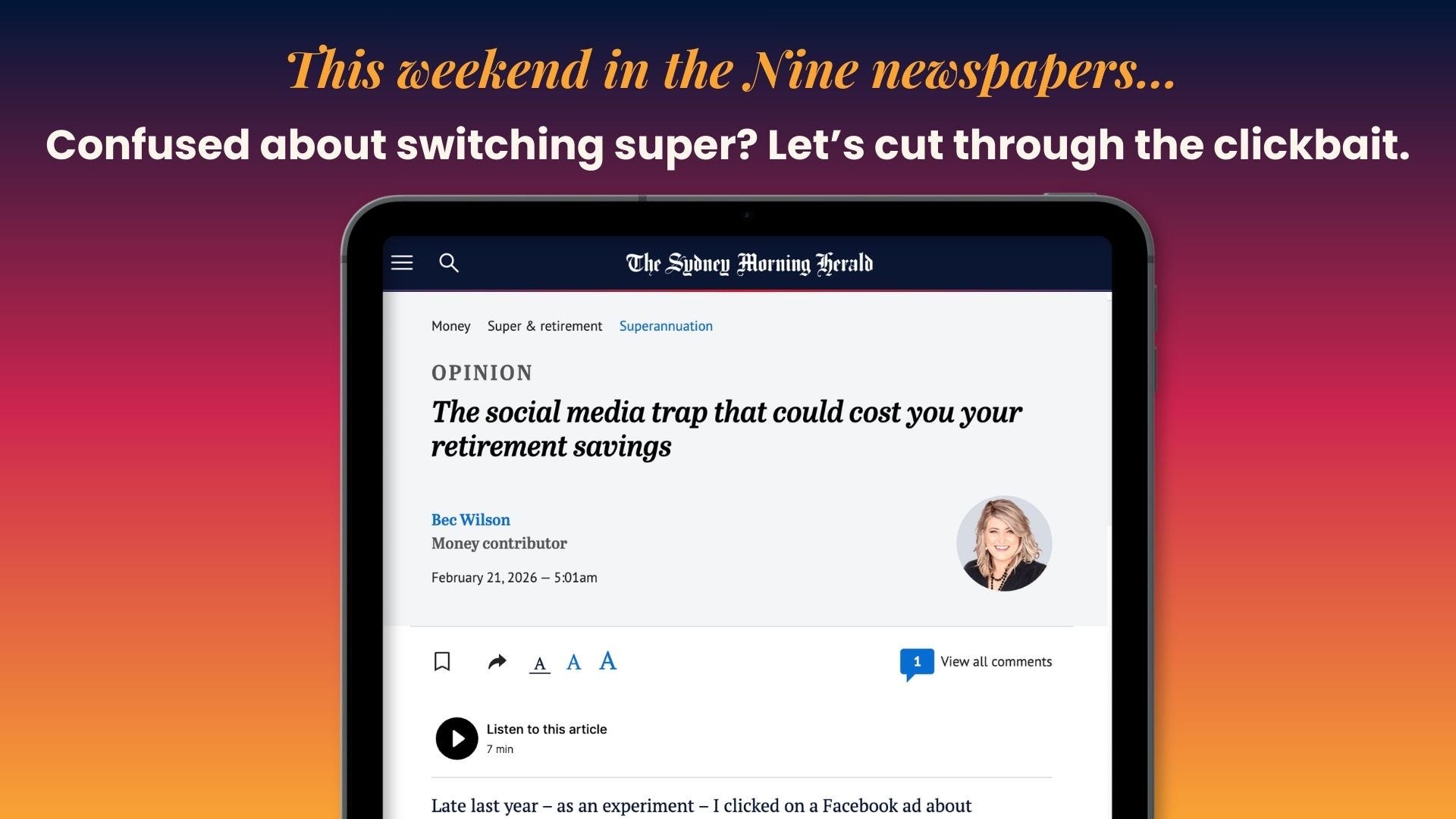
The social media trap that could cost you your retirement savings
Late last year – as an experiment – I clicked on a Facebook ad about superannuation. It was bright, urgent and confident. It warned that every year I delayed reviewing my super could cost me seven figures in retirement, and that hundreds of dollars were slipping away daily without me knowing. All I had to do was enter my details to get the “four steps” to beat time. Within minutes, my phone rang.
A businessman explained he ran a referral service connecting people to what he called the best financial adviser for them. He’d previously been a director of one firm he particularly liked, and my first appointment would be free.
I was referred on. A young adviser called to pre-qualify me. His questions were simple: Was I over 45? Did I have an Australian regulated super fund? Yes and yes, so I “qualified” for a phone-based discovery meeting after which a Statement of Advice could follow. No fee information, no quote, nothing until later.
This article was published in The Age and The Sydney Morning Herald on Saturday 7th February 2026. Read the whole article here. Note - it has a sign-up gate but no paywall.

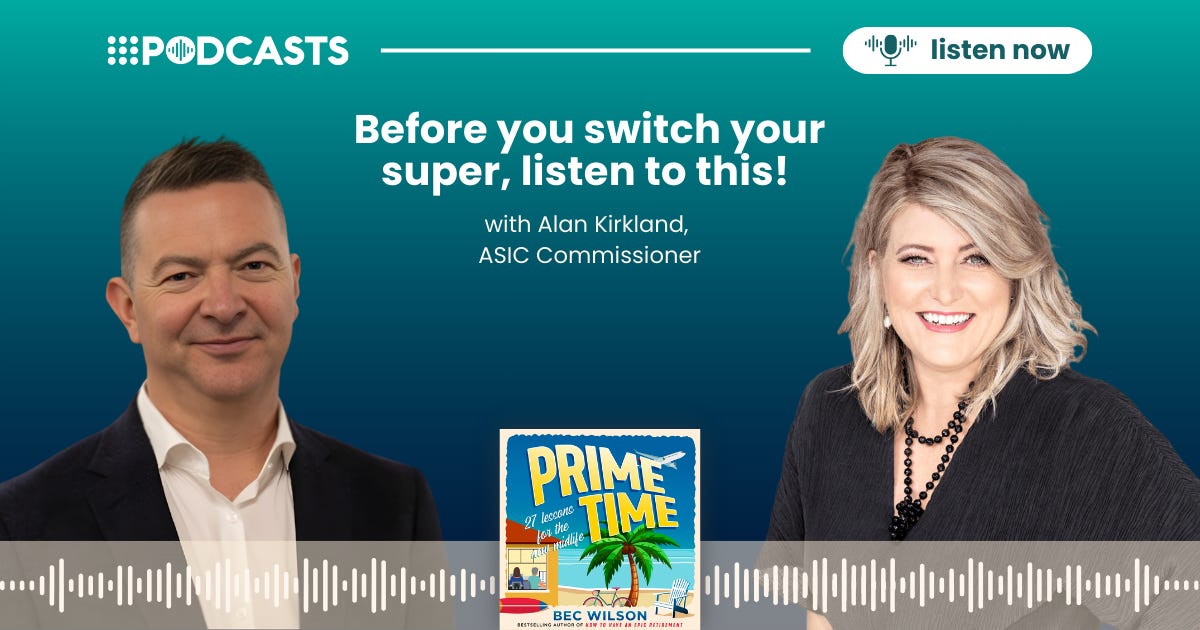
Before you switch your super, listen to this!
This week ASIC announced it has launched a review into financial advice firms and other companies connected to online super switching ads. If you’ve been on Facebook lately, you’ll know the ones I mean.
These are the ads telling you you’re losing money every day you don’t switch your super, ads suggesting your fund isn’t performing and ads nudging you to “check” or “review” your super which quickly becomes a conversation about switching.
I’ve been watching this build for months or even years. So I deliberately clicked one (as an experiment) to see how it worked and I saw it all in action.
To talk about this review of super switching financial advice and lead generation openly, I asked ASIC Commissioner Alan Kirkland to come on the show this week, just as this review has been launched.
We talk about what they’re seeing, how these online funnels work, what to watch out for, where harm has already occurred, and what consumers should do before handing over details or agreeing to a switch.
This episode isn’t anti-advice. It’s pro-careful decision making. So, if you’ve been wondering whether you should respond to one of those ads in your feed, listen first.
LISTEN TO THIS EPISODE OF THE PODCAST HERE:
Excellent 'advice' thank you Bec. This conundrum had been bothering me for some time. I have a house and super from downsizing but not enough to warrant $2000+ annual financial advisor support and to be honest other than managing investment already in the super fund I understood most of what was required. It was just timing and what I might be entitled to from aged pension etc. all explained in your Wonderful epic retirement but just needing a little more explanation for ME. So I booked in with a great financial services consultant at Centrelink. Free, and we worked through MY life, times, situation and he was great. He even told me that it would be beneficial to close my company and become a sole trader before retiring as it is much less complex and I would receive the pension more quickly, especially if I wasn't really going to be operating the company going forward. He explained the benefit of continuing to do some work and the Work Bonus and more. I now feel confident that when I reach 67 next year I will be in a good position to live an Epic Retirement. Thanks
About to retire and sought advice from 2 different advisors and got this exact scenario! Independant advisor - go with my "wrap product" platform; Superannuation fund advisor - go with our fund. While both adequately explained reasoning etc I didn't feel either were entirely without bias. What's missing is that third type of advice you describe, a strategic direction, and at a much more realistic cost as well. And on a related, the dense complicated 'advice' documents I received could be much better communicated in simple language and more visuals!