

How much super should you have at 50, 55 and 60 for a comfortable retirement?
And in this weekend's Nine Newspapers 'Why getting simple super advice has become an expensive nightmare'

In this edition: It’s a juicy one
Feature: How much super should you have at 50, 55 and 60 for a comfortable retirement?
From Bec’s Desk: Courses going strong
The Age and Sydney Morning Herald: Why getting simple super advice has become an expensive nightmare
Prime Time: ‘Have the rules for building wealth in Australia changed?’ with Saul Eslake

How much super should you have at 50, 55 and 60 for a comfortable retirement?
This is one of those questions almost everyone wants to know the answer to: how much super should I have now? And am I on track?
And, I’m pleased to say there is some useful benchmarks.
The Association of Superannuation Funds (ASFA) updated their ‘on track’ figures earlier this year, showing how much super people need at key ages on the way to retirement. It bases these numbers on what they say people need when they reach 67 and can potentially access a part or full age pension and use their super alongside it.
Here’s what their benchmarks say:
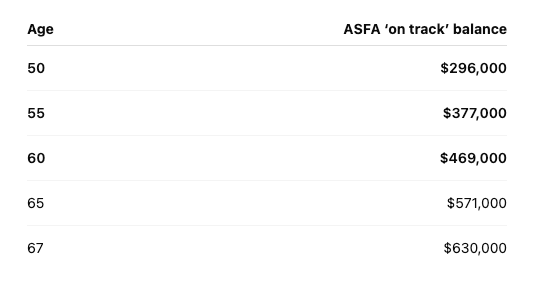
This would put you on track for ASFA’s Comfortable Retirement Standard, which currently assumes $630,000 in super at age 67 for a single homeowner, alongside access to a part Age Pension, and $730,000 in combined super for a homeowner couple.
If you’re not a homeowner, ASFA currently only publishes a ‘modest’ retirement standard for renters, rather than a comfortable one, reflecting the very different cost of funding housing throughout retirement.

So how do real 50-somethings and 60-somethings actually compare?
This is where it gets interesting - because the latest APRA average super balances are considerably lower than ASFA’s on-track numbers.
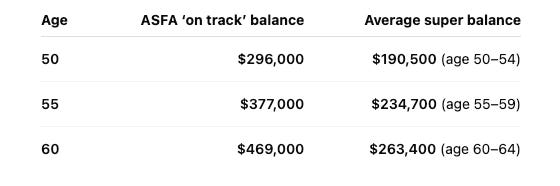
So if you’re looking at the benchmarks and thinking you’re well below the ASFA goal amounts, you’re certainly not alone. Rather than worrying - let’s use this information to get strategic and think about the things you can and should do right now to change your trajectory.
Put a little more into super
If you’ve got some room in the household budget, consider salary sacrificing a small amount extra each pay. It doesn’t have to be enormous to make a difference, particularly if you’re 50 and still have 10–17 years of contributions and compounding investment returns ahead of you. And if your circumstances allow, check whether you can take advantage of unused concessional contribution caps from previous years.
Check how your super is invested
This is a really big one. If you’ve got another ten years or more until retirement, being too conservatively invested can have an enormous impact on where you eventually end up financially. Equally, don’t blindly chase whichever investment option performed best last year. Know what you own, how much risk you’re taking and whether it makes sense for the time you have ahead.
Get serious about the mortgage
A bigger super balance isn’t the only way to improve your retirement position. Reducing the amount you’ll need to spend on housing can be incredibly powerful too because it reduces your outgoing spending. If you’re heading towards retirement with a mortgage, start modelling what it will take to get rid of it and how that fits alongside putting extra money into super.
Work out what your retirement will actually cost
ASFA’s Comfortable Standard is useful, but you aren’t ASFA’s hypothetical retiree. Look at what you spend now and build your own retirement budget. You might discover you need more than the benchmark. You may discover you need considerably less. Your number is the one that really matters.
Run your numbers forward
Don’t just look at today’s super balance. Use your fund’s calculator or the Moneysmart Retirement Planner to see where your current balance, contributions and investment strategy could take you. Then start changing the assumptions. What happens if you contribute another $200 a fortnight? Work an extra year? Go part-time rather than stopping completely? Pay the mortgage off first?
Don’t use these benchmarks to tell you whether you’ve succeeded or failed - use them as inspiration for doing the best you can in the years ahead.
Want to read more, I have two books - How to Have an Epic Retirement and if you’re not ready for retirement, Prime Time: 27 Lessons for the New Midlife.

This week was the kickoff for the How to Have an Epic Retirement Flagship Course. More than 400 students are now in there powering through their Week 1 lessons and they’ll all be on board for our first Live Q&A on Monday evening. We’ve shut the doors on this one - our next program will be in October. You can express your interest on the website.
Alongside this, the HESTA Epic Retirement Program passed its midpoint. So many happy learners - thousands and thousands of them. Another course will kick off in October for HESTA members too.
In the Prime Time podcast, I interviewed Saul Eslake - in what was a really interesting show. He has some very interesting views of what’s going on in the economy, and how we can think about the changes we’re seeing today in context. I’m trying hard to keep my mind open to the lessons we’re all learning about the role property should play in our assets, investments, and life-strategies as this shift in values takes place post the federal budget. Listen here
And, I’ve written a doozy of an article about financial advice. I spent heaps of time on this one, because I wanted to be quite open about the needs of everyday Australians approaching retirement, and how badly they’re being served by some of the problems in the financial advice industry. These are problems I believe our Financial Services Minister really does need to get on with solving as part of the next round of financial advice legislation, which everyone’s expecting him to announce this week. More here.
My books are almost completely out of stock around the country - so if you’ve been trying to buy hang in there. My publisher’s distribution centre has had a massive interruption to their operations and stores have not been restocked for weeks. They are coming back online slowly now though so stock should return soon. Amazon has just got stock back on board. The rest should follow soon.
And lastly, on Friday evening I went to a concert. I have to admit, I’m a bit of a small concert lover. Live music is my happy place. I saw the legendary Jon Stevens play the hits from his Noiseworks and INXS days. Every time I see him, I’m reminded of just how well some people age! At 64, his voice is amazing, his love for the crowd’s happiness is real, and he still seems to absolutely love what he does. There’s something pretty fabulous about watching someone still doing their thing, at full throttle, after all these years. Maybe we can get him on the podcast one day to tell us how he does it. I’ll try.
And that’s it from me - have a ripper Sunday!
Cheers - Bec

Author, podcast host, columnist, retirement educator, and guest speaker


Why getting simple super advice has become an expensive nightmare
If you walk into a financial adviser’s office at the age of 58, approaching retirement with about $700,000 in superannuation, a mortgage, a few hundred thousand dollars invested outside, what should happen next?
And if you walked into a super fund advice appointment, with the same amount of money, and the same mixed picture, what can they do to help you? What can they advise you on, and more importantly, what can’t they?
Most Australians would expect broadly the same thing from both: help understanding whether they have enough, what sort of retirement they can afford, what to do about the remaining mortgage and whether their super and investments are in the right place, and taking the right amount of risk, and, ultimately, a clear plan for what steps they should take next.
But what happens next can really surprise people because, despite starting with the same problem, the two advice models can’t offer the same help.
A comprehensive financial adviser is legally allowed to look across your broader financial life, including your super, investments, mortgage, tax position and retirement goals. But increasingly, many advice businesses are also built around providing ongoing investment management.
Part of the reason is that the regulatory burden and the cost of providing comprehensive advice has made smaller, one-off pieces of advice difficult to provide profitably. So what begins as a request for retirement advice can become the start of a much longer commercial relationship, with the client’s super and investments moved onto a platform and managed on an ongoing basis by the advice business or an investment manager connected to it.
This article continues… It is published in The Age and Sydney Morning Herald on Saturday 15th Aug 2026. Read the whole article here, without a paywall.


‘Have the rules for building wealth in Australia changed?’ with Saul Eslake
When we reach our 50s and 60s, we start looking at the world a little differently.
We wonder if we’ll have enough. We wonder what role our home should play in our future. We wonder when we’ll be able to stop working. And increasingly, I think many of us are wondering whether the economic rules we’ve lived by for the last 30 or 40 years are still the right ones to rely on.
So, this week on Prime Time, I’ve brought in one of Australia’s best-known economists, Saul Eslake, to help us make sense of it all.
It’s a fascinating conversation about just how much the financial landscape has shifted in our lifetime, and again in recent times.
Saul explains why Australians who bought property decades ago can find themselves in a very different position today from those who didn’t, and why reaching retirement without a paid-off home could become one of the biggest challenges facing Australians over the coming decades.
We also take a good look at our relationship with property. For years, we’ve treated the family home as much more than somewhere to live. It’s become a wealth-building strategy and, for many people, an unofficial retirement plan.
But Saul questions whether we can continue to expect property to play that role, and makes a really interesting point about the value of your own home. If you’re selling and buying in the same market, rising house prices don’t necessarily make you as much richer as you might think.
We also get into super, tax, inheritance, financial literacy and what all of this means for those of us trying to plan the second half of our lives.
There are some challenging ideas in this conversation, and you may not agree with all of them. But I think Saul gives us a really useful way of looking at how Australia is changing and what that could mean for the decisions we’re making today.
LISTEN TO THIS EPISODE OF THE PODCAST HERE: