

Learning to spend after a lifetime of saving
And, in this week's papers... 'Women’s super gap isn’t just a data point. It’s a ticking time bomb'

In this edition
Feature: Learning to spend after a lifetime of saving
From Bec’s Desk: Hello from London!
The Age and Sydney Morning Herald: Women’s super gap isn’t just a data point. It’s a ticking time bomb
Prime Time: Retirement planning with the pension in mind

Learning to spend after a lifetime of saving
For forty years we’re taught to watch our balances rise. Bank accounts, super, pensions - they’re all meant to go up. That’s the scoreboard of doing life well. That’s how you know you’re being sensible, responsible, grown-up. Bigger pots of savings, bigger super balances, compound growth!
Over many years, you learn to feel calmer when the numbers go up. You sleep better. You tell yourself you’re building security, protecting your future, being a good parent, a good partner, and a good adult.
Then you get to retirement.
And even the most capable, well-planned people feel a hefty jolt of discomfort as they have to start drawing down, and they watch the numbers start to go the other way. Some say it feels like a tightening in the chest. Others, a sense that something isn’t right. It feels like you’re doing something you were never meant to do.
You can know, intellectually, that your retirement plan works. You can have spreadsheets, projections, buffers and even a financial adviser telling you it’ll be ok. And still feel a flicker of guilt every time you draw money out. It’s as if you’re being careless. As if you’re letting your younger, harder-working self down by dipping into this pot to do things that go beyond spending on the basic cost of living.
But we have to remember, that’s what it’s been built for.
The guilt and discomfort people feel when spending in retirement is a widespread issue. And if it’s happening to you, you’re normal.
What’s actually going on here isn’t a money problem. It’s a conditioning problem.
For decades, your nervous system has been trained to associate not spending with safety. Saving became a form of control. Restraint was rewarded. Watching balances rise meant you were doing the right thing, protecting the future, being prudent.
So when retirement flips the system from accumulation to drawdown, your brain doesn’t calmly update the rules. It flags ‘danger, danger, danger’. It treats spending as a threat, even when it’s planned and affordable.
That’s why reassuring yourself doesn’t always work. More spreadsheets don’t fix it (but they’re important). Neither does being told, again, that “you’ll be fine”. Your brain isn’t confused about the maths. It’s reacting to a lifetime of habit.
There’s also a second layer to this. For most people, money has always flowed in one direction: work first, enjoyment later. Spending was delayed, justified, or rationed. In retirement, that sequence reverses. You’re being asked to enjoy first, without the psychological permission slip of having “earned it this month”.
That’s a big shift. And it’s why so many people hover in an uncomfortable middle ground. Retired on paper, but still living emotionally like they’re preparing for it.
So what actually helps?
First, you need to change how the money shows up in your life.
It’s not just about how much you have, but how you experience it. People almost always feel better spending “income” that has been designated as an income stream, than dipping into a lump sum. So, acknowledge this and consider setting up a regular transfer into a spending account that allows for both your cost of living and annual discretionary spending. This can be surprisingly powerful. It restores a sense of rhythm and legitimacy to what you can do. You’re not eroding an important savings pot every time you spend. You’re using money that’s been allocated for living life well.
Second, decide your spending rules in advance.
Most guilt doesn’t come from spending. It comes from impulse decision-making in the moment. If every purchase requires a judgement call about whether you’re being sensible, of course it feels uncomfortable to spend on joyous things. So, to get around this you can simply agree on a level of spending ahead of time, ideally when you’re calm and rational. Then let yourself spend within it without renegotiating every coffee, dinner, or plane ticket.
Third, recognise that some spending has a timing window.
Health, energy, mobility and curiosity are not evenly distributed across your retirement years. Some experiences are easier, richer, or only possible earlier on in life. And, if you delay all of your discretionary spending in the name of safety, you may end up protecting money you can’t fully use in the way you once imagined. Heck - you or your partner might even die, or lose mobility before you get to enjoy it if you’re not careful.
None of this is about being reckless. It’s about aligning your spending with the reality of this phase of life. Learning to spend after forty years of saving is not a moral failure or something to feel guilty about. It’s simply another transition. One most people were never prepared for.
But, if you can notice the feelings, understand your capacity to spend, and get ahead of the guilt, you can adapt.
This week’s challenge isn’t to spend more. It’s to stop reflexively telling yourself you can’t, and work out what you actually can afford.

There’s a long-held belief that the year in Australia doesn’t really begin until after Australia Day, so I’ve decided to take that quite literally.
I’m still in London, in the middle of meetings with UK pension funds and recording our very first UK edition of the Epic Retirement Flagship Course. At the same time, most Australians are in that familiar January in-between: one foot on the beach, one foot back at work, (and a fair few of you already well into retirement enjoying a lifetime of freedom).
Just five more days and I’ll be heading home. It’ll have been five and a half weeks living out of a suitcase - that’s nearly my limit.
My biggest piece of news this week is that we’ve officially welcomed Charlotte Gibson as our UK Lead of the Epic Retirement Institute.
Working across Australia and the UK in retirement education was always going to be complex, especially with me based in Australia. The systems are different, yet similar. The emotional context around money and ageing isn’t quite the same. And it’s a long way to go for a meeting too.
So finding the right person to help lead this work in the UK really mattered. And, I’ll admit, I quite love living in Australia. That matters to my Prime Time too. And I want to be present.
Charlotte is a retirement coach and a pensions actuary, which is a rare and powerful combination. She brings both technical depth and a very human approach to retirement, and I’m genuinely thrilled to be working with her as we build this next chapter.
This year already feels important for retirement.
Possibly the biggest year of retirements we’ve ever seen.
You could feel that energy in December. The Prime Time podcast absolutely took off during Epic Retirement Month, becoming our biggest month ever. It confirmed something I’ve sensed for a while: people want thoughtful, practical conversations about their Prime TIme and their retirement that don’t talk down to them or scare them.
This week on the show Justin Bott from Services Australia is back (one of your favourites!), talking openly about planning for retirement with the Age Pension in mind. It’s one of those topics that people need help with. Have a listen (details below).
Behind the scenes, hundreds of people have already registered for the 2026 edition of the Epic Retirement Flagship Course, which begins on 19 February. The earlybird pricing will come to a natural close once I’m back in Australia. More here.
On the same day, (19th Feb) the HESTA Epic Retirement Course also kicks off for HESTA members. You can find out more and register via HESTA if you’re one of their members! More here.
I’ve been sharing some of what I’m learning here in the UK on Facebook and Instagram. Just small snapshots. I’m very fortunate that really senior and very experienced leaders in retirement across the UK open their doors, come for a meal and spend time with me. It’s so amazing to be able to really know what the challenges are from both the business and the consumer frontier and I don’t take the opportunity to be part of the conversation for granted. Tastes here:
Facebook: facebook.com/becwilsonepic
Insta: instagram.com/epicretirement
And, while it’s not hugely relevant in Australia, I’m now the retirement columnist for The Times for the UK. You can check it out here (it’s paywalled).
Cheers - Bec Xx

Author, podcast host, columnist, retirement educator, and guest speaker

Women’s super gap isn’t just a data point. It’s a ticking time bomb
There’s new data out this week on retirement confidence in Australia, and it makes for uncomfortable reading. Only 41 per cent of women say they feel financially confident about retirement. For men, it’s 59 per cent. That gap – of nearly 20 per cent – should stop us in our tracks.
Dig a little deeper and the worry is everywhere. Nearly three-quarters of women are concerned about having enough super for retirement, compared with just over half of men. Seven in ten fear they won’t be able to afford the lifestyle they want later in life. More than half are already holding back on everyday spending because they’re worried about running out of money in retirement.
This isn’t a single data point or a momentary wobble in confidence. Women report higher levels of worry across every measure. It would be easy to describe this as anxiety and brush it off, but that would be a mistake.
These findings come from AMP’s Retirement Confidence Pulse, an important piece of research that tracks how Australians feel about their financial futures. As Melinda Howes, AMP’s Group Executive for Superannuation and Investments, put it: “We cannot accept a future where Australian women remain more worried than men about their financial futures.”
What the data really shows is not anxiety, but smart realism. Women are responding rationally to the reality of their financial lives, in a retirement system that has never fully accounted for the fact that women have more fractured working lives than men, even today.
This article was published in The Age and The Sydney Morning Herald on Sunday 17th January 2026. Read the whole article here. Note - it has a sign-up gate but no paywall.
The Epic Retirement Flagship Course for Feb 2026 is filling up quickly! Don’t miss 25% off earlybird sale.

How to Have an Epic Retirement – Flagship Course
Earlybird 25% off deal is still running - but not for long
The next edition of the How to Have an Epic Retirement flagship course kicks off on 19 February 2026. Hundreds of people have already registered, which I’m genuinely thrilled about. It’s a practical, Australia-first program for people in their 50s and 60s who want to understand how retirement actually works, without the overwhelm. . We do the program together through a combination of online learning and live events, over 6 weeks (it’s a synchronous course), so you’re not left on your own trying to make sense of it all.
What we cover
How Australia’s retirement systems really work
Practical ways to get money into super
How to turn super into income
How to think about spending, tax and the Age Pension
How to plan for health, purpose, and the long game of ageing well and ageing in place
What you won’t get
No jargon
No scare tactics
No product sales or hidden agendas
Just clear, honest, factual retirement education, designed to help you make better choices in the years ahead and feel calmer, more confident, and better prepared to live retirement well.

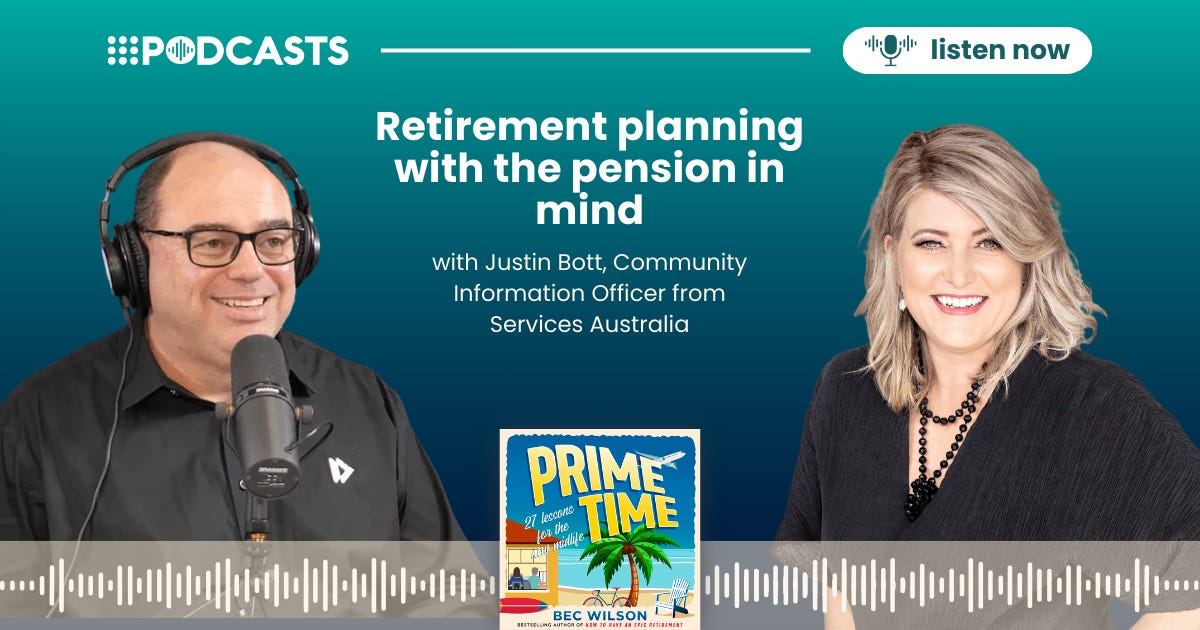
Retirement planning with the pension in mind
When we think about retirement planning, super often steals the spotlight. But for the majority of Australians, the age pension remains the backbone of their retirement income, and planning with it in mind can make a meaningful difference.
So, this week on Prime Time, I’ve invited Justin Bott, Community Information Officer from Services Australia, back on the show to help us unpack the role the pension really plays in building a sustainable retirement plan, and how you can get ahead of planning with it in mind.
From clever (and legal) asset strategies to common mistakes people make when applying and how things like offset accounts and family gifts might affect your eligibility, this episode is full of practical tips that can help you plan smarter and make more informed decisions.
LISTEN TO THIS EPISODE OF THE PODCAST HERE:
People could be living so much more in retirement! Here in the U.S., most retirees still have over 80% of their pre-retirement savings after 20 years in retirement, according to research by BlackRock.
Stomaching watching the portfolio go down after trying so hard to get it to go up for decades is tough. I've wrote about this issue, and still, I'm sure it's going to be an emotional challenge for me personally when I get there.
It’s not surprising women have less super than men on average. Women are the majority of low income earners and if you earning in that 16% and soon to be 15% tax bracket you effectively get 0% discount on your super concessional contributions. So how about changing this so everyone gets the same discount on their contributions?