

Love, grief and the life that follows
And in this weekend's newspapers: 'The hidden super tools you’re paying for – but probably ignoring'

In this edition
Feature: Love, grief and the life that follows
From Bec’s Desk: A trip to the Chant West awards
The Age and Sydney Morning Herald: The hidden super tools you’re paying for – but probably ignoring
Prime Time: The EOFY checklist and what you need to think about for the year ahead

Love, grief and the life that follows
Nobody puts grief and losing their partner or a loved one on their retirement plan. But for most of us, it shows up anyway.
By the time you’re in your 50s or 60s, loss is no longer an abstract concept. It's happened to most of us. The loss of a parent, a close friend, a sibling. And for many people, eventually, a partner. The second half of life is richer in a lot of ways, but it also asks more of you than the first half did - in managing grief and moving forward anyway.

There’s a particular kind of grief that doesn’t get talked about much. And it’s not the acute, early grief - the shock and fog of loss and the casseroles on the doorstep from well-meaning friends. But the longer grief - the one that settles in after the noise dies down, when everyone else has gone back to their lives and you’re left figuring it out, with all your hopes and plans broken and sadness in your soul.
Today I’m releasing a special edition of my podcast - a conversation with former NSW Premier, the Honorable Bob Carr. He lost his wife Helena suddenly two years ago after 50 years of marriage to an aneurysm while on holiday in Vienna. And this week, when we talked, he spoke about what he called “the leftover life” and how he’s moving through his grief. He’s still here, still functioning and had to learn how to cook, clean and do his own domestic duties, after losing the love of his life. But he’s missing the person who was woven into how he thought, how he planned, and how he made sense of the world.
As someone who’s been married for 25 years, our conversation quietened me. Because it’s not something we talk about. So much so that he wrote a book about it called Bring Back Yesterday. In it he reflects on his wife, their life, grief and his future.
It’s a book about the devastation, the early days and then the path forward. How uncomfortable it was yet how he wants to talk about grief, about Helena and about how it feels - so others can remember her, and feel a little more normal as they traverse their own.
We all need to remember that a long partnership isn’t just companionship. It’s the very architecture that holds our life in a structure. This is someone who holds half your memories. Who knows your real history. Who you process things with, even the small things - what happened at dinner, what you’re worried about, what made you laugh today. When that person is gone, it’s not just their absence you feel. It’s the absence of the version of yourself that existed with them.
And then there’s the social reality of grief. Some people think you should move on, or that you should ‘get over it’. Couples drift away, not unkindly, but gradually losing interest in your sadness. You become, without meaning to, someone who makes them uncomfortable about their own happiness.
This is the part people aren’t prepared for. The loneliness isn’t just about missing one person. It’s about finding yourself on the outside of a world that assumed you’d always be paired up in.
So what actually helps?
From Bob, and from the many people I’ve spoken to who have navigated this: it’s rarely the big things. Bob shows us it’s walking. Building a new routine. Showing up to something, even when you don’t feel like it. One friend who calls regularly. A reason to get up and go somewhere in the morning and a weekend, planned ahead and filled with activities to look forward to.
It’s also, when you’re ready, allowing yourself to imagine that the life ahead can still be good - not the same, but good.
Grief in the second half of life deserves more honest conversation than it usually gets. Not clinical nor relentlessly optimistic. Just the real kind - acknowledgment that this is hard, that it changes you, and that you’re allowed to take your time finding your footing again.
If this resonates, Bob’s memoir Bring Back Yesterday is worth picking up. And our full conversation is on Prime Time today, wherever you get your podcasts.
LISTEN TO THIS EPISODE OF THE PODCAST HERE:

This week I headed to Sydney for two days partly to interview Bob Carr in person - which was really special; and partly to attend the Chant West Superannuation Fund Awards, one of my favourite industry events of the year. Super is a relatively small sector, so it feels like a gathering of friends and colleagues. Competitive but collegiate. Everyone wants their team to win - which is a good sign that the superfunds are upping their game in 2026.
The big winners on the night were Aware Super, who picked up four of the biggest awards including Super Fund of the Year, Pension Fund of the Year, Best Fund for Member Services and Best Fund for Insurance. That is an extraordinary result that reflects a fund firing on every cylinder at once, and one that should make every other fund in the industry sit up and think hard about what they're building.
And AMP, who picked up three awards including Best Fund for Digital Advice, Best Fund for Lifetime Product and Advised Product of the Year for their MyNorth platform, a result that tells an important story about a fund that has been through significant transformation and is now competing seriously and winning in the retirement space too.
Both results are worth understanding, because they point directly to the services and products that can change your retirement outcome, most of which you're probably not using. I’ve written about this in the national newspapers this week (below).
Alongside this, this week we’ve launched our Epic Retirement Flagship Course in the UK, and we’re mid-course on our Australian Epic Retirement Flagship Course. We enjoyed our Week 2 Live Q&A with the Aussie Epic Retirement Flagship Course for Winter here, with Ashton Jones from MLC joining us. Week 3’s lessons have dropped for members doing the Aussie program. Our next program is in August - if you want to lodge an expression of interest, we’ll let you know when it goes on sale.
It’s been shocking weather in Brisbane with loads of rain and storms, and we lost the footy too. So, I’m going to be enjoying any skeric of sunshine I can get this weekend. I hope you get some too.
Make it epic!
Cheers - Bec Xx

Author, podcast host, columnist, retirement educator, and guest speaker

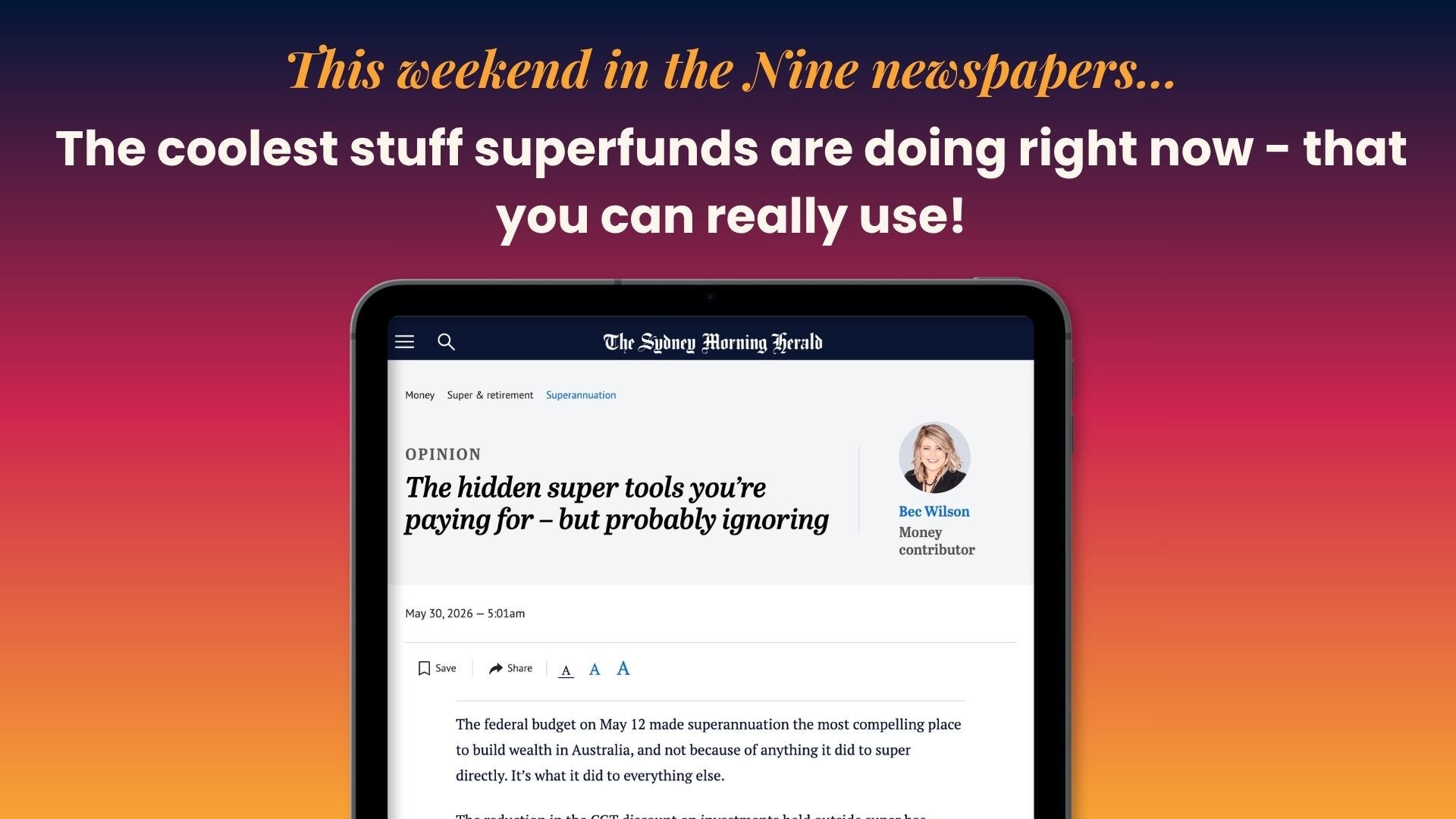
The hidden super tools you’re paying for but probably ignoring
The federal budget on May 12 made superannuation the most compelling place to build wealth in Australia, and not because of anything it did to super directly. It’s what it did to everything else.
The reduction in the CGT discount on investments held outside super has fundamentally shifted the maths on wealth building. Shares, investment properties and managed funds in your own name just became considerably less tax-efficient than they were. Super has been crowned the winner.
Which makes what I’m about to tell you either really exciting or mildly embarrassing, depending on how you look at it.
Most Australians are barely using their super fund before they retire. Sure, their employer deposits the 12 per cent contribution. But after that, people largely ignore them, sitting in a default investment option they set years ago and never reviewed, paying for services they have never accessed and leaving advice on the table they’ve already paid for.
The fund is doing the work. The member is nowhere to be seen. And if they did pay attention they would realise they can squeeze more juice out.
Once a year, superannuation research firm Chant West sends its researchers into super funds and interrogates them for weeks. It’s not a tick-box survey or a marketing submission where everyone gets a ribbon, but a forensic examination of what funds are building and delivering for members across every dimension of service.
Your super fund is working hard for you. The question is whether you’re working with it.
It’s primarily an industry exercise recognising genuine excellence, but it gives the rest of us a remarkably useful window into what the leading funds are doing and, more importantly, what you should be looking for in your own fund.
I was at the awards this year, donned a frock, sat among 300 industry people and watched each winner announced to a room that really did care about the result. Here’s what the best funds are building, and what you should use.
This article continues. It was published in The Age and The Sydney Morning Herald on Saturday 30th May 2026. Read the whole article here. Note - it has a sign-up gate but no paywall.

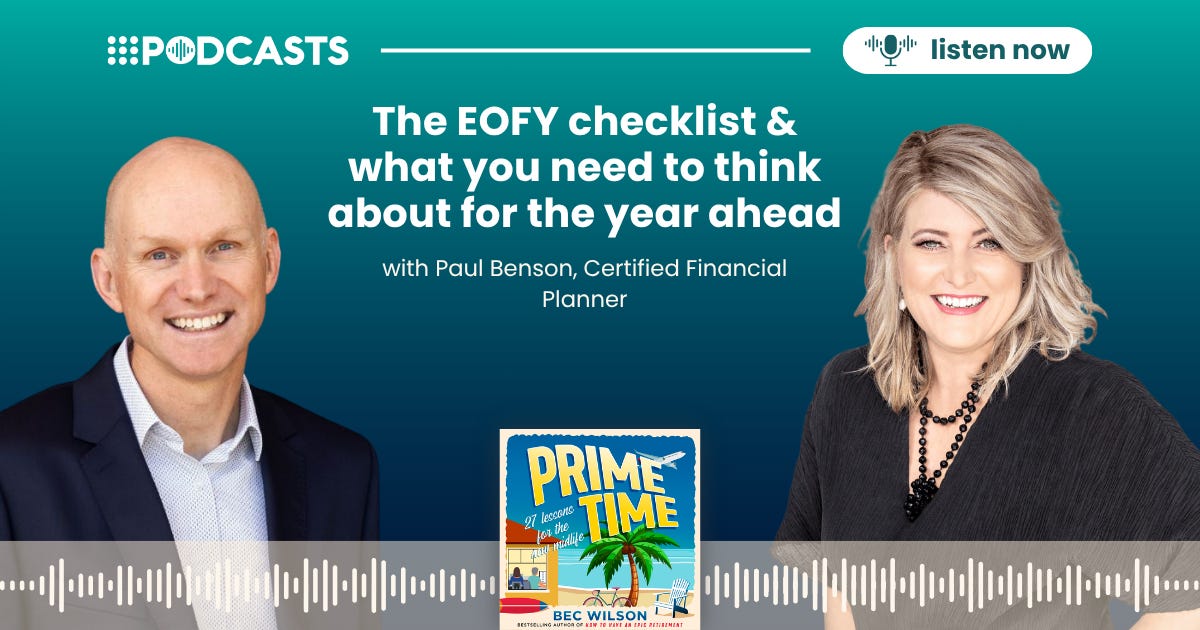
The EOFY checklist and what you need to think about for the year ahead
Every year around this time, we start hearing the same things: Top up your super. Save on tax. Don’t miss the deadlines.
But this year feels a little different, especially off the back of the budget, and a lot of people in midlife are wondering: are the old strategies still worth it?
So in this week’s episode of Prime Time, we cut through the noise and put together a practical end-of-financial-year checklist for real people.
I sit down with financial planner Paul Benson to talk through the smartest EOFY moves for people in their 40s, 50s and 60s; from super contributions and tax strategies to debt, investments, insurance and the changes people should be thinking about now.
I also chat with Peter Hogg from Aware Super about the superannuation housekeeping tasks many people overlook, and why a few small actions before June 30 can make a meaningful difference to both your tax position and your long-term retirement balance.
LISTEN TO THIS EPISODE OF THE PODCAST HERE:
Wonderful article and podcast @Bec Wilson - your most poetic one yet!