

Planning retirement when one partner is older than the other
And in this weekend's Nine newspapers: "The retirement rule book just changed. Here’s what you need to know"

In this edition
Feature: Planning retirement when one partner is older than the other
From Bec’s Desk: Fun times
The Age and Sydney Morning Herald: The retirement rule book just changed. Here’s what you need to know
Prime Time: Before you switch your super, listen to this

Planning retirement when one partner is older than the other
Five years, seven years or maybe even ten years. When you’re 35 and falling in love, an age gap barely registers. When you’re 58 and your partner is 51, or 65, it registers everywhere.
Because now you’re running two life-clocks into retirement. Two timelines heading toward the same financial targets, but not necessarily at the same speed.
Target one: preservation age, when super becomes accessible. Target two: Age Pension age.
Those two clocks don’t always tick together. So let’s start with the practical reality.
The older partner can access super earlier. Start an account-based pension earlier. Reach Age Pension age earlier. But Centrelink doesn’t see you as two separate people. It assesses you as a couple, whether that suits you or not. When the older partner hits pension age, the younger partner’s work income still counts in the income test. Your assets are assessed together. Everything is linked.
This is exactly why sequencing matters so much.
There’s a window most couples don’t know exists. While the younger partner is still under Age Pension age, their super in accumulation is generally exempt from the assets test for the couple. It’s not a loophole. It’s just an opportunity created by timing. And it can be a meaningful one.
For that period, one partner may qualify for some pension while the younger partner’s super sits outside the assets test. Drawdowns can be structured deliberately. But once the younger partner reaches pension age, their super comes into the assets test too and the window closes. This isn’t about sheltering assets forever. It’s about understanding the staging on two things:
The ability to access a little more Age Pension, if it’s available, and using it cleverly.
The ability to access superannuation when one partner turns 60 and retires, which might allow debt to be cleared or lifestyle choices to be made earlier for both.
But remember: you are not one age. You are two. Which means your retirement plan rarely fits a single date circled on a calendar. It usually needs to be phased.
Phase one: the older partner reduces or stops work.
Phase two: the younger partner transitions.
Phase three: you arrive at a shared lifestyle. That’s the financial shape of it.
Then there’s the human side.
When one partner retires and the other keeps working, you’re suddenly living in two different life stages under the same roof. One has freedom. One has Monday morning meetings. One wants midweek lunches; the other has deliverables due. I’ve seen couples navigate this beautifully. I’ve also watched resentment arrive quietly, without any announcement.
It’s rarely just about money. It’s about expectations. The retired partner might assume their travelling lifestyle begins immediately. The working partner might feel pressure to keep earning, or guilt, or low-level irritation they can’t quite name. Age gaps tend to amplify whatever communication gaps already exist, so if you know this is likely territory for you, get ahead of it - talk about it, explore how you’ll navigate these risks together.
And then there’s longevity risk. It’s often overlooked, and nearly always significant.
If one partner is considerably older, they may need care earlier. Their partner may become their carer earlier too. That shapes housing decisions, drawdown rates, whether you downsize sooner, and how much you prioritise liquidity. You’re effectively managing four clocks simultaneously: super access, pension eligibility, the end of work identity, and your health trajectories.
Mapped consciously, an age gap can actually create flexibility. But it brings its own complexity too.
The question isn’t just when do we retire?
It’s what does each stage look like for each of us? And how do we keep both people’s goals, dreams and hopes in the picture. That’s where the real planning starts.
Relate to this? Tell me what you’ve learned.
I cover a lot more on this in both my books - How to Have an Epic Retirement and if you’re not ready for retirement, Prime Time: 27 Lessons for the New Midlife.

From Bec’s Desk: Fun times
This week has been a big one for changes to retirement numbers. I’m almost whiplashed by how many.
Late last week we had changes to the deeming rates, which will flow through with the Age Pension indexation on 20 March. Then this week, ASFA fundamentally changed their retirement benchmarks. This isn’t just a tweak. It changes the way the industry talks about what retirement actually costs, for the first time in three years.
And on Thursday, wages data triggered an increase to super contribution caps from 1 July:
Concessional caps will rise to $32,500. Non-concessional caps will rise to $130,000.
If you’re thinking about using the bring-forward rule, pause before you act. If you trigger it this financial year, you lock in today’s lower caps. Once the new caps roll through on 1 July, you can’t retrospectively access the higher numbers. That doesn’t mean don’t do it. It just means make a conscious decision about timing.
My Sydney Morning Herald article this weekend breaks down all the changes, and I have a podcast coming out Tuesday with Mary Delahunty, ASFA’s CEO, to help navigate what the new benchmarks actually mean. Keep an eye out.
Inside the Epic Retirement world, we’re into week two of our two flagship programs: the HESTA Exclusive Epic Retirement Course and the How to Have an Epic Retirement course. The chatter has been terrific. I genuinely love sitting down each day to answer questions as they come in. People are working through the videos, doing the exercises, having lightbulb moments. Both programs combine self-paced lessons and workbooks with live events. Flexible, but with the shared momentum of doing it with a peer group.
I’m incredibly grateful to HESTA for backing this for their members, and to everyone who has signed up and shown up.
On a completely different note, I’ve been home in Brisbane this week, and somehow managed to squeeze in a Viking Ocean cruise ship tour and a pickleball lesson alongside the podcasts, courses and gym sessions.
The cruise ship visit coincided with a podcast I released with the wonderful Kathy Lette, comedic author of Puberty Blues and her latest bestseller The Sisterhood Rules. As a travel writer she’s taken many Viking cruises, so she came in to share what the experience is really like, and the difference between river and ocean cruising.

Between the show and the ship tour, I picked up a few things regular cruisers probably already know. Every ocean cabin has a balcony. All food and non-alcoholic drinks are included, no surprise bills at the end. Wine, beer and cocktails are available through a drinks package at around $41 per person per day, and it’s not bottom-shelf. You can also bring your own wine onboard with no corkage, which sounds pretty perfect on a French river cruise. Free internet across the fleet, a Nordic spa open to all guests, a big modern gym, and ocean ships carry 998 passengers compared to around 190 on a river cruise. It feels spacious. There are more highlights over on my Facebook post if you want a closer look.
Then came pickleball. I did my introductory lesson on Saturday and I have to say, I can see why people get hooked. Easy to pick up, courts half the size of tennis, and once you’ve done your intro session you can jump on an app and find a game near you for around ten or twelve dollars. Apparently it’s addictive. I’ll report back.
A big week of retirement numbers, a cruise education and pickleball. That’s Prime Time for you. You never quite know what’s ahead.
Until next week - make it epic!
Cheers
Bec xx

Author, podcast host, columnist, retirement educator, and guest speaker

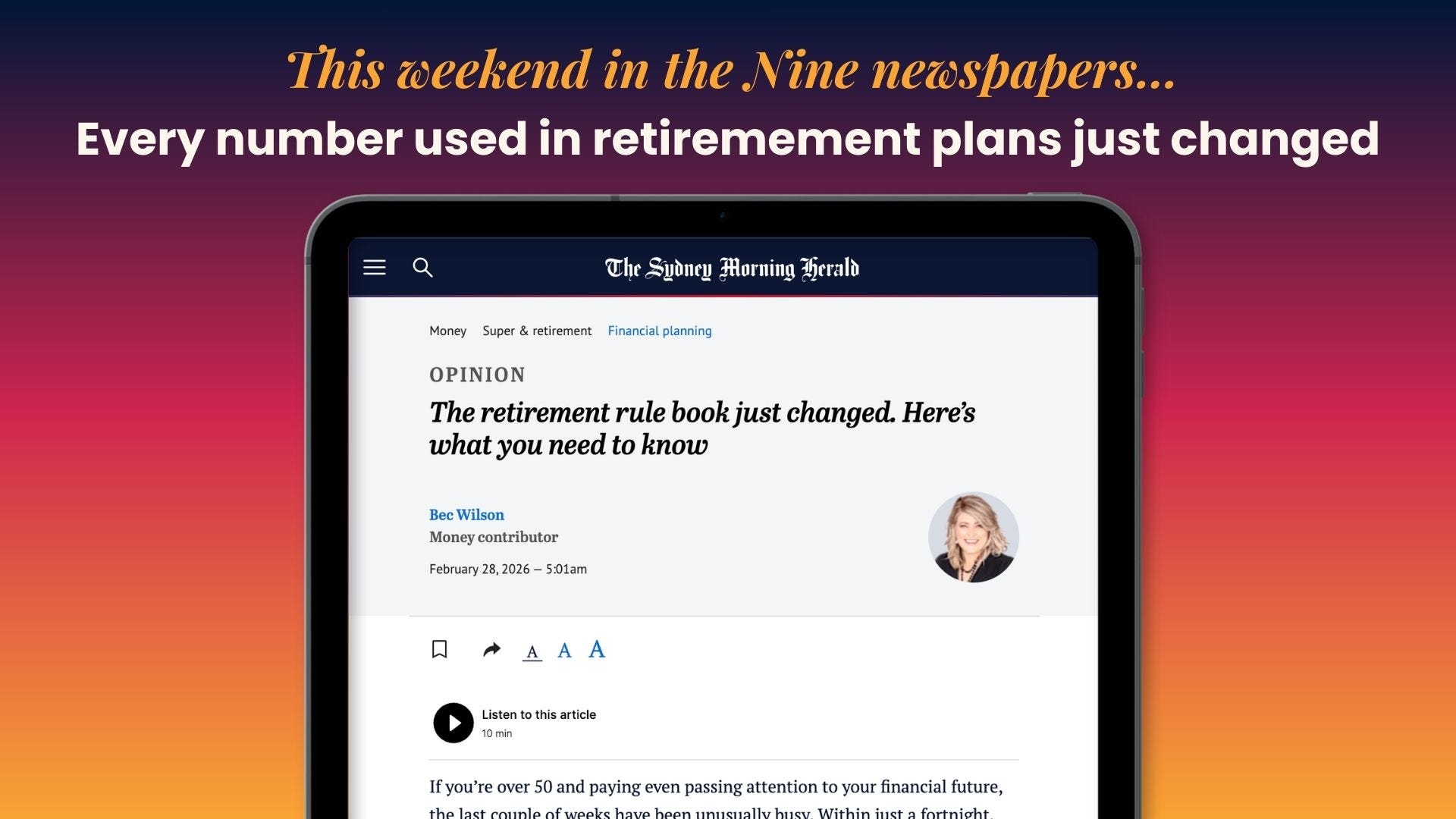
The retirement rule book just changed. Here’s what you need to know
If you’re over 50 and paying even passing attention to your financial future, the last couple of weeks have been unusually busy. Within just a fortnight, almost every key number in Australia’s retirement system has either changed or is about to.
The benchmarks for how much you need to retire. The rules around how much you can contribute to superannuation. The rates used to calculate your age pension. The caps on how much super can sit in the tax-free retirement phase.
That’s not normal. Usually, these things shuffle along quietly, one at a time. Currently, they’re moving all at once, and if you don’t know what’s changing, you could easily be missing some opportunities.
So today I’m going to walk you through it all and explain what each change means.
Retirement now costs more
Let’s start with the number people ask me about most: how much do you actually need to retire?
The Association of Superannuation Funds of Australia, known as ASFA, has just updated its retirement benchmarks for the first time in three years. And the shift is significant.
For a comfortable retirement, one that covers a decent lifestyle, a reasonable car, private health insurance, and yes, a modest amount of travel, couples now need $730,000 in super at retirement, up from $690,000. For singles, that figure has risen to $630,000, up from $595,000.
This article was published in The Age and The Sydney Morning Herald on Saturday 28th February 2026. Read the whole article here. Note - it has a sign-up gate but no paywall.


River and ocean cruising in your Prime Time with KATHY LETTE
There are some guests who don’t just talk about living boldly in the second half of life - they embody it.
This week on Prime Time, I’m joined by the brilliant Kathy Lette, bestselling author, feminist, travel writer and unapologetic Prime Timer, to talk about something I think more of us need to give ourselves permission to do:
travel differently after 50.
Not the frantic, kid-focused, schlepping suitcases across train platforms kind of travel.
But travel on your own terms. With curiosity and comfort. With a little bit of decadence, a lot of history, culture and adventure. And ideally… no kids and no casinos.
Kathy shares how her approach to travel has evolved from backpacking in her twenties to river cruising and archaeological voyages in her sixties, and why she believes this stage of life is when adventure matters most.
Her latest book is called The Sisterhood Rules, and it’s also our pick for March for the Prime Time Book Club.
LISTEN TO THIS EPISODE OF THE PODCAST HERE:
My Wife retired around 65 as was only working weekends then I was made redundant 3 weeks after I turned 60 in a restructure.(September 2023)That was my queue to retire.Started an income stream from both our super accounts.I had started a spouse super account back in 1993 when my wife wasn’t working due to raising a family then used every super rule to our advantage to give my wife a reasonable balance spouse continuations, co contributions,split contributions. I have now rolled my super back to accumulation and wife gets full age pension. I’m 62 It is difficult to get financial advice on this strategy as it depends on super returns after tax as to whether it’s viable.Its also a lifestyle choice to retire at 60 but would rather travel while I’m young enough to do all the walks.
Regarding the age gap between partners, I've had clients who informed me it wasn't the money aspect which caused problems but rather the emotional issues. For instance, one client complained, when he retired and his younger wife continued to work, each morning as she left their home she sarcastically said, "It must be nice!" When she returned after a day's work, her immediate question as she entered was, "Well, what did you do today?" Then continued to complain about her work load. The result was high tension which began to erode the relationship. Rick Atkinson