

Retire from the job, not from being challenged
And in this weekend's Nine Newspapers 'The simple $174,000 question many retirees still get wrong'

In this edition: It’s a juicy one
Feature: Retire from the job, not from being needed
From Bec’s Desk: Courses going strong
The Age and Sydney Morning Herald: The simple $174,000 question many retirees still get wrong
Prime Time: Understanding blood sugar and insulin resistance in midlife

Retire from the job, not from being challenged
The old retirement dream was freedom from obligation. No alarm clock, no boss, no diary and nobody demanding anything from you anymore. After 40 or more years of work, that sounds absolutely delicious.
But work does much more than pay you every month - truly! It pushes your brain to remember, solve, learn, negotiate, adapt and deal with people you didn’t choose. It throws problems at you and expects you to create answers. It makes you meet deadlines, change direction and turn up when somebody needs you, even on a fairly ordinary day. Work keeps our brains moving and shaking.
Then you retire and much of that stops - the meetings vanish and the problems belong to somebody else. Nobody needs an answer by Friday and, after the first glorious few months of freedom, every day can start to feel a little like Sunday.
That doesn’t mean you should keep working forever. But I want you to recognise what the job has done for your brain all these years. It has stretched it, tested it and kept pulling it into the world. When the job ends, you are going to need to find something else that will do that for you.
I stumbled across a 2025 review that brought together 22 studies on retirement and brain function. Across those studies, retirees generally performed worse on cognitive tests, declined faster and faced a higher risk of dementia.
Now, before you cancel the farewell lunch in fear, the outcome depended heavily on what people retired from - and what they retired to.
According to the studies, what you retire to really matters
Someone who escapes an exhausting or physically punishing job may sleep better, move more and feel an enormous weight lift from their shoulders. But someone who leaves a job that challenged them, connected them to other people and gave them a reason to get moving every morning can lose a lot more than their salary.
The studies didn’t prove that retirement automatically damages the brain. They showed that the type of work you leave and the life you build afterwards can change the result. When people stopped stretching their brains and stepped away from roles that made them feel useful, their cognitive health could suffer.
That’s the bit I think retirement planning keeps missing.
We ask whether you’ve saved enough, paid off the mortgage and chosen the right investment option. We rarely ask what will make you think hard on a Wednesday morning, who will notice if you don’t turn up or where you’ll find the next problem worth solving.
The science says that “keeping busy” won’t cut it
The stereotypical retirement advice tells you to find your purpose, volunteer, travel, take up golf or just keep busy. But the science shows that you can fill every hour of the day without really asking much of your brain. And “find your purpose” sounds like another impossible job to add to the retirement list.
Some new Australian research gives us a much more useful answer. Professor Henry Brodaty AO, our 2026 Senior Australian of the Year, and a large team of researchers ran the Maintain Your Brain trial with 6,104 Australians aged from 55 to 77.
They gave one group information about reducing their dementia risks. They put the other group through a personalised three-year program that tackled physical activity, nutrition, cognitive activity and mental health. After three years, the people who followed the personalised program recorded significantly better cognitive results.
The trial didn’t prove that the program prevented dementia, but it showed that simply knowing what to do isn’t enough - you have to actually do it.
We all know we should exercise, eat well, keep learning and stay connected. The problem isn’t knowledge. The problem is turning a good intention into something that actually happens on Tuesday morning every week - and something that challenges us enough.
A large American trial reached a similar result in 2025. Both groups exercised, improved their diets, challenged their brains and connected with other people. But the group that met regularly, worked harder and answered to other people improved slightly more than the group left to guide itself. That’s the difference between intention and action.
“I’ll exercise more when I retire” is an intention. Agreeing to meet three friends for a walk every Tuesday means people will call when you don’t appear.
“I’ll keep my brain active” is an intention. Enrolling in a course, tackling unfamiliar material and handing in an assignment forces your brain to work.
“I’d like to give something back” is an intention. Mentoring someone, running a community project or helping an organisation solve a real problem makes your contribution matter.
You don’t need to discover one magnificent purpose - really. You need to keep doing things that stretch you, connect you and make somebody else count on you. And from there, the often-recommended ‘purpose’ might just grow.
An exercise to do before you hand in your notice
Before you retire, I want you to write down everything your job gives you besides money.
Who challenges you?
Who needs you?
What forces you to learn?
Where do you solve problems?
How much do you move?
Who notices when you’re not yourself?
Then work out which of those things will disappear with your job and decide how you’ll replace them.
Don’t wait until six months after the farewell party, when the jobs around the house are finished and every day has started blending into the next. Join a group, book a course, take on a transition-worthy project and build the routine while you still have the energy and contacts to make good, challenging and interesting things happen.
Of course, leave plenty of room for holidays, slow mornings and doing absolutely nothing - you’ve earned that. But don’t retire from thinking hard, learning new things, turning up or being needed.
Want to read more, I have two books - How to Have an Epic Retirement and if you’re not ready for retirement, Prime Time: 27 Lessons for the New Midlife.

Another busy week! The highlight has been the HESTA Epic Retirement Course, which is now up to Week 3. We held our first live Q&A event this week and it was buzzing with energy. There are quite literally thousands of people doing this course, and it’s a real thrill to be delivering our biggest program for HESTA yet.
We’ve also been packing books and preparing the Welcome Packs for our directly booked Epic Retirement Flagship Course, which kicks off this Thursday.
For anyone waiting for their welcome pack with bated breath - they’re on the way Monday! Our publisher’s distribution centre got hacked and our bulk delivery of books were delayed getting to us but they’ve finally arrived and are ready to send to you - then it will be up to Australia Post. There’s a digital interactive workbook in the Week 1 module to get everyone started so hang in there if they are a day late or so.
This is all set to become our biggest-ever consumer direct program, with more than 400 students already registered. That’s a lot of books to sign and pack - but it’s pretty epic, huh!
If you’ve booked your place, I’m excited for you. If you haven’t, I’m offering newsletter readers a quick last-minute deal for the next two days: $100 off the Epic Retirement Aussie Course with the coupon code EPIC10
And in other news, our UK Flagship Course has launched again. Now that the pilot has finished, we’re offering it on demand, so you can kick off whenever it suits you. If you know someone in the UK who might be interested, please tell them about it.
Find out more about the UK Course here.
This week I made quite a few reels for Facebook and Instagram reels - one of which opened a huge can of worms. Someone wrote to me on Facebook and asked an excellent question “If I’m retired why wouldn’t I just take all my money out of super and put it in the bank?” I responded with a reel that went viral.
And, I decided to dive deeper - as you can see in the Sydney Morning Herald this weekend. With the help of Ian Fryer the General Manager of Chant West, I was able to offer a really meaningful comparison of the impact of taking your money out of super at retirement and putting it in the bank versus rolling it into the retirement phase of super. Make sure you have a read.
And the last thing that’s keeping me busy is a new book - but that has to be kept under wraps for now - because it is a while off before anyone sees it. Fun to think about it though and start work.
And that’s it from me - have a ripper Sunday!
Cheers - Bec

Author, podcast host, columnist, retirement educator, and guest speaker

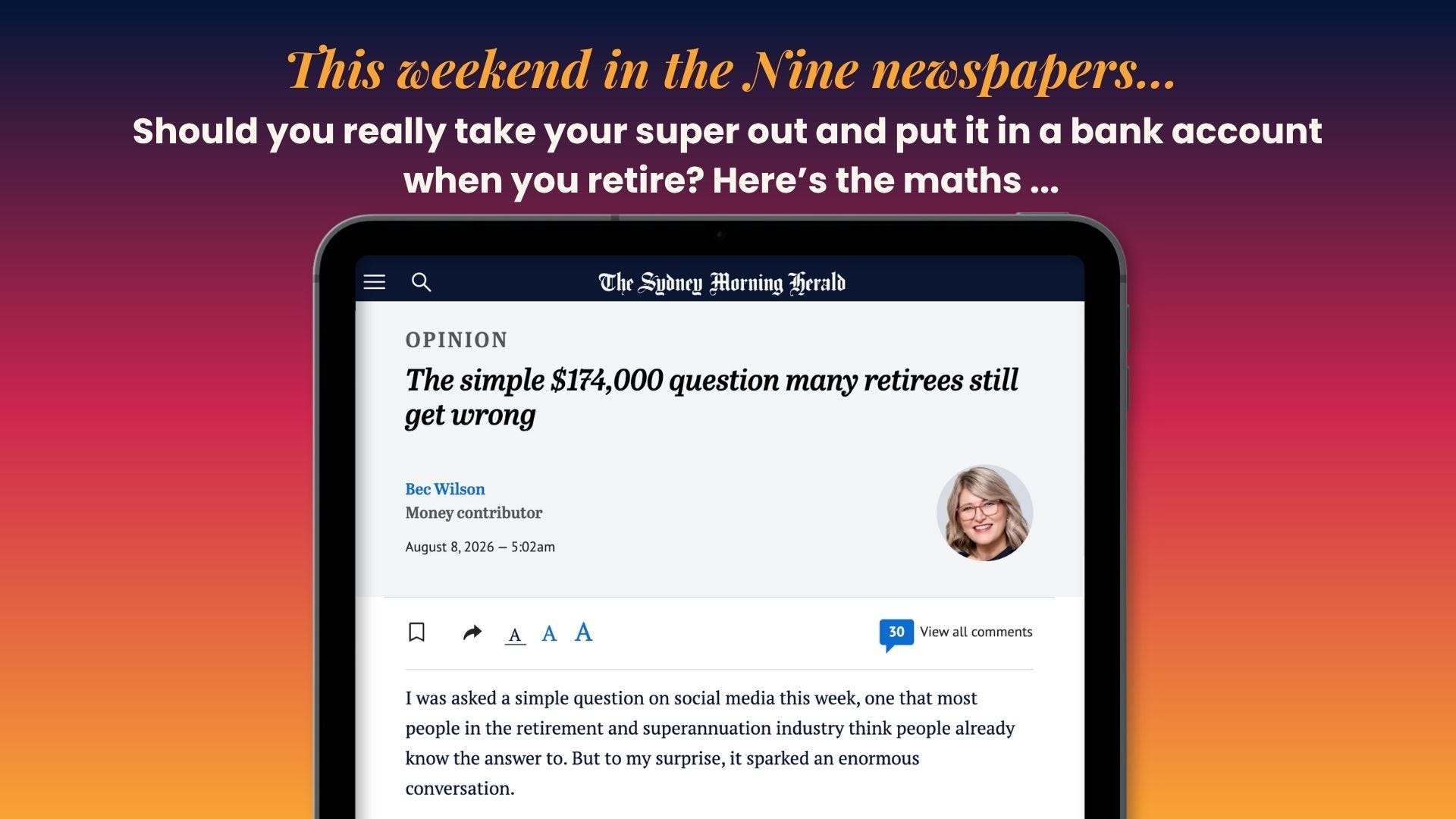
The simple $174,000 question many retirees still get wrong
I was asked a simple question on social media this week, one that most people in the retirement and superannuation industry think people already know the answer to. But to my surprise, it sparked an enormous conversation.
The question was “If I’m retired why wouldn’t I just take all my money out of super and put it in the bank?” Apparently, many people are unaware of the benefits of keeping their money in super, and don’t know about the really juicy upside of moving your superannuation into a retirement phase account so you can enjoy tax-free income when you’re retired.
So today we’re going back to basics – to what actually happens to your money the day you retire and why that decision, more than almost any other that you’ll make determines how far your retirement savings might stretch
While you’re working, your super sits in what’s called the accumulation phase. Most people reach retirement today with a reasonable or even large balance in their accumulation phase account, unable to access it until they meet two key conditions: reaching the official superannuation access age of 60, and ceasing just one job/employment relationship (even if they go back to work elsewhere afterwards) or, or simply turning 65 at which point you can access your super unconditionally, whether you’re working or not.
During your working phase of your life, you contribute to your superannuation account chiefly from your employer contributions, which are taxed at up to 15 per cent on the way in up to the concessional contribution cap of $32,500.
This article continues… It is published in The Age and Sydney Morning Herald on Saturday 8th Aug 2026. Read the whole article here, without a paywall.


Understanding blood sugar and insulin resistance in midlife
One of the things I’ve become increasingly interested in is understanding how our bodies change in the second half of life.
When we’re younger, it’s easy to take our health for granted. But as we move through our 50s and beyond, our metabolism changes, our hormones change, and many of us suddenly find ourselves dealing with things we’ve never had to think about before - stubborn weight gain, changing energy levels, rising blood sugar and an increased risk of chronic disease.
The good news? There’s a lot we can do about it.
This week on Prime Time, I’m joined by clinical nutritionist Sarah Di Lorenzo to unpack what’s really happening inside our bodies and why so many Australians are developing insulin resistance, pre-diabetes and type 2 diabetes. More importantly, we talk about the practical changes we can make today to improve our long-term health.
Sarah explains blood sugar in simple terms, shares the everyday habits that matter most, and reminds us that it’s never too late to make positive changes. As she says, we shouldn’t be waiting until we’re unwell to start paying attention to our health.
We spend a lot of time planning financially for our future, but looking after our health deserves just as much attention.
LISTEN TO THIS EPISODE OF THE PODCAST HERE: