

Scientists have proven that ageing doesn't have to mean decline...
And in this weekend's newspapers: How we invest our super is changing – and not necessarily for the better

In this edition
Feature: Scientists have proven that ageing doesn’t have to mean decline
From Bec’s Desk: A quiet week
The Age and Sydney Morning Herald: How we invest our super is changing – and not necessarily for the better
Prime Time: The truth about financial advice with Paul Feeney
But first, an ad for our upcoming course…

Booked your place on the next Epic Retirement Flagship Course yet?
Our next program kicks off on 14 May, and our Earlybird deal (25% off) is now open—but places are limited.
This is a six-week retirement education program designed to build your confidence and help you make sense of the many decisions ahead.
Learn more about the course here ➡️

Scientists have proven that ageing doesn’t have to mean decline
I’m going to ask you to set aside everything you think you know about getting older for a minute. Because a study has just been published in the the journal Geriatrics, from Yale, one of the world’s most respected research institutions, that has basically torn up the standard story about ageing. And I think it deserves way more attention than it’s getting.
Here’s the headline finding: nearly half of the older adults in the study actually improved in brain function, physical capacity, or both, over a period of up to 12 years.
Not “saw their health decline more slowly” and not “held steady as they got older!” They IMPROVED!
Just soak in that for a second!
The stories of getting old we tell ourselves become our reality
We have been marinated, from childhood, from every insurance ad, from every well-meaning doctor’s appointment, in a single story about ageing. That it goes one way - downhill, in a gradual and inevitable way, universally.
And, that story has been shaping your biology all throughout your life. But now, you could choose a different story to shape yourself around. One that has scientific backing!
The Yale researchers, led by Dr Becca Levy, followed more than 11,000 people aged 65 and over for up to 12 years. When they averaged everyone’s results together, which is how most ageing studies work, they saw what you’d expect – Decline. Cognitive scores dropped and walking speed slowed.
But then they did something different. They looked at individual trajectories instead of group averages. And that’s where things got interesting.
Nearly 45% showed improvement in cognitive function, physical function, or both. Around 32% actually improved their brain scores. Around 28% were walking faster at the end of the study than they were at the start.
So what made the difference?
Here’s the part that will either make you nod and smile or make you a little uncomfortable.
The researchers tested whether what people believed about ageing – the assumptions they brought into the study – predicted what actually happened to their health over the following decade.
And it did! Significantly.
People who held more positive beliefs about ageing were measurably more likely to show improvements in both brain function and walking speed, even after you account for age, sex, education, chronic disease and depression.
Your beliefs about ageing appear to be a biological input into how your body responds. Not just a mood or attitude. Something that’s actually shaping what happens inside your body over time.
Dr Levy has a name for this: ‘stereotype embodiment theory’. The idea is that from a young age, we absorb messages about what ageing looks like from ads, media, culture, the casual way people talk about getting old. Eventually those messages stop being abstract and become deeply personal. They shift from describing other people to describing you. And at that point, they start showing up in the body.
Her earlier research linked negative age beliefs to poorer memory, slower walking speed, higher cardiovascular risk, and brain markers associated with Alzheimer’s disease. This new study adds the other side of that coin: positive age beliefs predict improvement.
I find this extraordinarily exciting.
Something important to think about
I want to flag something specific in this research that I think it’s the most important part. The researchers didn’t just look at people who were struggling and got better. They did a separate analysis on people who had normal cognitive and physical function at the start – people who were already doing fine.
Among that group? Around 28% still improved their brain function over time. Around 23% improved their walking speed.
This wasn’t recovery from illness. This was people who were already healthy getting better as they got older
The researchers call it “reserve capacity.” The idea that later life holds more potential for growth than our culture has been giving it credit for. I’ve been saying this for years, and honestly it’s kind of wonderful to see Yale prove it.
So, what do you actually believe about getting older?
I ask this genuinely because I want you to stop and think about it.
If you’ve absorbed the standard cultural story (decline is inevitable, the body just fades, the brain slips, the best years of your life are behind you), that story may be doing you real harm. Not just to your mood or your motivation. Potentially to your actual health trajectory.
The good news and I want to be clear this is genuinely good news is that the researchers say age-related beliefs are modifiable. You can change them. And because you can change them, there’s real scope for doing something about it.
That might look like this:
Noticing the internal voice that says well, at my age... and asking whether it’s actually true
Deliberately seeking out people who are thriving – not just surviving – in their 60s, 70s, 80s
Pushing back when the cultural narrative around you defaults to telling you about your imminent decline
And let me be clear. None of this is about toxic positivity or pretending the challenges that come with getting older don’t exist. They do – ageing is real. But the research is telling us that the trajectory into later life is far less fixed than we’ve been led to believe – and that what we expect from life has a measurable effect on what we experience.
Maybe, if you already believe you’ll have an epic retirement, then you’re on the right path.
So here’s my challenge for you this week: Think about one story you’re telling yourself about ageing that might not actually be serving you? It might be time to rewrite it.
Source: Levy, B.R. & Slade, M.D. (2026). “Aging Redefined: Cognitive and Physical Improvement with Positive Age Beliefs.” Geriatrics, 11(2), 28.
Want to read more, I have two books - How to Have an Epic Retirement and if you’re not ready for retirement, Prime Time: 27 Lessons for the New Midlife.

I realise every day, whether I’m walking downstairs to my little home office or driving to the airport for a speaking gig, that I’m a very lucky person to love what I do so much.
This week was a full week at the desk. Articles, podcasts, newsletters, courses. No events, no travel, no distractions. I got a lot done, but it also means there’s not a huge amount to report from the road. Next week makes up for it though: Adelaide and Tassie, here I come.
On the content front, the government dropped an important consultation this week on how they plan to change the rules around financial advice – specifically around how people can pay for advice when they’re thinking about switching super funds. I wrote about it in The Age and The Sydney Morning Herald, so check that out if it’s relevant to your situation.
My podcast this week was a good one too. I sat down with Paul Feeney from Otivo to dig into the real challenges people face trying to get financial advice today – it’s a conversation a lot of you will relate to.
And if you haven’t caught my recent reels on social media, I’ve been doing a lot of short micro-lessons breaking down how to navigate retirement step by step. Worth a follow if you’re not already across them — link below.
Finally, it’s been a huge week of sales for the next 6-week course which kicks off on 14 May. The 25% Earlybird offer is available for the first 200 people to book but we’re already over 150 booked as I write this Friday afternoon! So don’t delay!
👉🏻 You can book your place here
👉🏻 Or learn more and download a brochure.
Now, have a lovely Sunday. The real, post-Easter year starts next week. I hope you’re ready!
Until next week — make it epic.
Cheers, Bec xx

Author, podcast host, columnist, retirement educator, and guest speaker

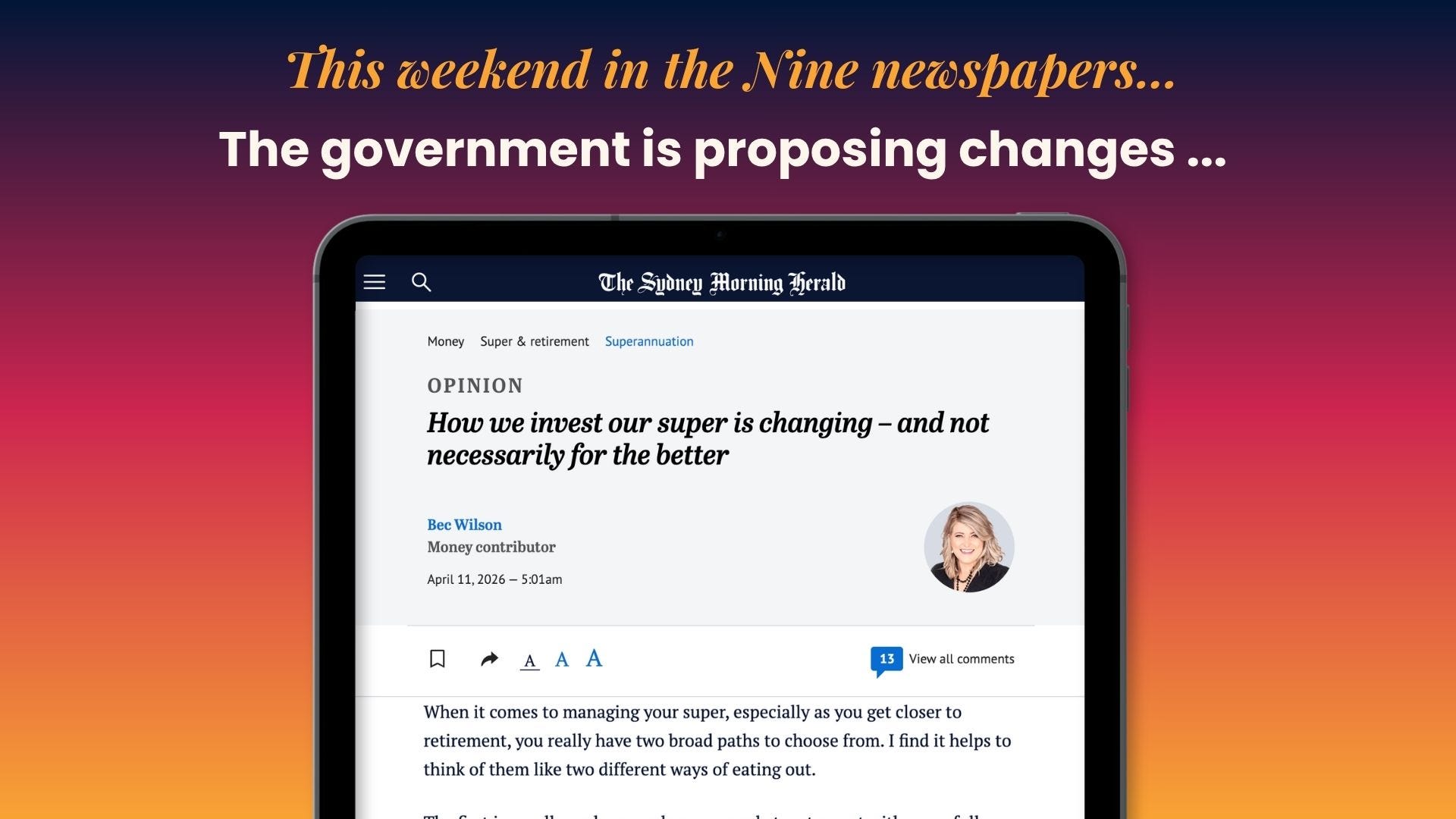
How we invest our super is changing – and not necessarily for the better
When it comes to managing your super, especially as you get closer to retirement, you really have two broad paths to choose from. I find it helps to think of them like two different ways of eating out.
The first is a well-run large scale mass-market restaurant with a carefully standardised menu. Think of your big industry or retail super fund as exactly that. In these, big professional investment teams do the cooking.
The menu has been curated tightly, the ingredients vetted for cost and importance, and the whole thing runs at scale for millions of members. Your job is to pick what suits you from what’s on the menu, using the waiter’s help.
For most Australians building their retirement savings over a working life, this is a genuinely good option. Reliable, cost-effective, and much more sophisticated than it used to be.
The second suits people with more complex needs. Think of it as hiring a professional chef who shops at a premium wholesale supermarket on your behalf and tailors your meal plan. The chef is your financial adviser, and the supermarket is an investment platform, one that ordinary consumers can’t just walk into.
But here’s what most people don’t realise: many of these chefs work inside what are effectively chain restaurants. The franchise has already decided which products they allow their chefs to use from the supermarket and which dishes are on the approved menu.
While we are debating how to stop people being exploited when they seek advice, we have paused the reforms that would have made it that advice easier to find.
Your chef personalises your experience within that framework, and they genuinely can do a great deal for you within it. But by the time your meal arrives, quite a few hands have shaped what was possible.
This article was published in The Age and The Sydney Morning Herald on Saturday11th April 2026. Read the whole article here. Note - it has a sign-up gate but no paywall.

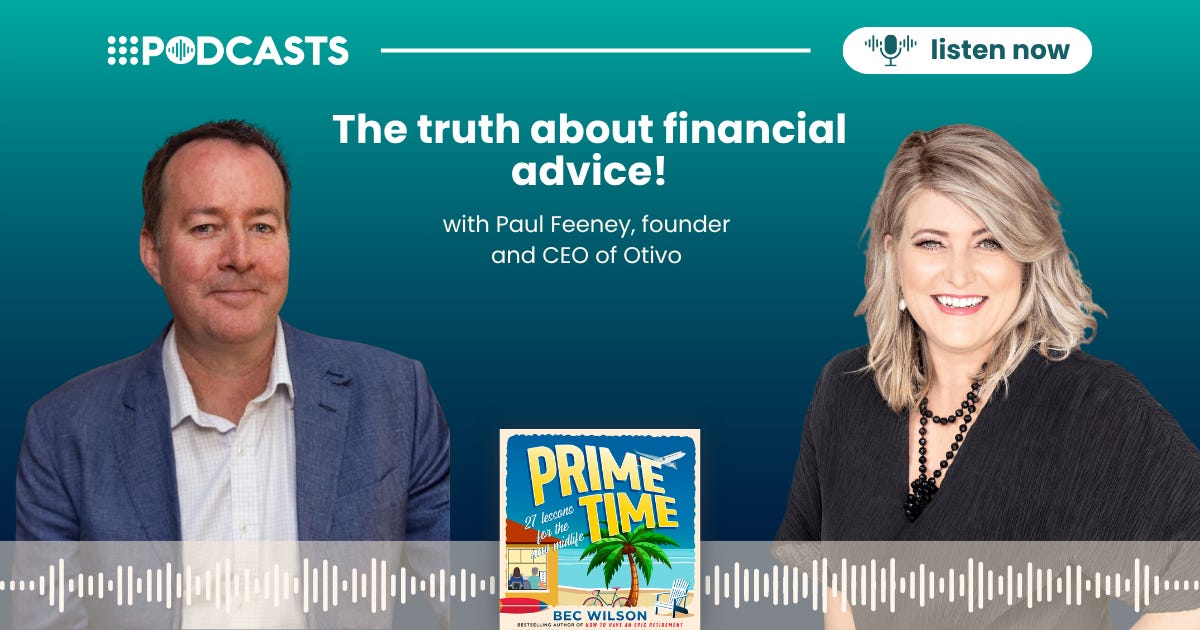
One of the biggest challenges I see for people in Prime Time isn’t a lack of money. It’s a lack of clear, trustworthy guidance.
People know they’re making big decisions. They know the stakes are high. But full financial advice can feel expensive or intimidating. Free information often comes with hidden incentives. And online tools, including AI, can leave you feeling more overwhelmed, not less - or with more questions to answer.
So, this week on Prime Time, I chat to Paul Feeney, founder and CEO of Otivo and someone who has spent years inside the advice industry in a variety of roles. It’s a refreshingly honest take on where it works, where it falls short, and what everyday Australians can do about it. The reality is that quality personalised advice has historically been more accessible to people with significant assets, leaving many everyday Australians without affordable guidance at the very moment they need it most.
We dig into the real difference between information, guidance and advice, because these words get thrown around a lot and they don’t mean the same thing. Information educates, guidance helps, and regulated advice is personalised to your exact situation.
And he’s offered everyone listening an opportunity to try out Otivo. To set up a free Otivo account you can go to www.otivo.com and use the discount code ‘Otivo4EpicRetirementor’. This coupon is only valid until 30 June 2026.
LISTEN TO THIS EPISODE OF THE PODCAST HERE:
When I was in my 50’s I seemed to be feeling that decline starting to happen. I said to myself that‘I’m not done yet’ and started to act on it, rebelling against convention. I totally believe that the decline isn’t inevitable, and by changing my thinking have turned things around. With a better diet and exercise to start, my energy is through the roof, I look and feel the best I ever have. I’m now pursuing my creative goals, primarily music, and powering ahead. Yes, your mindset is a very powerful driving force. Now in my 60’s my life is full steam ahead and feeling very Epic 😂.
I really enjoyed the insights in this article, especially the research from Yale that challenges the common narrative about aging. It’s so encouraging to hear that positive beliefs about aging can actually improve our health and well-being. The discussion around how external factors like the Iran war are impacting retirees’ financial security is also eye-opening.