

“Should you stay in growth with your super at 59 or is it time to get defensive?”
And, in the weekend Nine Newspapers: There’s a $2.5b issue with our super, and it’s costing retirees

In this edition
Feature: “Should you stay in growth with your super at 59 or is it time to get defensive?”
From Bec’s Desk: Every week is different
The Age and Sydney Morning Herald: There’s a $2.5b issue with our super, and it’s costing retirees
Prime Time: PART 1: The 6 things everyone fears about retirement and how to tackle those fears
Ad - Before we start — a big thanks to our newsletter sponsor this week, Viking

Viking’s new 2026-2028 River Voyages Brochure is now available
From the fairytale landscapes of Central Europe to the sun-soaked vineyards of Portugal and the iconic Mississippi, some places are best explored by river.
Discover new sailing dates, recently launched itineraries and unique experiences exclusive to Viking, with 232 pages of inspiring content in our new 2026-2028 River Voyages brochure.
Explore intimate and immersive experiences found along the world’s most majestic waterways. Glide past Europe’s medieval castles, see the vine-covered temples of the Mekong, delve into the wonders of India’s Golden Triangle and uncover the secrets of the Nile.
Order your free copy today with complimentary delivery to your door.

“Should you stay in growth with your super at 59 or is it time to get defensive?”
The market fell pretty hard on Friday in Australia. Bitcoin’s in ribbons, silver is slipping. The volatility is up. Crazy stuff is happening and when it does, the same question always turns up.
It hit my inbox almost immediately friday morning, from Robert. And lately, it’s coming up far more often.
Markets feel jumpy right now. The news cycle in 2026 is relentlessly messy. There’s talk of changes to CGT, a government that can’t seem to make the budget add up without fuelling inflation, and interest rate rises that are playing havoc with confidence. There’s even talk of AI obliterating the jobs market, changing the economy.
So, let me give you my take on the big question ‘should you stay in growth with your super at 59? Or is it time to get defensive?’
Stop for a minute and think about it… this isn’t new.
I could walk you back through the last 30 or 40 years and the moments that genuinely unsettled people as they were happening, watching super balances fall during the GFC, the dot-com boom and bust, the Asian financial crisis, seeing the world shut down overnight during COVID, the September 11 attacks, oil shocks and petrol price spikes, Afghanistan, the European debt crisis, Brexit, trade wars, sudden interest rate hikes, banks wobbling, property markets freezing, borders closing, flights grounded, shelves emptying, jobs disappearing, crazy tarriffs, Trump... It’s happened all our lives.
What does change is how it feels when you’re in your late 50s. Suddenly it can feel like you’re standing right at the edge of retirement, looking down, thinking:
“I really can’t afford to get this wrong now.”
So let’s slow this down and put it into plain English.
First, this decision isn’t really about your age.
It’s about when and how you’ll actually use your super.
If you’re almost 59 or 60 but you’re not planning to draw heavily on your super for another 5, 10, or even 15 years, then your time horizon is still long. And long time horizons are exactly what growth assets are built for. They’re bumpy in the short term, yes, but over time they’ve historically done a much better job of growing your money faster than inflation.
And here’s the part that we don’t talk about very much. You don’t spend all your money in retirement in the first five years. And for most, modern retirement is not a short phase anymore. Many Australians will spend 25 or 30 years drawing on their super. That means a big chunk of your money still needs to keep working for a very long time.
The bigger issue for most people isn’t growth versus balanced portfolios.
It’s how you react when markets wobble.
If market downturns make you anxious, or if you know you’re the kind of person who might switch out after a big market fall just to stop the discomfort, that’s a problem you need a plan to address. Not because growth is “bad”, but because panic-selling is how real damage gets done to your retirement plans. In that case, a slightly more balanced mix can be less about returns and more about helping you stay the course of keeping yourself in the market when things shake.
Another important question to ask yourself is whether you’ll need a lump of money soon.If you’re planning to use super in the next couple of years to pay off a mortgage, fund a renovation, or cover a big expense, that portion probably shouldn’t be riding market ups and downs. Many people forget that they don’t have to treat their entire balance the same way. Some money can be invested for long-term growth, while other money is kept more stable for near-term needs.
What worries me most is when people feel paralysed and sideline themselves. Then they sit in cash for years “waiting for things to settle down”. Or they make big switches purely because the economic mood feels over-inflated, or the volatility intolerably bad. The irony is that this kind of fear-driven decision-making often creates more risk, not less.
A more sensible approach is one that assumes the world will always be a bit messy. Because it is and always has been.
Think about the things you can to do hold some assets in growth…
So if you’re in your late 50s and feeling nervous as the world is stirring right now, the question isn’t “growth or defensive?” It’s how do you stay invested in growth without blowing yourself up when markets wobble?
Two simple ideas help here: buckets and guardrails.
Buckets are about matching your money to when you’ll need it.
You might think of your money in three rough buckets.
One bucket holds money you expect to use in the next few years. This is your sleep-at-night money. It’s there to cover near-term spending, surprises, or the early years of retirement. This bucket is usually more defensive.
The second bucket is for the middle years. Money you won’t touch for a while, but not decades away either. This is often where balanced options sit.
The third bucket is your long-term bucket. This money may not be touched for 10, 15, even 20 years. This is where growth assets belong. This bucket gives you protection against inflation and longevity risk.
Guardrails are what stop you from making emotional decisions at the worst possible time. Instead of reacting to headlines, you set some simple rules in advance. For example:
If markets fall sharply, you don’t want to sell from the growth bucket
You draw spending from the defensive bucket instead
You only rebalance back into growth when things recover, not when you’re scared
Guardrails turn investing from something you react to into something you manage. But beware, they don’t eliminate risk. Nothing does. Instead the job of buckets and guardrails is to help you contain the risk.
And that’s very different from gambling on the market or pretending volatility won’t happen. It will. And the goal isn’t to predict the economy.
It’s to build a plan you can live with, stick to, and sleep well with.
I cover a lot more on this in both my books - How to Have an Epic Retirement and if you’re not ready for retirement, Prime Time: 27 Lessons for the New Midlife.

Every week is different in my world. This week it was a crazy week of … radio shows, TV recordings, and course preparations. I’ve been keeping up my health-kick this week - have you? Weights to the point of failure and protein counting is becoming more familiar and very regular.
My first flight to Sydney for the year took me into the Nine TV studios to record a TV segment with Homemade, on homecare services.
Back in Brissy, I also recorded a podcast for Prime Time with our newly awarded Senior Australian of the Year, Dr Henry Brodati all about the cause that got him there, cognitive health and Alzheimers prevention. Keep an ear out for that one - it was terrific and it’ll come out next week. He’s darned impressive.
There were a few wonderful ABC radio conversations too – ABC Sydney, ABC Overnights, and ABC Western Plains. And next week I’ll be on ABC Perth as well.
I love talking about retirement in a way that doesn’t create ugly fear, but instead normalises the choices people actually have today, and helps them understand how to use those choices well.
And the courses - are moving fast.
Our How to Have an Epic Retirement Flagship Course Earlybird deal is now officially closed and I can say proudly this is again “OUR BIGGEST COHORT EVER!”. We’re packing the welcome packs on Monday. My downstairs is literally piled with boxes and boxes and boxes of workbooks and books. It’s going to be a big day of packing, but that makes it feel so much more personal doesn’t it to know me and my wonderful team still do it by hand!
If you haven’t got your seat on the program yet - you can use this link to apply a 15% off coupon at the checkout. It’s only for our newsletter readers!
The HESTA exclusive edition of the Epic Retirement program is booking right now (and the places are limited), for kickoff on the 19th Feb. It’s a fully-tailored program for HESTA members to learn how to have an epic retirement. And it’s EPIC! You can register your place here - it’s only for HESTA members though!
I’ve got some events coming up:
In-person in Melbourne on Saturday 21st February, speaking about ‘How to make your retirement EPIC’ at Lifestyle Communities Deanside. It’s a great way to see a community in real life too. It’s free but you need to RSVP to come along. More info here.
And, also on the 19th February I’ll be speaking at the Aware Super online event ‘Planning for Retirement for Couples’! This is an information-packed event, and it’s online, for Aware Super members. More here.
Last thing this week… I am on a drive to find more of the country’s future-retirees and help them. So if you know someone who might benefit from this newsletter, please send it on and suggest they subscribe for free. We’ll both be grateful I hope (me and them!)
Thanks for being here… making it epic. Have a lovely Sunday!
Cheers
Bec xx

Author, podcast host, columnist, retirement educator, and guest speaker

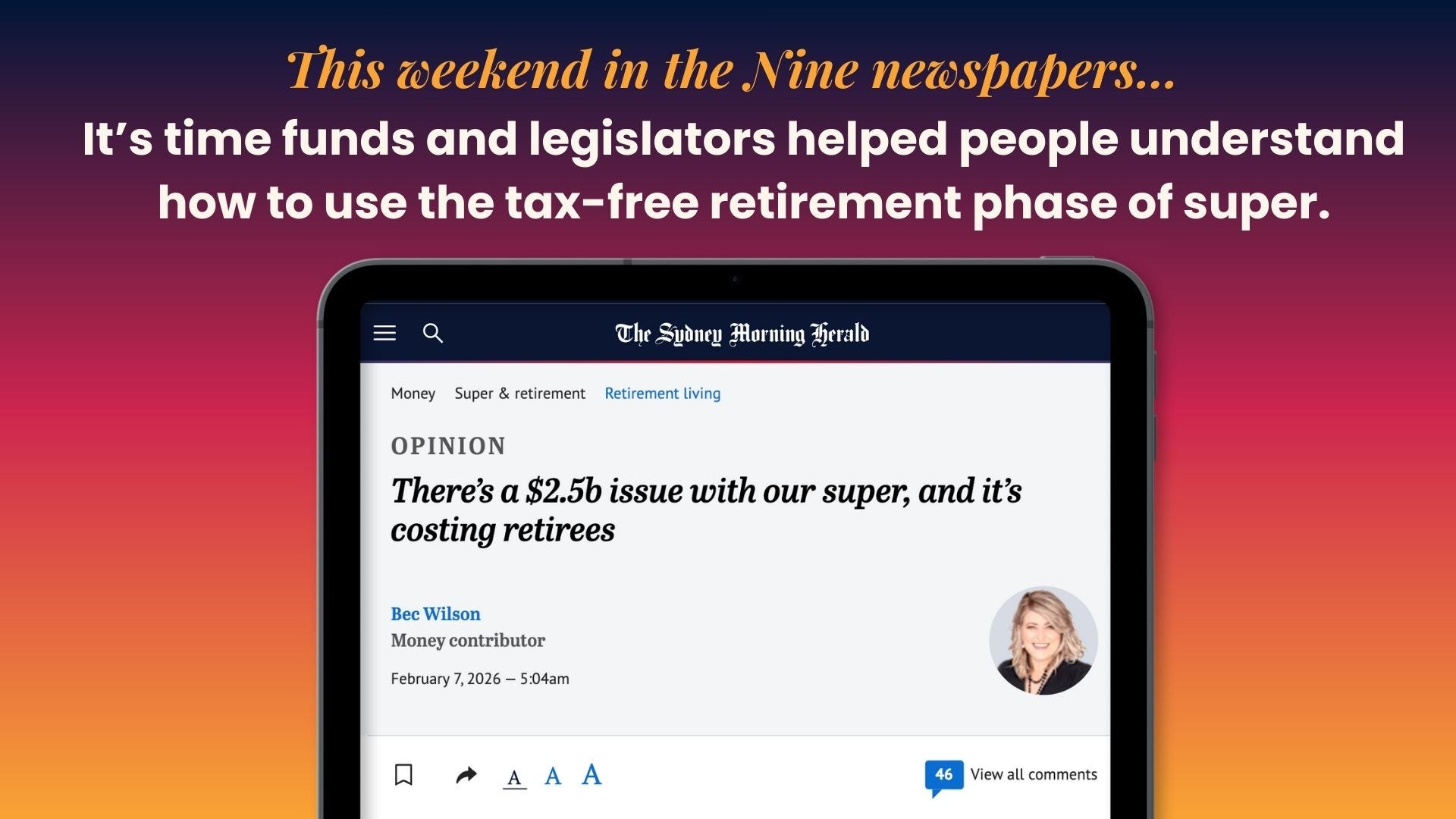
There’s a $2.5b issue with our super, and it’s costing retirees
There’s an enormous wave of people approaching retirement in Australia today. Many, particularly over the next decade as super matures, will have relatively small balances and limited financial confidence.
Instead of feeling prepared, they feel overwhelmed. They put off engaging with their super, delay important financial decisions, and quietly hope things will sort themselves out when work ends.
For many of these people, meaningful financial advice simply isn’t accessible. Advice is expensive, often geared towards larger balances and private asset management, and increasingly unreachable for those who need help the most.
Yet, these are precisely the people who need support to set themselves up for retirement, to understand how super, the age pension, tax-free retirement income and any ongoing work fit together to fund a liveable retirement, and to feel confident they’re not making costly mistakes along the way.
This is where Australia’s retirement system needs to change, and quickly.
If large numbers of people are overwhelmed, disengaged and unable to access advice, then simply waiting for them to make the “right” retirement decisions is no longer realistic.
Super funds need to be allowed, and expected, to play a more active role in helping members move from accumulation into retirement, so their superannuation generates tax-free returns, and is used to help them have a good life.
This article was published in The Age and The Sydney Morning Herald on Saturday 7th February 2026. Read the whole article here. Note - it has a sign-up gate but no paywall.

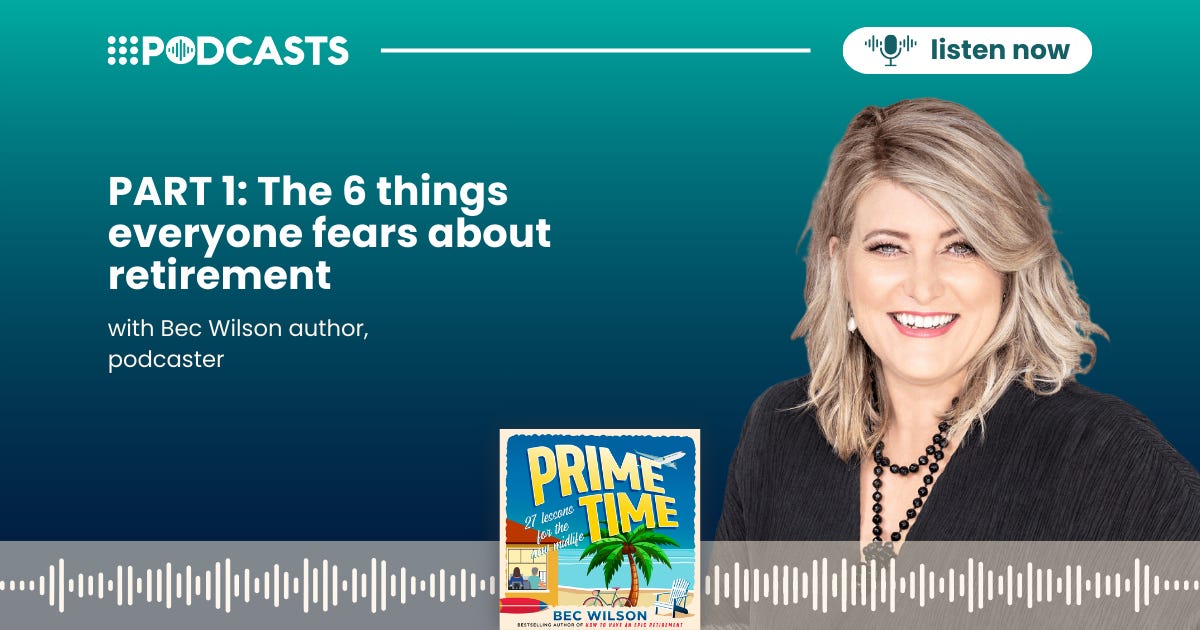
PART 1: The 6 things everyone fears about retirement and how to tackle those fears
When I asked our Epic Retirement Club community what they feared most about retirement, the responses came flooding in.
“Running out of money.”
“Dying at my desk.”
“Losing my identity.”
“Not knowing how to spend my time.”
“Being alone.”
Does any of this sound familiar?
It struck me how consistent these concerns were. These aren’t irrational fears - they’re smart, thoughtful people trying not to mess up the second half of their lives.
So, this week on Prime Time, I’m doing something a little different. I’ve sat down with our program producer, Gen, to name the six fears that came up again and again. We unpack the first three in today’s episode: running out of money, running out of time and health, and loss of identity.
We talk through why these fears are so common and how each one could be managed - not eliminated - because we can’t just chase them away.
LISTEN TO THIS EPISODE OF THE PODCAST HERE: