

Six things to do well before 30 June
And in this weekend's newspapers: 'Half of us are terrified of retirement. Here’s why you might be OK'

In this edition
Feature: Six things to do well before 30 June
From Bec’s Desk: A much quieter week
The Age and Sydney Morning Herald: Half of us are terrified of retirement. Here’s why you might be OK
Prime Time: Two shows: Thinking about Antarctica - the things you need to know; and How to soft launch your retirement

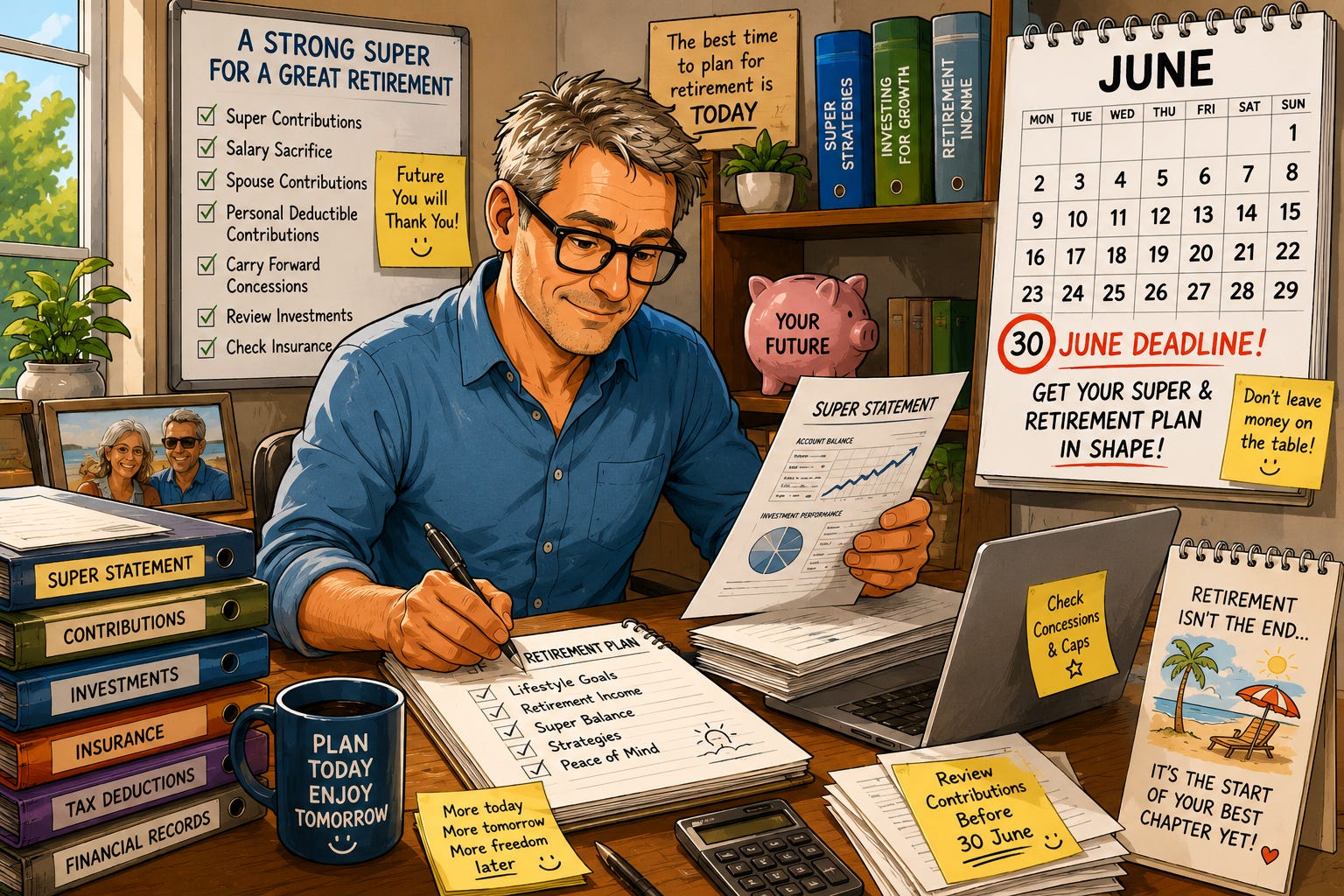
Six things to do before 30 June
30 June might feel like it’s a few weeks away, but your super fund has other ideas. Most funds stop processing contributions a week or so before the end of the financial year - so the real deadline for all things financial is closer than the calendar suggests. If you’re somewhere between 45 and 65, the next two weeks are some of the most valuable weeks in your financial year. Worth snapping to it.
Here are six things worth doing before the financial year closes.
1. Top up your concessional contributions
The concessional contributions cap for 2025–26 is $30,000. That includes your employer’s super guarantee (currently 12% of your salary), any salary sacrifice you’ve set up, and any personal contributions you choose to make.
If your employer contributions are sitting well under that $30,000 mark, you may be able to top up the difference yourself with a ‘personal contribution’ - and claim a tax deduction for it. That means the contribution is taxed at just 15% inside super, rather than at your marginal tax rate, which for many people in this age bracket is 32.5% or higher.
To do this, you transfer money directly into your super fund (most funds accept BPAY or EFT - check your member portal for the details). It’s straightforward but you can always ring your fund’s hotline for help.
But after you move the money - there’s a step 2 that you need to take, if you put in a personal contribution… and it’s the step a lot of people miss.
2. Lodge your Notice of Intent to Claim form
Simply putting money into super doesn’t automatically make it a concessional contribution. Without one extra step, it defaults to a non-concessional contribution, and you lose the tax deduction entirely. [Trust me I have had many frustrated people write to me wishing they knew this]
That extra step is lodging a Notice of Intent to Claim a Tax Deduction - sometimes called a NOITC, or ATO form NAT 71121 - with your super fund. Most large funds let you do this online inside your member portal in a couple of minutes. Smaller funds may ask you to complete a paper form.
The form tells your fund: “I want this personal contribution treated as a concessional contribution, and I intend to claim a tax deduction for it.” Your fund will then acknowledge receipt in writing, and that acknowledgment is what you use when you lodge your tax return.
The notice must be lodged with your fund and acknowledged before you lodge your 2025–26 tax return - whichever comes first. Don’t wait until tax time and assume you can sort it then. If your return goes in first, you’ve missed the window.
No form = no deduction. It’s that simple, and that easy to get wrong, and no begging of the tax department or your super fund overturns it - even if ‘you meant to do it’.
3. Check your carry-forward contributions - you might have more room than you think
If you haven’t maxed out your concessional contributions in previous years, you may be able to contribute more than the standard $30,000 cap this year. It’s called the carry-forward rule (sometimes called catch-up contributions), and it’s frankly underused.
The rule you need to look for: if your total super balance was under $500,000 on 30 June 2025, you can carry forward any unused cap space (the $30,000 concessional caps) from the past five financial years and use it this year. So if you had years where you contributed less than the annual cap - maybe you were working part-time, taking time out, or just weren’t focused on super and didn’t top up your employer’s contributions, you may be sitting on a sizable unused allowance.
To see exactly what’s available to you, log into myGov, access the linked ATO service, and in the super menu select Information, then Carry-forward concessional contributions. This will show your unused amounts by year, and confirm whether you’re eligible based on your total super balance.
A few things to note:
Unused cap amounts from earlier years don’t last forever - the carry-forward window is five years, after which they expire. The ATO applies the oldest available year first. In practical terms, any unused amounts from 2019–20 that weren’t used by the end of 2024–25 will have already expired, so it’s worth checking sooner rather than later.
The $500,000 balance threshold is assessed at 30 June of the prior year (so 30 June 2025 for this financial year). If your balance has since grown above $500,000, you can still use carry-forward amounts this year, as long as you were under the threshold on that date.
If you do make a personal contribution using carry-forward amounts and want the tax deduction, the NOITC form in step 2 still applies.
4. Check your minimum pension drawdown if you’re already retired
If you’ve moved your super into a retirement income stream (account-based pension), the government requires you to draw down a minimum amount each year. That minimum is based on your account balance and your age.
Make sure you’ve met your 2025–26 minimum pension drawdown before 30 June - and check what your 2026–27 withdrawal requirement will be, particularly if your minimum drawdown rate is increasing. Missing the minimum drawdown can have real tax consequences, so it’s worth confirming with your fund if you’re unsure.
5. Move savings into super
If you have money sitting outside super - in a savings account, offset account, or just cash - consider whether any of it could be moved in before 30 June. Non-concessional contributions (after-tax money) don't attract a tax deduction, but once inside super your earnings are taxed at just 15%, and at zero once you're drawing an income in retirement. The annual cap is $120,000 this financial year, rising to $130,000 from 1 July. That's worth knowing if you're thinking about using the bring-forward rule - because the amount you can bring forward depends on which year you trigger it, and the numbers change on 1 July. If you're considering a large lump sum contribution, it's worth getting advice before you act, because timing can affect how much you're able to put in. Your fund’s intrafund advice team can help with this.
6. Review your total super balance - the 1 July changes matter
From 1 July 2026, contribution caps are indexing upward and the transfer balance cap rises to $2.1 million. Your total super balance on 30 June 2026 determines which contribution rules and thresholds apply to you in the next financial year.
The amount you can bring forward depends on your total super balance on 30 June 2025 — the higher your balance, the less flexibility you have. If you’re thinking about a large lump sum contribution, get advice before you act, because the rules are tiered and the thresholds are changing on 1 July.
It’s also worth noting the Division 296 tax kicks off - from 1 July 2026, individuals with super balances above $3 million will face an additional tax on earnings linked to that portion of their balance. This affects a small number of people, but if you’re approaching that threshold, it’s worth getting advice before the new financial year begins.
A little note on getting help
None of the above is financial advice - it’s a prompt to act, not a prescription for what to do. How much you contribute, and which strategy makes sense for your situation, depends on your income, your balance, your age, and your broader financial picture. If you’re not sure, a financial adviser or your super fund’s helpline can walk you through it. But the window closes on 30 June - or frankly about a week before for most funds. So if any of this applies to you, now is the time to look into it.

Winter arrived this week in Queensland. Chilly, windy and sunny… delightful. It’s the sort of weather that makes you want to walk outdoors and feel the sun on your face. And so I have, every - single - day. With no travel for a few weeks, I’m delighting in getting through the workload on my desk, rebuilding my website, supporting the courses currently underway in Australia and the UK; and preparing for the launch of the next programs.
I’ve also signed my next book deal - a fun project to get started on. And this time I’ve gone with Penguin Random House as the publisher - a big change for me. When I wrote my first retirement book only one publisher was curious - all the others said there’s no market for this stuff. ☺️ Three years later I had a few wanting a piece! Must be doing something right. I’ll tell you more about the 2 book deal I’ve signed on for once the books take shape.
Our Epic Retirement Courses are going great guns. This week in Australia we held our Week 3 Live Q&A with Jen Harding from HESTA; and next week it’s Week 4 with David Lane, Senior Adviser, from Ord Minnett. And in the UK, we host our first live Q&A - cant wait to get up at 3am for that.
Feedback is rolling in from our mid-course survey - get some of these!
“This course is mind blowing!!”
“Pleased I'm doing the course as it's raising awareness of all the gaps in my knowledge. Currently know just enough to be dangerous.”
“Great content. Learning a lot. Easy to understand.”
“I'm finding the content very informative but feel that it has just highlighted my need to seek more information relative to our particular situation.”
Our next program is gearing up to begin on the 13th August - if you want to lodge an expression of interest, we’ll let you know when it goes on sale.
And now you’ve read all the EOFY stuff to the bottom - get out and enjoy some winter sun. Have a lovely long weekend - to everyone other than us Queenslanders!
Make it epic!
Cheers - Bec Xx

Author, podcast host, columnist, retirement educator, and guest speaker

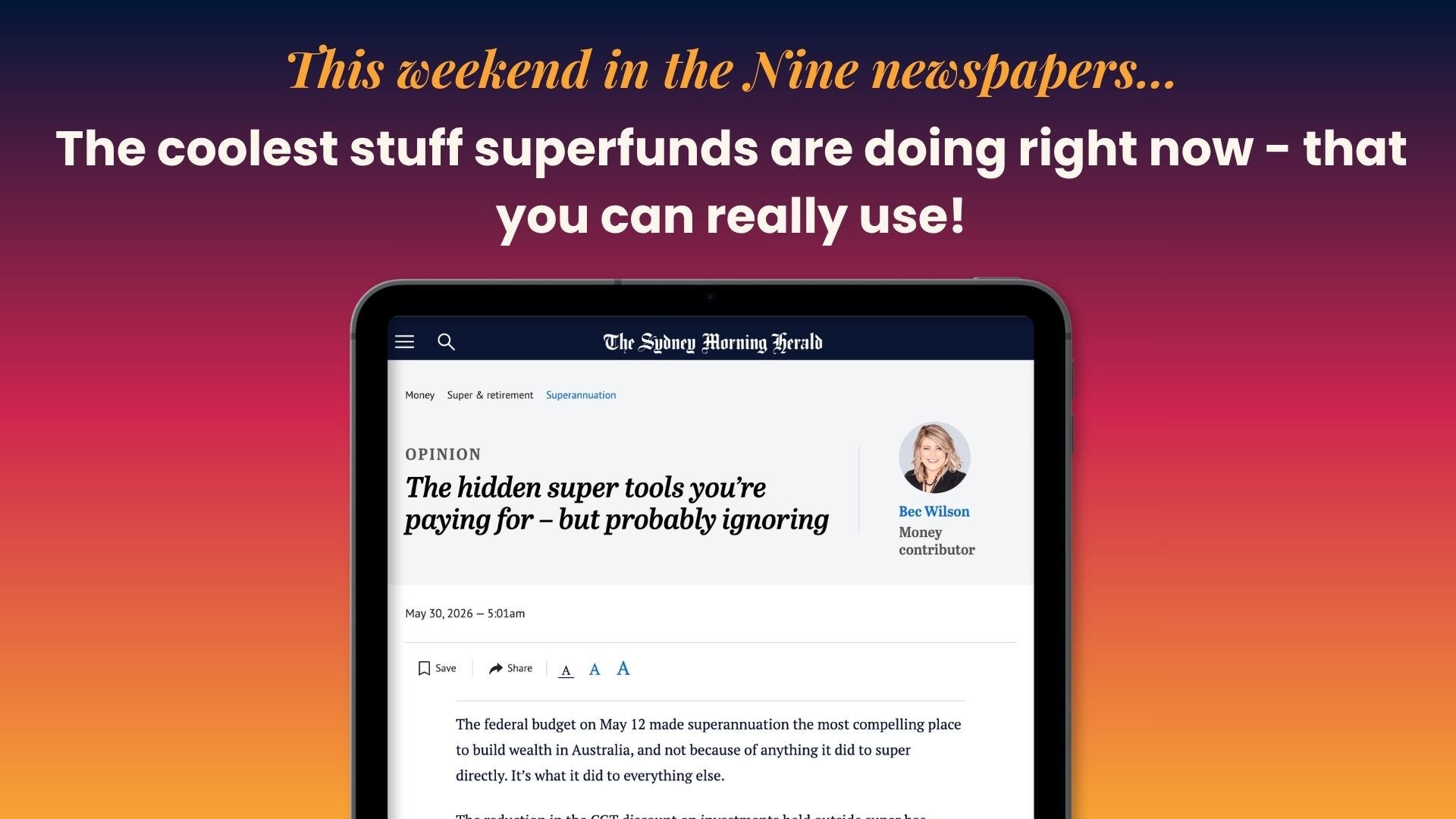
Half of us are terrified of retirement. Here’s why you might be OK
Last year I wrote a column taking a long hard look at a pattern I kept seeing in the superannuation industry: report after report measuring how anxious Australians feel about retirement, with very little action to show for it.
PR dressed up as progress, I called it, and my readers agreed loudly. We don’t need more reports, we need more action to help members navigate their retirement.
So when Colonial First State’s annual Rethinking Retirement report landed on my desk this week, I’ll admit I picked it up with a slightly raised eyebrow. But then I read it properly. And then I read it again. Because CFS has actually done a lot of work on its retirement and advice propositions this year, not just commissioned another survey.
And there was a finding buried in that report truly worth sharing and talking about today. It could be the most important thing I’ve read about retirement all year.
It concerns the amount of worry people are expending on retirement, possibly unnecessarily, and how such worry has surprisingly little to do with the money they have as they approach retirement but more to do with how proactive they are in understanding their real position.
This article continues. It was published in The Age and The Sydney Morning Herald on Saturday 6th June 2026. Read the whole article here. Note - it has a sign-up gate but no paywall.

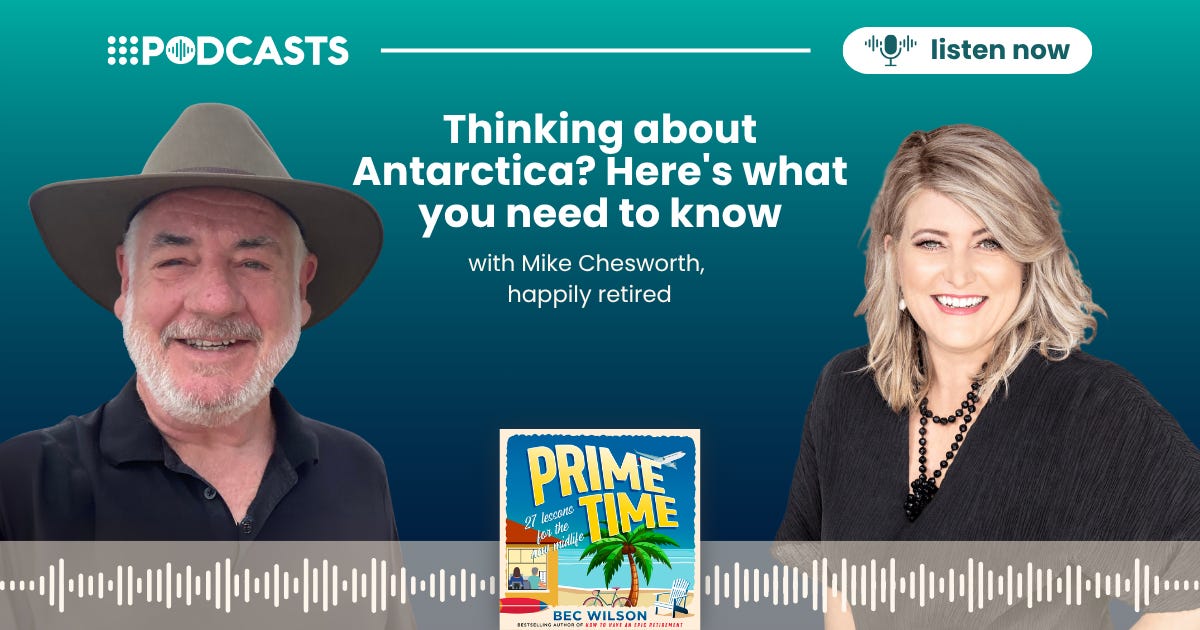
For years, Antarctica has sat on many people’s bucket lists.
But unlike most holidays, it’s not the sort of trip you book on a whim. It’s expensive, remote, weather-dependent and often requires planning more than a year in advance.
So is it actually worth it?
In this week’s episode of Prime Time, I sit down with regular Prime Timer Mike Chesworth, who has just returned from Antarctica, to get the unfiltered truth about what it’s really like.
We talk about everything from choosing the right expedition, booking timelines, the level of fitness required and costs, to the wildlife, the scenery, the notorious Drake Passage and the unexpected highlights of travelling through South America along the way.
If Antarctica is on your list for 2027, 2028 or beyond, this conversation will help you understand what the experience is really like before you commit.
LISTEN TO THIS EPISODE OF THE PODCAST HERE:
BONUS EPISODE: How to soft launch your retirement
Retirement doesn’t have to be a hard stop.
In fact, for many people, the best transition is a gradual one — reducing work, exploring new interests and creating a lifestyle that balances income, purpose and freedom.
In this special June series, I’ve teamed up with Aware Super to explore the new rhythm of retirement and what it really looks like in practice.
In this episode, I sit down with Bambi Price, founder of War On Wasted Talent, and Peter Hogg, General Manager of Guidance & Advice at Aware Super, to discuss how to “soft launch” your retirement without losing your sense of purpose, or your paycheck, overnight.
Together, we explore why more Australians are choosing a phased approach to retirement, how to stay connected to meaningful work, and the practical steps you can take now to design a transition that works for you.
LISTEN TO THIS EPISODE OF THE PODCAST HERE: