

The ages every pre-retiree should know
And in this weekend's newspapers: Thinking about helping your adult kids?

In this edition
Feature: The ages every pre-retiree should know
From Bec’s Desk: Read the feedback!
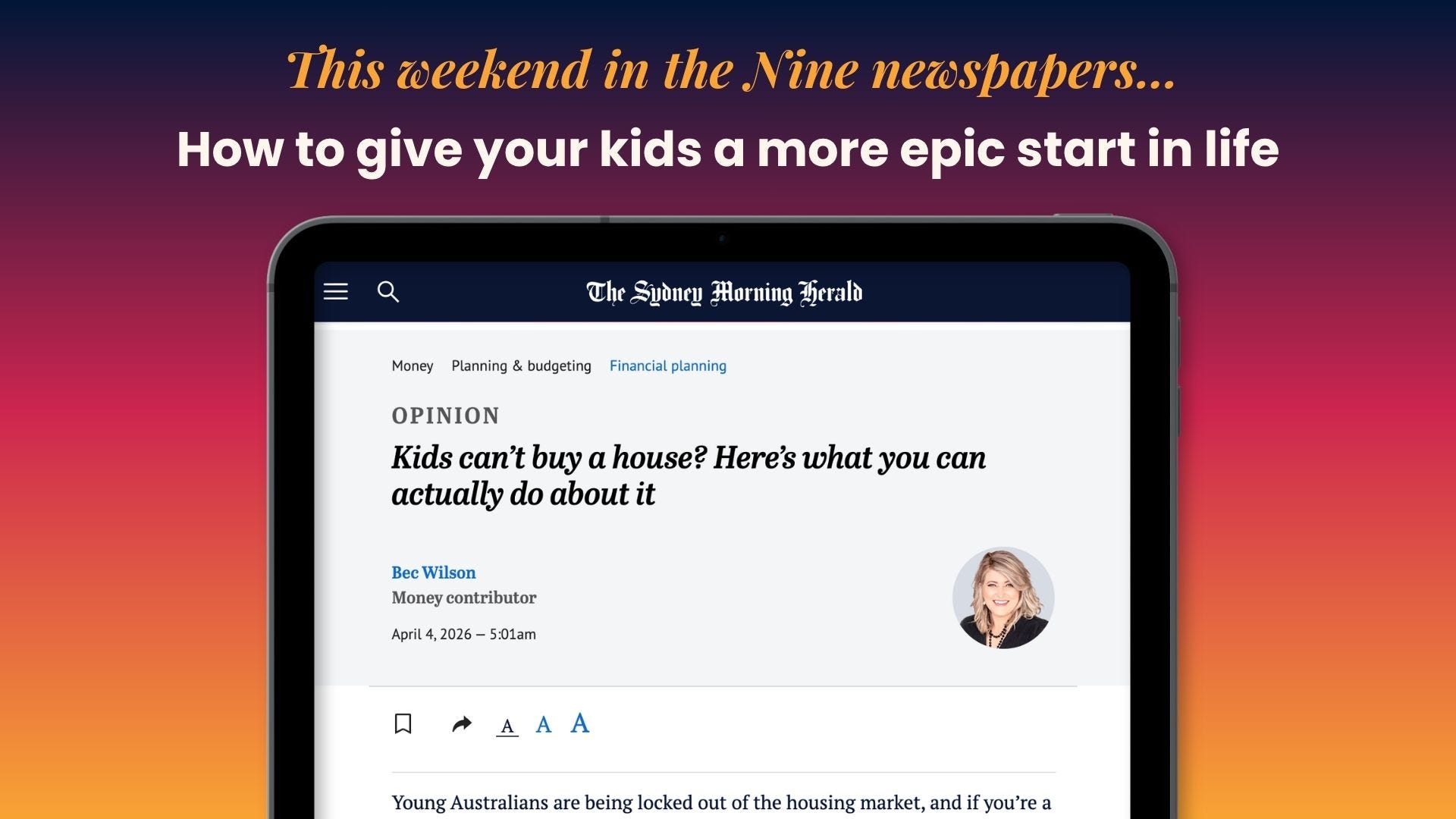
The Age and Sydney Morning Herald: Thinking about helping your adult kids?
Prime Time: Two shows: A guide to downsizing from your family home; and Kathy Lette on the power of ‘I don’t give a shit lit’

Booked your place on the next Epic Retirement Flagship Course yet?
Our next program kicks off on 14 May, and our Earlybird deal (25% off) is now open—but places are limited.
This is a six-week retirement education program designed to build your confidence and help you make sense of the many decisions ahead.
If you’re starting to think seriously about what comes next, this is the perfect way to get prepared.
Learn more about the course here ➡️

The ages every pre-retiree should know
One of the most searched questions around retirement is simple: when can I retire?
But the real answer isn’t one age. It’s a series of ages, and each one opens up a different set of options.
What I see all the time is people anchoring to one number. Usually 60, 65 or 67, as if that’s when everything suddenly changes and the finish line appears. But the people who navigate this well don’t wait for one moment. They understand how the system works across time and use it to shape their transition.
If you’re looking towards retirement, these are the ages that actually matter.
First, there’s 55. This is when the downsizer contribution becomes available. If you’ve owned your home for ten years and lived in it for some of this time as your PPOR, you can contribute up to $300,000 per person into super from the sale of that home without it counting towards your contribution caps. It’s a powerful option if you’re thinking about moving to a lifestyle property or freeing up capital.
Then, at 60, the doors to super really start to open.
This is the age where you can access your super if you retire from a role and meet a condition of release, even if you later return to work. If you choose to keep working, you can also consider a transition to retirement income stream (TTR), which allows you to draw between 4% and 10% of your super balance each year.
From age 60, payments from super become tax-free. With a TTR, those payments are tax-free, although the earnings in the fund are still taxed until you fully retire and move into retirement phase.
Some people use a TTR to reduce their hours and ease out of full-time work while maintaining an income. For many, this is the first time work starts to feel more like a choice than a necessity.
Age 60 is also where the tax system begins to work in your favour. Once you’ve met a condition of release and moved your super into retirement phase, the income your super earns and any capital gains become tax-free. Withdrawals are also tax-free.
That’s a big shift. It opens up the ability to combine part-time work with tax-free income from super, and to make lump sum withdrawals when needed. For many people, this is the point where they can start reshaping how they work and live.
At 65, things become simpler again. Turning 65 is itself a condition of release, which means you can access your super regardless of whether you’re working. The focus shifts from eligibility to strategy, and how you structure your income and investments becomes the priority.
Then there’s age 67, which is when most people become eligible for the Age Pension.
This is the age everyone knows, but it’s often given more weight than it deserves. The Age Pension is an important safety net, but it’s not the whole plan. For those with lower balances, the focus is on how the Age Pension and super work together. For others, it plays more of a supporting role.
And then there’s age 75, which tends to fly under the radar.
At 75, a number of contribution opportunities come to an end. You generally can’t make non-concessional contributions anymore, and the bring-forward rule is no longer available. Most voluntary contributions, other than employer contributions, effectively stop at this point, with contributions only allowed up to 28 days after the end of the month you turn 75. One of the few contributions still available beyond this is the downsizer contribution.
This matters because the years leading up to 75 can be some of the most valuable for shaping your financial position. It’s often the window where people consider strategies like recontribution to reduce the taxable component of their super and improve outcomes for their beneficiaries. Miss that window, and you lose flexibility.
When you step back and look at all of this, the idea of a single retirement age doesn’t really hold up.
Retirement isn’t a switch you flick at 60 or 65. It’s a transition that unfolds over a number of years. The real opportunity is in how you use that time — easing back rather than stopping suddenly, starting to draw on your super while you’re still working, and making deliberate decisions about how you want your time and energy to be spent.
The people who get the most out of this stage aren’t waiting for a date. They’re using these ages as guideposts and adjusting along the way.
Want to read more, I have two books - How to Have an Epic Retirement and if you’re not ready for retirement, Prime Time: 27 Lessons for the New Midlife.

Happy Easter! I hope the bunny has delivered a few eggs to your house this morning.
Hard to believe it’s April, isn’t it? And fuel prices are the biggest conversation of the week (and possibly for many months in the future). Gulp. I almost don’t want to admit I’m a Tesla owner at times like this. My car, a bottom-of-the-range Model 3, is no ego-wagon. It’s seven years old, white, and has cost me a grand total of $400 in servicing over its lifetime, and one set of tyres. So it’s quietly holding up its end of a bargain I didn’t know I was making. How’s yours going?
Anyway, onto more serious things. This week was deliciously short. I keynoted two Adviser events for AMP North, one in Brisbane and one on the Gold Coast, which were both fantastic.
It also marked week 6, the final week of our Autumn How to Have an Epic Retirement Flagship Course. We held our last live session with Fiona Dalton on how to get the most out of travel, which is always a crowd favourite.
And in the HESTA Exclusive Epic Retirement Course, we wrapped up with Tania Phillips from CareAbout, who walked us through how to plan for care and how the system actually works. Such an important topic, and one most people don’t feel confident about until they’ve had it explained properly.
I genuinely love running these courses and being part of the live sessions. And I’m thrilled to say that the first round of finishers seem to be enjoying them just as much as I do. Here’s some fresh feedback that came in this week:
“I would consider this an essential course for everyone. I would recommend reading Prime Time and Epic Retirement, and unlike me at 62 years old and retired to do so earlier in life to be ready. Great coverage of lots of topics relevant to all of us. Thank you for the books and the course.”
“Feeling in a better place to handle everything now. Thank you”
“Terrific program. We loved the content and Bec’s delivery style is just so engaging. Highly recommend the course, and likewise Bec’s wonderful books “How to have and Epic Retirement” and “Prime Time”, and her podcast “Prime Time”.”
And one from the HESTA course too:
“This course has been very helpful. It has put the planning for retirement in to a structure I can follow and given me hope for an Epic Retirement. I was very anxious about my low super balance and nil savings, being divorced and having to do it all on my own. But now it feels doable. I can still do some of the travel overseas I have always dreamed of. Thanks for this opportunity to participate in this great course. Highly recommended to everyone over 50 years old.”
100% of people who finished so far said they’d recommend the course to their friends too! Honestly, what a buzz.
The next 6-week course kicks off on 14 May. It’s just opened for enrolments, and the 25% Earlybird offer is available for the first 200 people to book. We’re booking fast.
👉🏻 You can book your place here
👉🏻 Or learn more and download a brochure.
Now, that’s enough of the heavy stuff - it’s time for some chocolate.
Hope the bunny delivered, and that you’re having a lovely, family-or-friend-filled Easter. And there’s plenty of chocolate around you today.
Until next week — make it epic.
Cheers, Bec xx

Author, podcast host, columnist, retirement educator, and guest speaker

Why a large super balance can actually reduce your retirement income
Young Australians are being locked out of the housing market, and if you’re a parent or grandparent watching it happen, it’s genuinely painful.
Home ownership for people in their 20s and 30s has been falling for years. Your children are buying later than you did, borrowing more than you ever considered, or giving up on the idea altogether, scared off by the size of the mortgage they’d have to sign on for. And, it doesn’t look like the system is going to fix this for them any time soon.
I’ve been having this conversation with my 22-year-old daughter. When you actually sit down and do the sums with them, what it costs to save a deposit in one of our capital cities, on a starting salary, with the life expenses that come with being young, it feels scary.
It’s not impossible. But it takes real discipline, real commitment, and increasingly, it depends on whether family support is sitting behind them to catch them if the economy gets tough or they lose their job.
The money exists in our economy to help. In fact, trillions of dollars will move between generations over the coming decades, from Australians in their late 80s and 90s to their children, who’ll be in their late 50s and 60s by then. By the time that inheritance lands, for many it will be too late to change very much.
This article was published in The Age and The Sydney Morning Herald on Saturday 4th April 2026. Read the whole article here. Note - it has a sign-up gate but no paywall.


A guide to downsizing from your family home
Downsizing the family home is one of those decisions that sits in the background for years…until suddenly, it’s right in front of you.
This week on Prime Time, I sit down with regular guest Mike Chesworth to talk about the good, the bad and the reality of downsizing after more than 30 years in the same home.
Big house. Kids grown. Life shifting. And like so many people in this stage of life, the question becomes… is it time?
In this episode, Mike shares what actually goes into making that decision, from figuring out your “why”, to navigating timing, finances, bridging loans, strata, inspections and the chaos of moving just before Christmas. Along the way, he reflects on what it means to future-proof life in your 60s, let go of the weight of a big home, and create a lifestyle that offers more freedom, flexibility, and ease.
Mike offers hard-won insights into choosing the right property, getting clear on your priorities, managing costs, and treating a move like a project rather than a challenge.
LISTEN TO THIS EPISODE OF THE PODCAST HERE:
BOOK CLUB: The power of ‘I don’t give a sh*t lit!’ with Kathy Lette
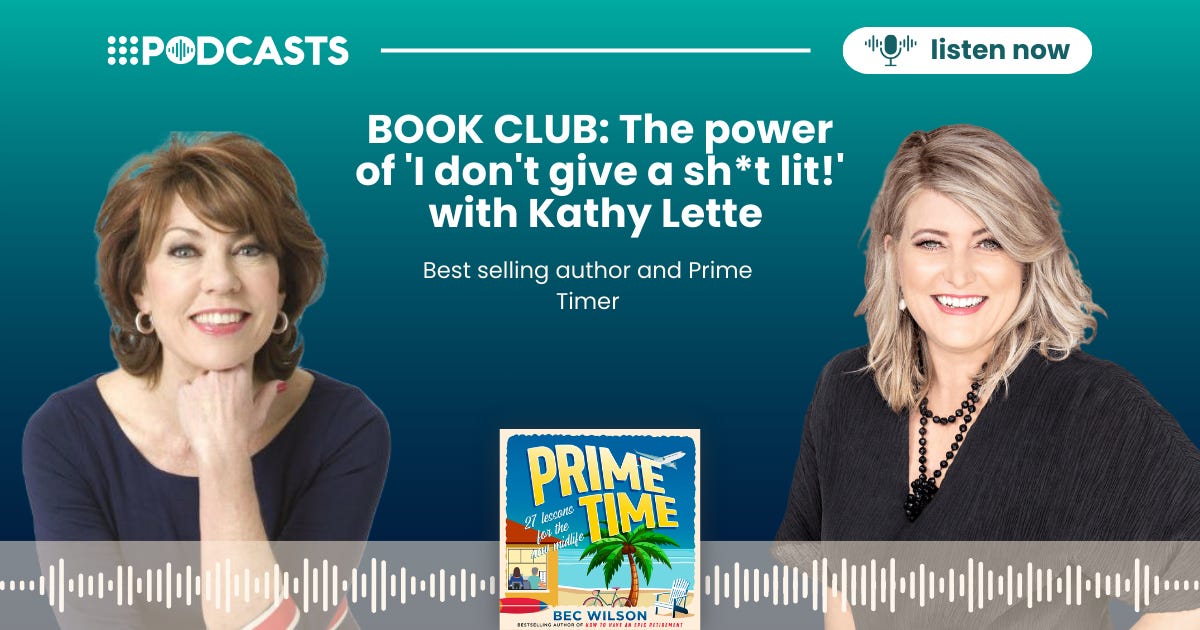
It’s month two of the Prime Time Book Club, and this one is an absolute hoot.
This month we’re diving into The Sisterhood Rules by the one and only Kathy Lette - and yes, she’s back on the show with us for a proper book club sit-down… and the kind of girl talk we don’t have nearly enough of.
If you’ve ever read chick lit, chances are Kathy has been part of your life. From Puberty Blues to now, she’s been soundtracking the different stages of womanhood, and this latest book is firmly for us in midlife.
I’ve just finished it and I loved it. It’s sharp, funny, rebellious… and underneath all of that, it’s about something much deeper: what happens when women of a certain age stop playing by the rules and start leaning into the power of the sisterhood.
In this episode, we talk about everything from falling out with the women closest to you, to ageing, sex, reinvention… and why midlife might just be the moment you stop caring what anyone else thinks and start having a lot more fun.
You can find a copy of ‘The Sisterhood Rules’ at all good book retailers & online here.
LISTEN TO THIS EPISODE OF THE PODCAST HERE: