

The retirement question most people ask backwards
And, in this weekend's newspapers, 'Thinking about retiring early? These six reasons could change your mind'.

In this edition
Feature: The retirement question most people ask backwards
From Bec’s Desk: Back down under
The Age and Sydney Morning Herald: Thinking about retiring early? These six reasons could change your mind
Prime Time: What you need to know about the Division 296 Super Tax
Ad - Before we start — a big thanks to our newsletter sponsor this week, Viking

Win a 13-day ‘In Search of Northern Lights’ ocean voyage worth AU$20,000*
Viking is giving one lucky couple the opportunity to win an unforgettable Northern Lights voyage. Departing in March 2027, you’ll embark on a wintertime journey to the Arctic Circle, where nature’s most elusive spectacle awaits.
Glide across the Norwegian tundra on a thrilling dogsled ride or strap on snowshoes to explore the pristine wilderness. Marvel at UNESCO-listed rock carvings and chase the northern lights as they dance across the night sky. Exploring from Tromso to London with meals, tours and drinks included, this is a prize like no other.

The retirement question most people ask backwards
Here’s one question I hear all the time, all over the world, and it makes me slightly shudder. Because when people ask it, they’re usually looking for the wrong kind of answer.
“How much is enough to retire?”
Most people don’t realise that the answer they’re hoping for isn’t actually very helpful.
If I tell you that a single person needs around $595,000 in super, or a couple needs around $690,000, to have a ‘comfortable’ retirement, you still haven’t got much to work with. Because those numbers don’t tell you how your life will actually be funded, year by year.
The number you really need to work your way towards isn’t a super balance at all.
It’s this: what does your retirement income look like in layers, and which of those layers do you need to fund from your own savings, versus how much will come from other sources.
Once you look at it this way, retirement planning becomes far more practical.
You stop asking, “How big does my super need to be? Blindly hoping you’ll like the answer”, and instead you ask, “How much income do I need each year, and where is it going to be coming from?”
Most Australians will have a mix of income sources in retirement. The mistake is looking at each one in isolation, rather than seeing how they stack together.
For many people, some of that income will come from the Age Pension, either full or part. That’s income you don’t need to fund from your own savings. It reduces the amount your super has to provide each year.
Some income may come from work, at least for a period of time. Not full-time and not forever, but income that contributes to the total and again reduces the draw on your savings, allowing it to continue to compound more rapidly in your part-time years.
Some people will also have income coming from investments or assets held outside super. That might be regular income, or it might be money you draw on in certain years.
Only after you’ve accounted for those layers do you get to the final piece of the puzzle.
How much income still needs to come from your super.
That’s the number that matters.
Super isn’t there to fund your entire retirement income on its own. It’s there to fill the gap between what you want to spend each year and what’s coming in from other sources.
When you understand this, a lot of the anxiety falls away.
You’re no longer trying to hit a single magic balance.
You’re building an income picture, layer by layer that looks a bit like a lasagne.
And you can see clearly what each part of the system needs to do.
That’s why the question “How much is enough to retire?” is the wrong place to start.
The better place to start is much simpler.
What income do I want each year as a total amount to cover my living costs and lifestyle goals?
What income will I get from each source each year?
And what does my super need to cover?
Get that right, and retirement planning becomes a lot more grounded in reality, rather than hope.
I cover a lot more on this in both my books - How to Have an Epic Retirement and if you’re not ready for retirement, Prime Time: 27 Lessons for the New Midlife.

They say the official start of the year for most Aussies is actually the day after the Australia Day long weekend. And by the time you’re reading this, I’ll have just landed back home from two weeks working in London, ready to get stuck in.
It was a fascinating trip.
In some ways, I think the UK is a little ahead of Australia in the retirement space. Our funds and legislation are still lagging when it comes to properly supporting people once they stop working. But in other ways, I actually like where Australia is heading.
Our system is slowly moving towards giving people more choice in retirement, and encouraging them to understand those choices, rather than funnelling everyone into a narrow set of standardised income products.
The UK, by contrast, seems to be heading down a more automated and authoritative path. Funds are being pushed to actively guide people into retirement, and by retirement I mean specific products designed to deliver an income. There’s a lot of structure, and a lot of direction and a massively reduced need for complex advice once it happens.
There’s good and bad in both approaches, and I learnt a lot from seeing the UK system up close.
But for me, it’s now full steam ahead on Aussie projects.
First up, the podcast. The numbers came in this week for Prime Time in December, and it hit #127 on the Australian Made Podcasts chart. That’s our highest ranking ever, and we’re sitting alongside some seriously impressive shows – comedians, true crime, sport and hard news. I’m really glad you’re enjoying it.
I’m back in the studio this week and can’t wait. If there are topics you’d like covered or questions you want tackled, just hit reply and email me.
Then there’s the flagship course.
We’ve officially sold through the first 200 places in the next How to Have an Epic Retirement Flagship Course. I’ve opened up a small number of additional spots for any stragglers who want to move quickly, but don’t hang around. Now that I’m back, we’re getting ready to send out the welcome packs very soon. More on this below – scroll down.
And finally, our HESTA course. The HESTA Exclusive Edition of the How to Have an Epic Retirement Flagship Course is now open for bookings via HESTA. You’ll need to be a HESTA member to be eligible, and places are limited. It kicks off on 19 February, and you can find more details via this link.
Right now though, I’ve got a plane to board and 24 hours of movies, snacks and the inside of my eyelids ahead. Sometimes it’s nice to do absolutely nothing.
See you back down under very soon.
Cheers
Bec xx

Author, podcast host, columnist, retirement educator, and guest speaker

Thinking about retiring early? These six reasons could change your mind
Someone wrote to me last week asking if they should retire at 52. “I have savings to bridge me through to 60 and enough super to fund my life after that,” he wrote.
My first reaction is to ignore the numbers. Instead, I want to ask what this person actually means by retire. Retirement means different things to different people. For some, it’s stopping work entirely.
For others, it’s leaving their first career behind, and starting to work with more flexibility, or for the pleasure and meaning of it. Once you’re clear on what you mean by retirement, the next step is to think seriously about the consequences and risks.
On the surface, this reader, Mark, sounds well-prepared. He has savings to bridge the gap to 60 and a healthy super balance. From a purely mechanical perspective, retiring at 52 may be possible, and it can sound rather sexy.
This article was published in The Age and The Sydney Morning Herald on Sunday 24th January 2026. Read the whole article here. Note - it has a sign-up gate but no paywall.

Begins soon: The Epic Retirement Flagship Course Feb 2026. Earlybird sale ends soon.
The How to Have an Epic Retirement Flagship Course is now less than a month ‘til kickoff. The six week online course is done week-by-week and includes
8.5 hours of comprehensive retirement education, delivered by Bec Wilson
6 Live Q&A events, held on zoom in an interactive manner, allowing you and your classmates to ask questions as you learn, each week. (Yes, they’re all recorded)
A 150 page printed workbook
A signed copy of the new edition of How to Have an Epic Retirement, the book
Online quizzes and challenges to help you grasp the lessonsAnd more…
Hundreds of people have already booked for the next program, and we’ve added extra spots at the earlybird price of $374. (But we’ll be closing the deal off soon so we can send the welcome packs).
You can download a brochure packed with detail here.

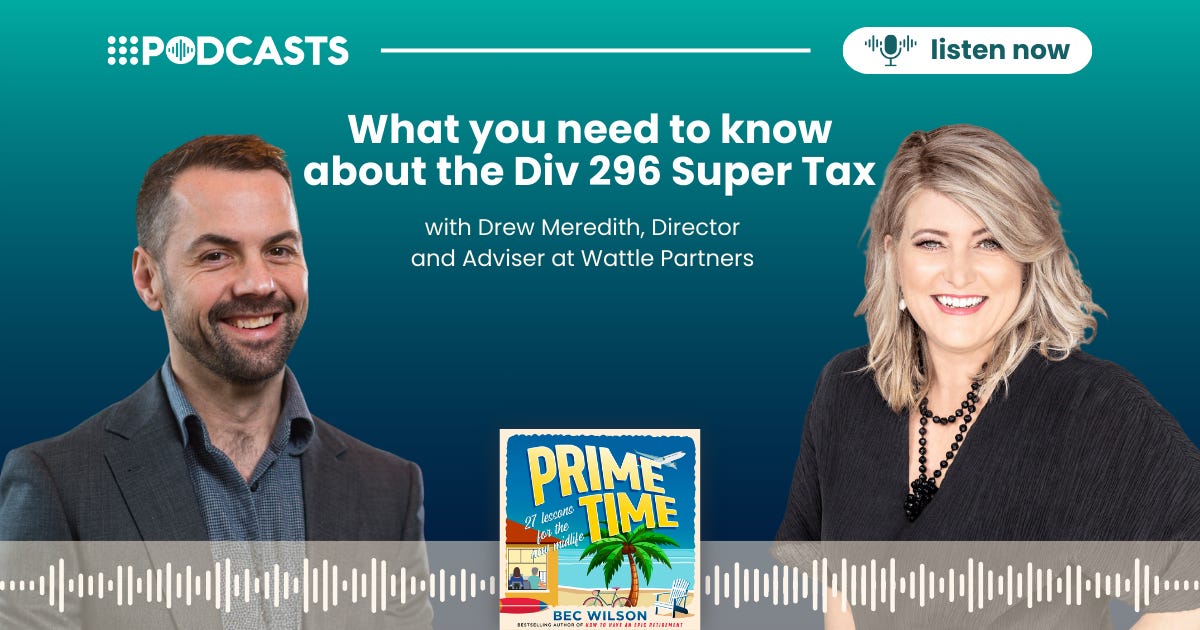
What you need to know about the Division 296 Super Tax
This week on Prime Time, I’m joined by Drew Meredith, Director and financial adviser at Wattle Partners, and one of the clearest wealth thinkers in the country, to unpack the revised Division 296 super tax and what it means in real life.
There’s been a lot of confusion (and noise) since the changes were announced, but the dust is starting to settle and it’s time to understand what this new tax actually means, who it impacts, and how to think about your super if you’re edging close to those thresholds.
Drew and I break down how the new tax works, the differences between balances over $3 million and $10 million, the role of indexation, and what kinds of planning conversations are already starting, especially for people in SMSFs.
If you’ve seen this topic floating around and haven’t quite wrapped your head around it yet, this is a great place to start.
LISTEN TO THIS EPISODE OF THE PODCAST HERE:
You don’t begin with a super balance. You begin with an income target and work backwards. What do I want to spend each year? What will come from pension, part-time work, investments? What does super actually need to cover? That clarity removes a huge amount of anxiety.
But there’s another layer most Australians don’t consider.
Your required income number is not fixed. It’s location dependent.
If you decide you need $100k per year to retire comfortably in Sydney or Auckland, that’s one equation. Housing, rates, insurance, food, utilities, everything is structurally expensive. That income target demands a very large capital base.
Now run the same exercise assuming you live in parts of Southeast Asia, Southern Europe or Latin America. You may find that $60k to $70k per year delivers a high quality lifestyle. Lower rent or no mortgage. Lower healthcare costs. Lower day-to-day living expenses. Suddenly the capital required drops dramatically.
That’s geo-arbitrage.
Lower your cost base and you reduce the size of the portfolio required to sustain you. Reduce the portfolio required and you reduce sequencing risk. Reduce sequencing risk and you increase flexibility.
Instead of grinding until 60 to fund a six-figure lifestyle in a high-cost city, you might hit financial independence in your 40s on a lower number, with a better quality of life.
Planning your retirement income layers is essential. But so is questioning the geography those numbers are built on. Change the location and you can change the timeline.
This shift is everything. When you stop chasing a single number and start mapping your income layers, retirement planning becomes less overwhelming — and a lot more real.