

The thing the financial advice industry doesn’t talk about
And, in the Nine Newspapers this weekend " AI could revolutionise your retirement. But don’t fall for this trap"

In this edition: It’s a juicy one
Feature: The thing the financial advice industry doesn’t talk about
From Bec’s Desk: Make sure you read about my bucket list trips - I need your input
The Age and Sydney Morning Herald: AI could revolutionise your retirement. But don’t fall for this trap
Prime Time: The crucial health step most of us are missing out on
Ad - Before we start — a big thanks to our newsletter sponsor this week, Lowe Living

Your Invitation
Join Lowe Living to explore the opportunities that come from rightsizing with intention. Whether you’re considering a move soon or simply exploring what’s possible, this event will provide valuable insights into creating a lifestyle that better reflects how you want to live.
Hear from:
Keynote speaker: Bec Wilson
Panel discussion: Bec Wilson, Urbis Associate Director, Harry Scott, and Lowe Living Co-Founder and Managing Director Tim Lowe.
Discover how rightsizing can create greater freedom and give you the confidence to shape your future.
DATE: Tuesday, 14 July
SESSION TIMES: 1.30pm – 3.30pm or 5.00pm – 7.00pm
LOCATION: 466 Hampton Street, Hampton, Melbourne


The thing the financial advice industry doesn’t talk about
I talk to people in the superannuation and financial advice industry almost daily. And there’s a widespread understanding amongst them about how people get advice and invest for retirement. What there isn’t, is much appetite to talk about how that’s changing - because I’m not sure everyone wants you to understand it.
But it is changing. Largely without the people it affects most, everyday superannuation holders, knowing much about it. But I think it’s time we talked about it all a lot more openly, and without bias.
Here’s what most people think happens when they go to see a financial adviser. They think they’ll pay a one-off fee and someone will look over their whole financial situation, consider how their super is currently invested, and explore whether their existing fund is working well for them. That the adviser will know all about the different super funds on offer, which ones perform best and which ones have good services, and and give them an honest view of whether they're in the right one, move them to another if the one they are in isn’t good. They’ll look at all their other investments, review the mix and suggest any rebalancing required, then contemplate how to set up the strategy most efficiently for their needs, and help them make the changes.
Increasingly, though, that’s not always where the conversation ends. Sure, there’s a full review of what you hold, and a strategy, absolutely. Most don’t go real deep on superannuation funds though, unless your fund referred you in.
They’re not required to. They’re legally required to:
Collect detailed information about your financial situation — assets, liabilities, income, expenses, insurance, super, other investments
Understand your goals and objectives
Assess your risk tolerance
Consider your relevant circumstances before making any recommendation
Provide a Statement of Advice documenting all of this
What they’re NOT required to do is benchmark your existing super fund against alternatives, or tell you your current fund is performing well and you should stay. They have to consider your situation, but the scope of the advice is usually agreed at the beginning of the engagement.
In fact, one senior executive from a large super fund told me this week that, in his view, eight or nine in ten people who go to see a financial adviser of their own accord end up with their super rolled out of their existing fund and onto an investment platform. I can’t independently verify that figure, but after years of talking to people across the industry, it’s certainly consistent with the direction the market appears to be heading. For many it could provide a decent, if not always meaningfully different, financial outcome. But the question worth asking is whether it’s always driven purely by what’s best for the client, or whether the overriding business model plays a bigger role than most people realise - and whether people truly understand that a platform isn't just an investment recommendation. It's a different structure entirely, replacing their super fund with something that looks similar but works very differently and creates an ongoing advice relationship with their adviser.
To be fair, there are good reasons many advisers recommend this approach. Platforms can make it easier for the adviser to manage retirement income, rebalance investments over time, access a broader range of investments and review your strategy as your circumstances change. For people with more complex financial affairs, tax planning opportunities, or who genuinely want ongoing investment management, they can be an excellent solution.
The important thing is understanding that’s the service you’re choosing. You’re not simply receiving retirement advice. You’re choosing an ongoing investment management relationship, and that’s a different proposition altogether.
And it's not hard to see why this model has become so common.
When an adviser moves your super onto a platform and manages it on an ongoing basis, they generate a recurring revenue stream for themselves, some advisers have shareholder-level financial links to the asset management businesses that invest for them too (it’s not wrong - they just have to disclose them if they do). Typically the ongoing advice fee is around one per cent of your balance per year, often more when you layer in the platform fees and asset management costs, on top. Think of it like a subscription - except most people don’t realise they are signing up for it forever as a permanent replacement for their super fund. That’s how most advice businesses are built today. And it means the adviser who keeps you in your existing super fund and sends you home with a solid one-off strategy is, financially speaking, probably worse off than the one who moves you onto an investment management platform and guides you through the years ahead.
That doesn't mean it's the wrong recommendation. But it does raise an important question.
Now, platforms aren’t bad or the wrong answer for everyone. For people with genuine complexity, interest in picking or more deeply understanding their investment mix, or who can benefit from the tax opportunities - including retaining franking credits for their own use - a platform can be worth every dollar.
But for a lot of people approaching retirement, already inside a large, low-fee super fund that’s performing well, the honest answer might be: you don’t need to move. You might just need to understand the competitive landscape and alternatives on offer more directly. That means assessing what you’re invested in, put in place an income stream, set up a bucket strategy and review your situation each year. You could get one off retirement advice from your superfund to do this, if you wanted, for a smaller fee. Most funds offer that. Most advisers, unless working with the fund more strategically, probably won’t recommend it.
The tradeoff really is this: you’re walking away from a company with hundreds of people on their investment team, to be managed by a small operator who is often using external model portfolios to tailor an investment mix for you.
My biggest concern is that someone who wants real retirement advice - without a move to a platform - is increasingly hamstrung. If you walk into an adviser’s office wanting to stay in your existing fund or choose a better one for retirement, you’d probably need to specifically say so and underline it upfront and ask if they will provide you a service anyway. Because the default, the path of least resistance, and the most financially rewarding path for the adviser is the platform.
So I just want you to know this, and walk into an advisers office with your eyes wide open, knowing your options, how to evaluate them, and how to advocate for yourself clearly. Ask them:
What will happen to my super - and what will it cost, in total, compared to what I’m paying now?
What would a plan look like if I stayed in my existing fund?
Do I actually need ongoing investment management, or do I need a strategy?
How do you select, review and govern my investment mix if I move to a platform?
And will you be better off if I move - and more importantly, will I? Show me…
Good advisers will answer all five without flinching. And there are genuinely good advisers out there - lots of them, and good platforms too. But walking in knowing that ongoing platform management is now the dominant service on offer from advice makes all the difference. Advice is a service business - and increasingly it’s tied to investment management as a service. Know what you're buying - and know that a simple one-off strategy may not even be what's on the menu.
Want to read more, I have two books - How to Have an Epic Retirement and if you’re not ready for retirement, Prime Time: 27 Lessons for the New Midlife.

Courses update!
This week we hit the end of the Winter Aussie Epic Retirement Course. Nearly 400 more graduates are now much more confident, and know their stuff. And they’ve left us some amazing reviews. In the week ahead we’ll launch our Spring Program 25% off deal. We’re just putting the finishing touches on the new platform - yes we’ve completely re-platformed the course, improving the experience again. (It was already great - we just want to make it even better and more scalable). The course kicks off on the 23rd August. Register your interest for the earlybird deal here.
We’re also launching a new Epic Retirement program for HESTA members in the next week or so. So if you’re a HESTA member - keep your eyes peeled on their member emails to you. It’s a great course.
—
Melbourne rightsizing event
I’ll be heading to Melbourne in two weeks for a really cool event on luxury rightsizing into glam apartments with Lowe Living. If it interests you - register your place. Should be super-interesting as I’m speaking alongside property economics experts from Urbis.
—
Bucket list holidays - read this!
OK, I have an exciting project in the wings that we HAVE to talk about! What if we developed a few community bucket list holidays a year - guided by me, Fiona Dalton our Epic travel guru, and maybe one or two other really travel (and life) experienced Prime Timers - to the true dream locations we all want to go - that are active and experience oriented?
I mean real handpicked bucket list stuff. Active and experience-first. And never the same destination twice. If you’re keen, Fiona and I think we can work with the best operators for each place - and set up amazing experiences suited to active 50 and 60-somethings. Interested? On my bucket list for this is:
Patagonia to see the end of the earth, big skies, Torres del Paine, and do the kind of hiking that makes you feel like you’re really alive.
Iceland / Viking Territory to see the midnight sun, and the volcanic landscapes, Norse history, and silence you can’t find anywhere else. Could even extend into the Norwegian fjords.
An active European River journey (not a quiet one) cycling between villages, eating well, sleeping on the water. Somewhere in France, Germany, Austria, or Portugal. Slow, foodie, wine-loving and never boring.
Vietnam riding motorbikes, eating in the markets, mountains, river towns, the best food in the world, and enough history to fill a book. Who knows where we’d go - we have to decide. Its all magnificent.
An African Safari - one that stops you in your tracks with camera in hand. The real thing, not the resort version, with Mike Chesworth and photography part of the journey maybe - learning about it, doing it with a passionate Prime Timer.
Walking Umbria through hill towns, olive groves, truffles, with Renaissance art around every corner. Slow, beautiful, restorative.
Seeing the stately homes of Ireland enjoying history, landscape, characters and craic. The Ireland most tourists never find.
A Christmas Markets River Cruise think Glühwein, cathedrals, snow, and the Danube at its most magical. Active on shore, magical on the water.
I’m not sure what we’ll do first.
But, I’m taking expressions of interest. Put your name on this list to tell me you might be curious. We’d be travelling in a group, maybe up to 20 or 40 spots on the bucket list trips - and they’d be all organised for us by true professionals! There will of course be some solo rooms available - we’ll make sure of it. Express your interest here - no obligation.
And that’s got me excited. It’s a passion project - not about making money or building a travel business (I’ve done that before - it’s hard work). It’s just about us all having some bloody good fun in our midlife, together, proactively, with like-minded people and living the dream.
Until next week - make it epic! Cheers Bec xx

Author, podcast host, columnist, retirement educator, and guest speaker

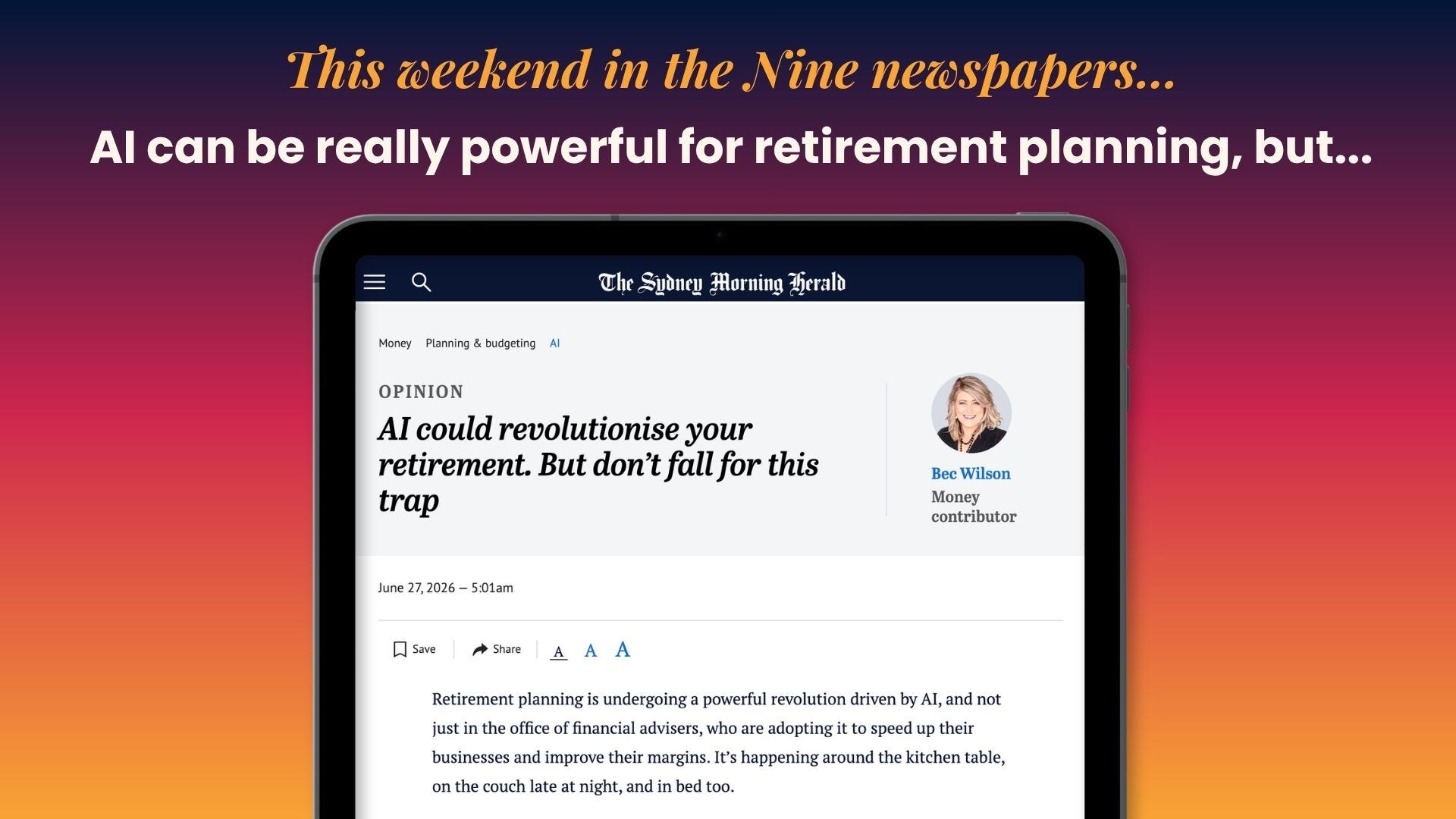
AI could revolutionise your retirement. But don’t fall for this trap
Retirement planning is undergoing a powerful revolution driven by AI, and not just in the office of financial advisers, who are adopting it to speed up their businesses and improve their margins. It’s happening around the kitchen table, on the couch late at night, and in bed too.
More than 65 per cent of retirees in my community admitted this week to using it to ask questions, and 38 per cent admit they’ve used it to ask questions and run calculations.
Those two numbers tell us all something important: that people are hungry for accessible, affordable and helpful answers, and they’re going to find ways to get them with or without the industry’s blessing.
The financial services industry has not entirely welcomed this shift. If you’ve spent any time in adviser circles, you’ll sense why: for the first time, the knowledge gap that made professional advice feel essential for people with relatively straightforward situations is starting to close.
AI is, in my opinion, the best thing to happen to retirement planning in 20 years. It’s the only tool I’ve ever seen that has managed to engage everyday people to explore their money keenly, in an easy-to-use, curious manner.
So I’m going to say what many won’t – and that is every Australian heading toward retirement should have AI open on their phone right now, asking it the questions that the system has made it too expensive, too scary and too difficult to answer.
This article continues… It is published in The Age and Sydney Morning Herald on Saturday 27th June 2026. Read the whole article here, without a paywall.

The crucial health step most of us are missing out on
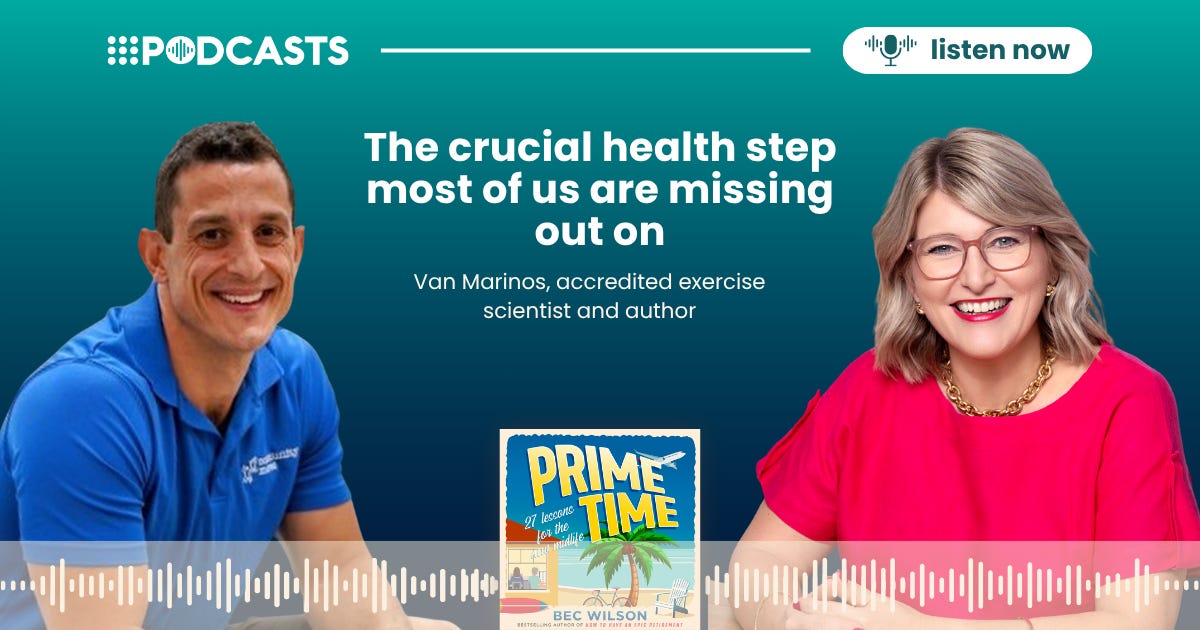
One of the things I talk about a lot is that we’re all planning for longer lives.
We’re working longer, retiring later and, for many of us, spending 30 or 40 years in the semi-retirement and retirement phase of our second half of life. But while we spend a lot of time thinking about the financial side of that equation, we don’t always spend enough time thinking about the physical and social side.
How strong do we want to be? How mobile do we want to be? And who are we going to spend all those extra years with?
In this week’s episode of Prime Time, I sit down with Van Marinos. He is an Accredited Exercise Scientist, a physical educator, and the founder of Community Moves - an organisation dedicated to functional fitness for older adults. He’s also the author of Strong & Social, a new book built around a simple idea: staying fit in our prime years isn’t just about the physical heavy lifting. It’s also about the community we build along the way that makes it enjoyable.
We discuss why it’s never too late to start exercising, the role strength training plays in healthy ageing, and why finding your tribe may be just as important as finding the right workout.
LISTEN TO THIS EPISODE OF THE PODCAST HERE:
Such an important article Bec, and clearly explained. Being advised to move to a platform was exactly what happened to me earlier this year. I had a smallish super balance and very straightforward needs. Given this was the biggest financial decision of my life, I took a step back when my instincts told me this wasn't the best option for me, so I paid for advice from an existing fund. Such an expensive exercise but so important. Ended up staying with a fund and allocated pension, simple and not reliant on one person.
It's so important that people vet their financial advisors, and also understand what good financial advice actually looks like. Otherwise you may not be receiving objective recommendations.