

The two things that will shape your retirement more than money
And in the newspapers this week: The silent deadline that could make or break your retirement

In this edition
Feature: The two things that will shape your retirement more than money
From Bec’s Desk: Very interesting weeks
The Age and Sydney Morning Herald: The silent deadline that could make or break your retirement
Prime Time: The hidden ways you’re being nudged to spend with Chris Kohler

The two things that will shape your retirement more than money
There’s a question I get asked a lot, in various forms….
“Am I on track financially?”
It’s fair, and it matters a lot to retirement planning. But after years of working with people navigating this transition, I’ve come to believe there are two things that matter just as much as your super balance and almost nobody talks about them.
Curiosity and courage.
And, not in a motivational-poster way. In a very practical, neurological, life-outcome kind of way.
What happens to curiosity in midlife
For most of us, the years between 45 and 65 are full of work, family, ageing parents, financial pressure. And somewhere in the middle of all that busyness, curiosity quietly goes into hibernation. We stop asking “what if?” and default to the routines of life, not because we’re lazy, but because routine is efficient when life is demanding.
The problem is that retirement is precisely when curiosity becomes most important. Because retirement, at its core, isn’t a financial event, it’s an identity event. And navigating it well requires genuine openness to who you might become next. If you arrive at that transition without having exercised your curiosity, the blank page can feel terrifying and well… blank… rather than exciting.
But the science says we can get past this. And here’s how. When you become genuinely curious about something, your brain releases dopamine, a real reward hit that motivates you to keep exploring, which is why curiosity tends to build its own momentum. But it goes deeper than that. Curiosity also engages the hippocampus, the part of your brain responsible for memory and learning, which means you don’t just feel more motivated when you’re curious, you actually retain and apply what you learn better.
This matters enormously for anyone approaching retirement, because this is a period of significant learning: new financial decisions, new routines, a new relationship with time and your identity. The more curious you stay, the better equipped your brain is to process all of it. And because of neuroplasticity – or the brain’s ability to rewire itself – staying curious is also one of the best things you can do for your long-term cognitive health.
And then there’s courage
Curiosity is what opens the door. Courage is what gets you through it. Truly!
Most people misunderstand what courage actually is. It’s not the absence of fear, it’s acting in spite of it. Every time you consider doing something outside your comfort zone, the brain’s amygdala fires up a threat signal. That’s just your nervous system doing its job - like it did in caveman days when you were under threat. Courage happens when your prefrontal cortex takes the wheel anyway, weighs the actual risk, and moves forward.
Here’s the part I find genuinely encouraging: every time you act with courage – even in a small way – you’re rewiring your brain to be less reactive to that fear signal next time. You practise it, and it really does become easier.
Why does this matter? I hear you asking. The years just before retirement bring a cascade of genuinely difficult decisions: when to stop working, whether to downsize, how to align your timeline with your partner’s, what you actually want this chapter to look like. These aren’t purely financial questions. Stop and look at them! They’re all questions about identity, risk, and change. The people I see navigate them well tend to be curious about what’s possible and have enough courage to sit with uncertainty while they figure it out.
Here’s how to get started
If you’re feeling less curious and less courageous than you’d like to be, you don’t need a dramatic overhaul.
For curiosity, start with some small questions rather than grand intentions. Follow something that mildly interests you and see where it leads. Talk to people who think differently to you. Read outside your usual lane.
For courage, start with small risks and practise visualising the upside rather than fixating on what could go wrong. And be kind to yourself when it’s hard because courage means trying, not being perfect.
Retirement planning done well isn’t just about the money. It really is about having the curiosity to imagine what’s possible, and the courage to pursue it. And you’re never too old for that!
Where has your curiosity been hiding lately? Hit reply and let me know.
The Epic Retirement course and/or book walks you through exactly this process building your own retirement picture step by step, so you can move from worry to excitement about your retirement.
Get your copy of my books here: How to Have an Epic Retirement and if you’re not ready for retirement, Prime Time: 27 Lessons for the New Midlife.
Or explore the course here: Epicretirement.net/upcoming-courses

I’ve been to the other ends of the country this week - Adelaide and Perth. Both quickly, on the North platform Adviser roadshow. A fascinating room full of Advisers in each location, learning how to improve and expand their advice offerings for people over 50 (or 47.5 as I teach). I love playing my role in talking about what people approaching retirement want, need and can be doing better with the Advice industry - many of whom are focussed on retirement.
Alongside this, we’re in course preparation mode. The Epic Retirement Course is on its last weekend of promotion before Earlybird pricing (25% off) closes. It’s the biggest course ever with hundreds and hundreds of people registered. So if you’ve been on the sidelines thinking ‘I’m not sure’ - don’t delay. The price jumps from $374 to $499 next week - and I want you all to enjoy the discount.
What do you get?
6 weeks of structured, well-organised education designed to walk you through the big lessons everyone needs to navigate as they approach and make decisions about retirement. (100 lessons, structured into 15 modules)
A 170 page print and digital workbook, mailed to you
A signed copy of the new edition of How to Have an Epic Retirement
6 Live Q&A Events, held on Monday evenings each week with some of Australia’s most respected retirement experts
Challenges and quizzes to bring the program to life.
It’s a great way to really learn about all the choices you have, and to shape your plans for the future, without pressure. So - want to learn more, here’s the website. Head to www.epicretirement.net/upcoming-courses to learn more, download a brochure and book your place.
Now, the week ahead is an interesting one. I'm heading to Cairns to speak at the Financial Counselling Australia National Conference — presenting on how people who don't have a lot of money can still build an Epic Retirement. It's had me thinking deeply about what that actually looks like in practice: understanding what government support is available, yes, but more importantly, shifting the focus from money to constructing a life that genuinely brings joy. And it turns out curiosity — the very thing we've been talking about today — becomes even more important when resources are limited. Maybe that's next week's topic. Watch this space.
Anyway - have a lovely Sunday, and for Queenslanders enjoy your long weekend! I know I will.
Cheers - Bec Xx

Author, podcast host, columnist, retirement educator, and guest speaker

The silent deadline that could make or break your retirement
I turned 50 at the start of this year, and it’s been the trigger I needed to get serious about my own retirement plan.
As the author of two bestselling books on retirement, I know exactly what to do. But there’s something very different about actually sitting down and doing it yourself, with your partner beside you, setting real goals for your super and other assets, working out how much you can both contribute and how quickly, and running the numbers on what compound investing actually does over a 10- to 15-year runway.
Goals not just to grow your money, but to one day use it. It’s made something that I teach every day feel genuinely more exciting. Because what we’re working towards isn’t just a goal number.

It’s a number that we understand, and that allows us to have choice: the choice to work after 60 because we want to, not because we have to, if life pans out according to plan.
As I’ve stepped through it, something has become obvious to me. The choices available to us right now, in our early to mid-fifties, are remarkable. But a lot of them won’t be there at 65. Some will be weaker. Some will be entirely gone. And that’s the main reason to take your super and savings seriously now, rather than later.
Let’s look at how we can make a big difference:
This article continues. It was published in The Age and The Sydney Morning Herald on Saturday 2nd May 2026. Read the whole article here. Note - it has a sign-up gate but no paywall.

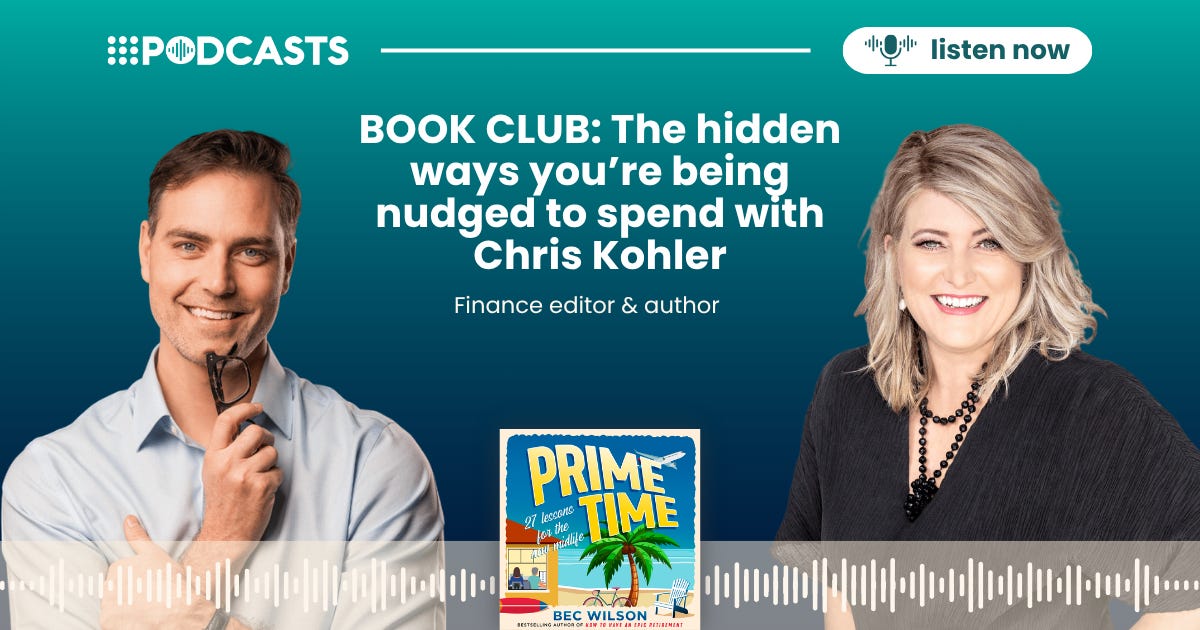
It’s time for this month’s Prime Time Book Club episode, and this one might just change the way you look at your everyday spending.
Our April Book of the Month was How They Get You by Chris Kohler - a brilliant, slightly unsettling look at all the ways modern life quietly nudges us to spend more money. From subscriptions to loyalty programs, food delivery and even the way we pay.
These are all things we use every day… but rarely stop to question.
And what’s fascinating is, many of these systems didn’t always work the way they do now. They’ve evolved quickly, and often in ways that benefit businesses far more than consumers.
I’m joined by Chris himself to discuss how it all works; how companies get into our habits, our decisions, and ultimately… our wallets - and what you can do about it.
It’s one of those episodes where you’ll find yourself thinking, “I do that… I never realised why.”
You can find a copy of ‘How They Get You’ at all good book retailers & online here.
LISTEN TO THIS EPISODE OF THE PODCAST HERE:
All I knew when I retired at 60 was that I wanted something radically different for the next chapter of my life. I could not stand the thought of sitting comfortably in the same suburb for the next 20-30 years.
Moved 5 hours away, to a small town, into an old house with a big garden close to the sea. My days are filled with new routines, new places and people and its been invigorating.
Perhaps it was courage or just a desperate need to escape the geography of the last 44 years of work.
Totally agree! Unfortunately many retirees hide away from being curious and courageous. Those that retain these two human traits often times experience a life of adventure and satisfaction.
From a personal point of view, these two traits have served me well in my retirement.