

What actually makes sense now
And in the newspapers this week: Seven money tricks that just became a whole lot better

In this edition
Feature: The case for getting more money into super - now
From Bec’s Desk: My position is simply to get proactive on the right stuff
The Age and Sydney Morning Herald: Seven money tricks that just became a whole lot better
Prime Time: Has this Federal Budget just fundamentally changed the way middle Australians build wealth?


What actually makes sense now
Four and a half days on from the budget and I’m done reacting to it. The proposed changes are real, the direction is clear, and there’s plenty of time for the politics to play out before anything actually becomes law. So let’s talk about what to actually do and shut up on the whining about what sucks.
If the budget has done anything useful, it’s simplified the question of what to do now if you’re planning for retirement. The system is increasingly rewarding two things and two things ONLY: Super and the family home. So the smartest thing most people can do right now is get more money into one or both of those as deliberately as possible. Here’s how:
Get more money into super
This is especially important if you can see the time when you’ll be able to access these funds coming up (60-65).
The concessional cap is $30,000 a year. Most people aren’t hitting it. If you’re salary sacrificing nothing beyond your employer’s super guarantee, you’re leaving a significant tax advantage on the table.
But the bigger opportunity is the carry-forward rule. If your super balance is under $500,000, you can use unused concessional caps from the last five years – potentially contributing well above $30,000 in a single year. Log into MyGov, go to the ATO section, and check your available carry-forward amount. For many people in their 50s it’s substantial.
Non-concessional contributions (after-tax money) are also worth considering if you have savings sitting outside super earning returns that will soon be taxed more heavily. You can contribute up to $120,000 per year, or $360,000 in one hit using the three-year bring-forward rule.
The goal is simple: get as much as you reasonably can into a zero-tax retirement environment before you need to draw on it. And that’s what super is AFTER retirement - a zero tax environment for funds up to the transfer balance cap which will hit $2.1M in July.
Pay down the home – or upsize or both
I can’t believe I’m now suggesting to people with excess funds to consider upsizing rather than downsizing, but that’s a sign of the times. After the budget, the family home remains the most tax-effective asset you can own. No capital gains tax when you sell, exempt from the age pension assets test, and now looking even more central to retirement planning than before.
If your mortgage isn’t paid off, paying it down faster is one of the most straightforward things you can do. Every dollar of equity in a paid-off home is a dollar sitting in a CGT-free, pension-exempt asset – growing at whatever rate property grows at in Australia from here, and that’s a genuine question mark.
But here’s the less obvious move. If you’re in your 50s and have free cash sitting outside super and want to secure some long term growth, you might find yourself thinking about upsizing to a better home, a different location, something that genuinely suits the next stage of life. Doing it now locks more of your wealth into a CGT-free asset before the rules tighten further. It feels counterintuitive. But the numbers may support it, depending on what happens to property prices from here and whether you believe they’ll continue to grow; and of course whether you need or want access to those funds.
The thread connecting all of this
None of these strategies are new. Super contributions, paying down the home, thinking carefully about your asset mix – this has always been good retirement planning. What the budget has done is make the case for doing them more deliberately, and sooner, harder to ignore. And it’s rendered all the other types of investment outside super more expensive today than they were last week.
The window for most people reading this is the next five to ten years. That’s enough time to move the dial significantly… if you start now rather than waiting for the politics to settle.
Get your copy of my books here: How to Have an Epic Retirement and if you’re not ready for retirement, Prime Time: 27 Lessons for the New Midlife.
Or explore the course here: Epicretirement.net/upcoming-courses

I won’t beat around the bush. I’m unimpressed with the budget. I love Australia’s have-a-go spirit – the slightly uneven playing field that people can learn the rules to play on. The government has decided that’s unfair, and they’ve moved to level it. I get it. But these changes make getting ahead harder for anyone who planned to self-fund and isn’t already in the right asset structures. Some serious strategies have been rendered a lot less profitable, and once you factor in higher tax and fees, some investments outside super start to look a lot less attractive than they did. Which means some people have a real rethink ahead of them.
For the average person – simple super, family home, not much else – it doesn’t change a great deal. It probably just shuts up the mate at the pub who’s been bragging about his multiple investment properties. Because unless those are inside super, that strategy is looking a lot less clever than it did a week ago even with grandfathering.
But I’ve always tried to stay out of politics and get on with the job of understanding how the system works and making the most of what’s in front of us. So that’s where my head is this weekend. I hope you’re with me.
Now onto more fun things:
The first week of our Winter How to Have an Epic Retirement Flagship Course is underway. I love the first week of a new course. There’s energy, comments, buzz and excitement. Hundreds and hundreds of people are in there starting out. They’re sharing stories and curiosity. It’s our biggest course ever. We sold OUT of workbooks it surprised us so much.
We’ve just launched our UK pilot for sale too.
And this week I did a live event online for Aware Super Members, preparing them for the End of Financial Year: For Couples. I love these events. Hundreds of curious members came along, stayed for every single minute of the event and hung around for the huge Q&A at the end too. Thanks for coming - if you were there!
And that’s it. It’s been a long week of money talking. So I’m having a quite Sunday in the garden, ignoring social media. I hope you are too.
Make it epic!
Cheers - Bec Xx

Author, podcast host, columnist, retirement educator, and guest speaker

Seven money tricks that just became a whole lot better
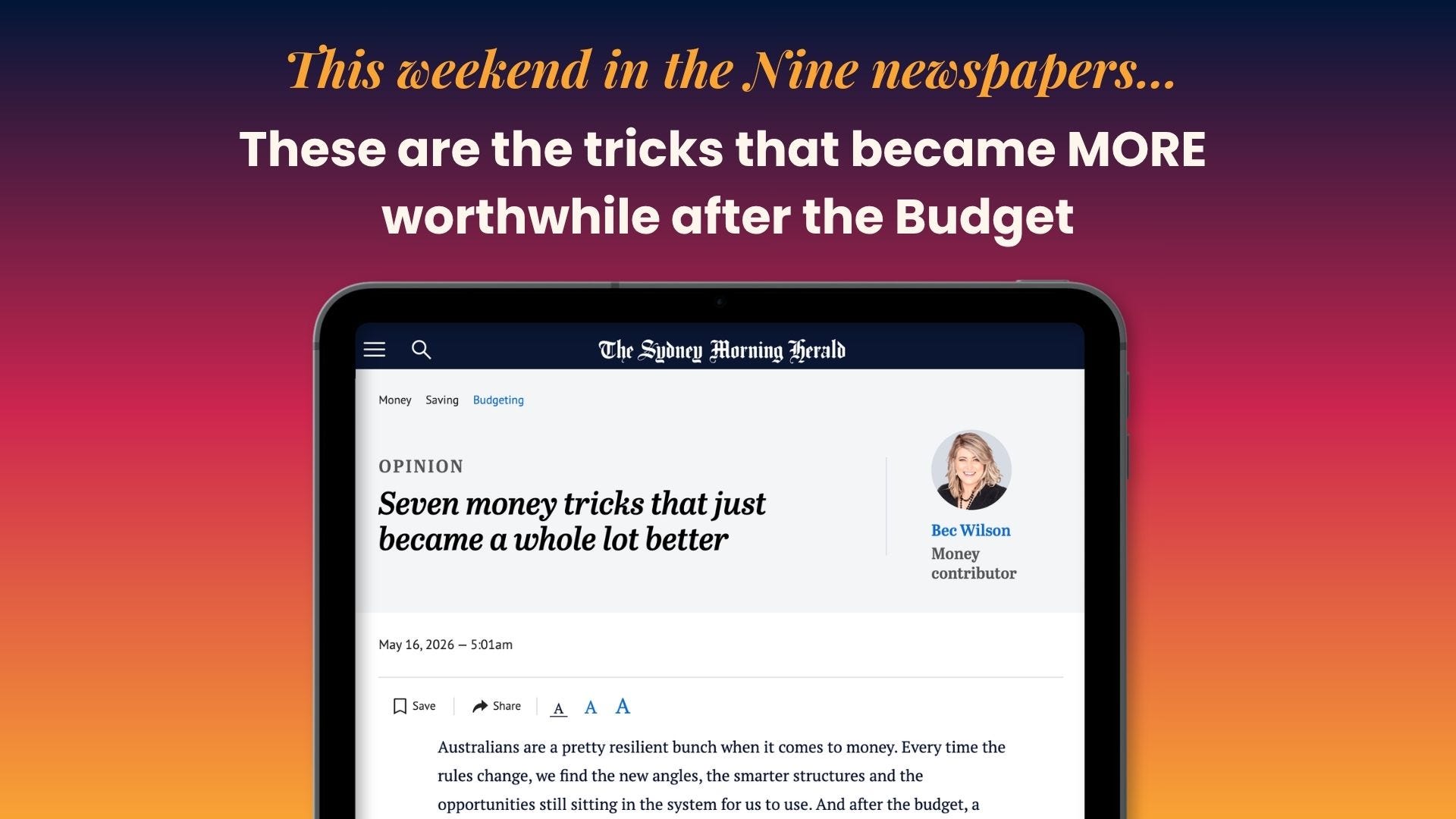
Australians are a pretty resilient bunch when it comes to money. Every time the rules change, we find the new angles, the smarter structures and the opportunities still sitting in the system for us to use. And after the budget, a few specific ones come into focus.
Yes, this budget will sting for some people, particularly those with wealth sitting outside super and younger Australians still trying to build a deposit.
The government’s decision to replace the 50 per cent capital gains tax discount with an inflation-adjusted cost base indexation and a minimum 30 per cent tax on capital gains from July 1, 2027, is a significant shift. Combine that with negative gearing being limited to new builds from the same date, and the investing landscape has truly changed.
But here’s what I want you to do: instead of spending the next six months fuming about it, look for the opportunities that just got a lot more interesting – particularly if you’re a Gen X parent trying to help your adult kids get ahead while also navigating your own path toward an epic retirement.
Here are seven money moves worth paying attention to this week that might not have been as appealing before.
This article continues. It was published in The Age and The Sydney Morning Herald on Saturday 16th May 2026. Read the whole article here. Note - it has a sign-up gate but no paywall.

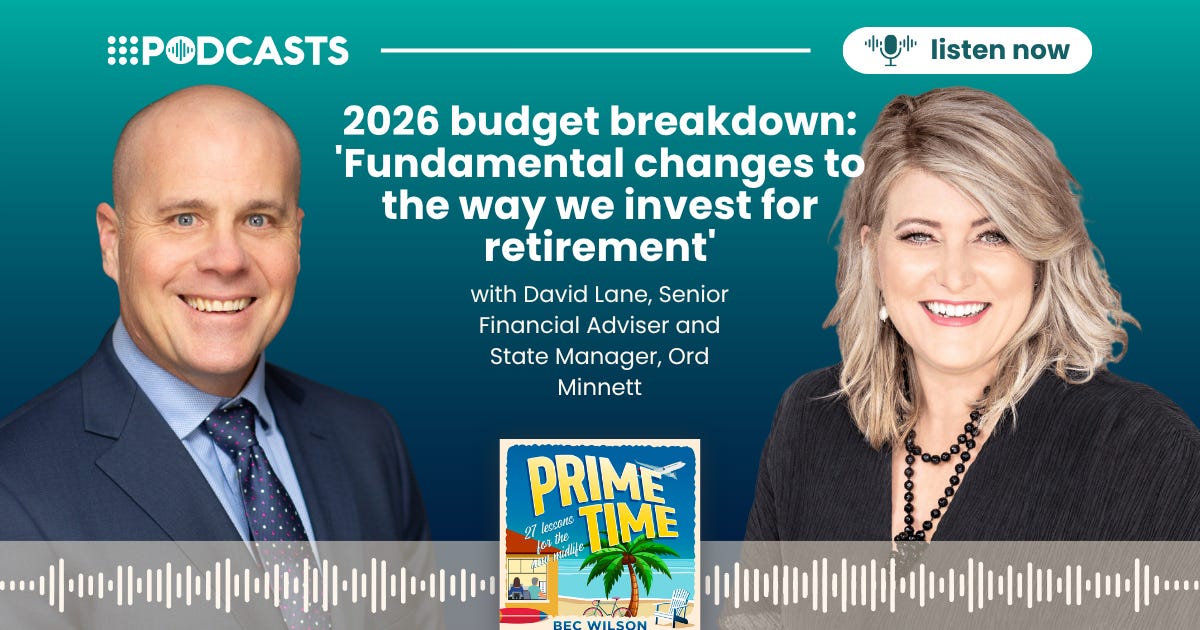
Has this Federal Budget just fundamentally changed the way middle Australians build wealth?
In this special post-budget episode of Prime Time, I sit down with Senior Financial Adviser and State Manager of Ord Minnett, David Lane, to unpack what could become one of the biggest shifts to retirement planning and investing in decades.
Thanks for reading Prime Time! Subscribe for free to receive new posts and support my work.
Together we break down the proposed changes to capital gains tax, negative gearing, trusts and superannuation and what they could mean for ordinary Australians in their 40s, 50s and 60s trying to build security, prepare for retirement and help their kids get into the housing market.
The conversation explores whether Australians are watching the old wealth-building playbook being rewritten in real time. From investment properties and rent-vesting to franking credits, shares, trusts and superannuation, David and I discuss the winners, losers and unintended consequences buried inside the Budget.
We also tackle the emotional tension many Gen X Australians are feeling right now: following the rules for decades, only to find the rules changing late in the game.
This is a practical, plain-English conversation about what may happen next and the decisions Australians may need to start making over the next few years.
LISTEN TO THIS EPISODE OF THE PODCAST HERE: