

What I'd actually do this weekend if I was 55 or 65 and the world felt a bit wobbly
And in this weekend's newspapers: The sweet spot has changed: Why having less super can sometimes mean you get more retirement income

In this edition
Feature: What I’d actually do this weekend if I was 55 or 65 and the world felt a bit wobbly
From Bec’s Desk: Finishing early
The Age and Sydney Morning Herald: Why a large super balance can actually reduce your retirement income
Prime Time: Why FIBRE is your missing ingredient to longevity
Ad - Before we start — a big thanks to our newsletter sponsor this week, Viking

Explore the world for less in 2027-2028 with Viking’s Explorer Sale*
For those planning to travel in the year ahead and beyond, Viking offers a world of possibility. With sailings to all seven continents, our thoughtfully designed voyages invite you to explore at your own pace — whether closer to home, along Asia’s cultural shores, through Alaska’s majestic landscapes or across Europe’s storied waterways. Each journey is crafted to reveal deeper connections, richer insights and the quiet luxury of discovering the world.
This is your last chance to fly free, upgrade to business class or save up to $5,000 per couple on 2026–2028 river, ocean and expedition voyages.*

What I’d actually do this weekend if I was 55 or 65 and the world felt a bit wobbly
What a week. Oil hit $113 a barrel. The war in the Gulf is now in its fourth week and showing no signs of easing. Petrol prices are climbing and our grocery bills are going up again. The RBA raised rates which sounds scary until you realise it’s because nobody really knows what comes next and inflation matters here.
And if you’re in your 50s or 60s, things are feeling a little uncomfortable. You might not be panicking, necessarily, you just might have that low-level hum of worry sitting in your gut. The feeling that things you worked hard to build feel a little less certain than they did a month ago.
So let me talk to you like a friend this weekend. Because there are a few things worth doing and none of them are all that complicated.
First, take a breath and step back from the noise
Turn off the finance news for the weekend. Not because what’s happening doesn’t matter – it certainly does – but because none of the decisions you need to make right now will be improved by watching oil price tickers, hearing about the horrible fuel price or watching market updates scroll past.
The Gulf disruption, the inflation creep, the cost of living squeeze – these are all real. But they’re largely outside your control. What you can control is whether you respond thoughtfully or react out of fear. And that always starts with slowing down and really thinking things through.
Next, remind yourself what your actual timeline is
Here’s the question I’d ask you to sit with: “when do you actually need to draw on your investments for income?”
Not when you want to stop working. “When you’ll need the money to live on.
For a lot of people between 55 and 65, the honest answer is still five, eight, even ten or more years away. Markets have recovered from oil shocks before in 1973, 1990, 2008. They’ve come back from worse than this quite quickly. And, frankly, the Australian market isn’t really all that far from it’s highs right now. But acknowledging that, time is what gives your investments room to breathe.
If you’re already in drawdown, the question shifts a little bit, but the core of it is the same: do you have enough money in a more stable type of investment or is your superfund drawing from the lower risk part of your portfolio to avoid being forced into selling growth investments or shares while they’re low?
Check whether you have a buffer and be honest about it
This is the one I keep coming back to with people in this season of life.
Do you have two or three years of living expenses in something stable — a high-interest savings account, term deposits, cash or lower risk investments? Not in the sharemarket. Somewhere it just sits, keeping up with inflation ideally, but at the ready.
Because if you do, you can ride this out. You’re not forced to sell when the market is down. You have ‘choices’. That buffer isn’t dead money. It’s the thing that lets you stay calm while everyone else is pulling at their hair.
WHAT IF YOU DON’T HAVE A BUFFER RIGHT NOW
If you don’t have a buffer right now. I want to be straight with you here, because glossing over this doesn’t help anyone.
If you don’t have much set aside outside of super or your investments, this week probably felt harder than it needed to. And that’s worth acknowledging that, not as a reason to panic, but as useful information.
The question to sit with this weekend isn’t “how do I fix everything at once.” It’s simpler than that: what’s one thing I could do in the next 90 days to start building a little more breathing room?
Maybe it’s redirecting $200 a month into a savings account you don’t touch. Maybe it’s looking hard at where money is leaking out right now in your cash flow. Maybe it’s a conversation with a financial adviser or the advice team in your superfund, not to overhaul everything, just to get a clearer picture of where you actually stand. (And bear in mind when the market is down all of these people are booked ahead).
You can’t build a buffer overnight. But you can make a decision this weekend to start. That matters a lot more than people realise.
Have an honest look at your spending right now
With petrol up, groceries creeping higher and energy costs rising, your day-to-day spending has probably gone up without you even noticing. This isn’t about cutting back dramatically but it is about knowing where you stand.
Grab a coffee and spend half an hour with your last few months of bank statements. Just three questions:
What am I actually spending each month right now?
Has that crept up in the last three months?
Is there anywhere I can claw back a bit of breathing room?
You’re not looking for perfection. You’re just looking for a clearer picture of your spending than you had on Friday.
Finally, think about what this stage of life is really asking of you
There’s a shift that happens for a lot of people somewhere in their 50s. It really does stop being about building alone, and starts being about protecting your assets as well – so at some point you can enjoy the life you want, make the choices you want to be able to, and feel the ense of ssecurity that lets you sleep at night.
In that context, another week of volatile markets and geopolitical noise shouldn’t be a crisis. It should be a prompt. A reminder to check in on whether your setup actually gives you flexibility and the ability to make good choices rather than being forced into bad ones.
That’s what this weekend is for. Calmly reassessing where you are, and taking control of where you want to be.
The war in the Gulf is certainly looking serious. The oil price is really high and the cost of living pressure that might come from this could be even more difficult. And none of us like looking at the price of petrol or the rise in interest rates coming through, especially if you’re already feeling stretched.
But the people who come through these periods best aren’t the ones who predicted it all or moved everything to cash in February (because they never know when to get back in). They’re the ones who had a plan they trusted, a buffer they could lean on, and the discipline not to let the noise and fear make their decisions for them.
If you’ve got the buffer then great, sit tight and trust the plan.
If you don’t, this is your weekend to decide to start building one. That decision, made over a coffee on a Saturday morning, is worth using your weekend’s spare time on.
You’ve got this. And I’ll be here with you through it all.
Bec x
Want to read more, I have two books - How to Have an Epic Retirement and if you’re not ready for retirement, Prime Time: 27 Lessons for the New Midlife.

This week I’m headed off for a local weekend away… and it’s a big one.
It’s my last ever school mums’ weekend. My youngest is in Year 12 this year, so this feels like a bit of a rite of passage for me too. I’m wrapping things up early on Friday (much earlier than I’d usually send this newsletter!) and heading to the Gold Coast for what looks like a rainy weekend of wining, dining, meditation, yoga… and celebrating with a group of women I’ve shared years of life with.
I have to admit, I’m feeling a little unsettled about what life looks like when these structures fall away. If you’re ahead of me on this path, I’d really love your advice.
On the work front, it’s been a big week.
The poddy this week was on Fibre, and for a gal that’s eating protein like it’s the only ingredient left on this earth, I found this important and timely. The role fibre plays in our health is important in so many ways - and Joanna really brought that to life. Hve a listen.
This week, we recorded the UK course in my studio. Still can’t quite believe I’m saying that. We’ll be running the Australian and UK programs side by side, just on opposite time zones. It feels like a real “pinch me” moment.
We’ve also locked in all the speakers and details for the next How to Have an Epic Retirement Flagship Course here in Australia. The Winter edition kicks off on 14 May, and we’ll be launching the earlybird offer next week. If you want first access, you can register your interest.
Inside the Autumn edition of Epic Retirement Course this week, we had a brilliant live Q&A with David Lane, Senior Financial Adviser and State Manager at Ord Minnett. He’s deep in platforms, SMSFs, equities and investing, so we threw some proper curveballs at him. The questions from this community are always next level.
Next week, we’re diving into purpose. One of my favourite topics.
And in the week ahead, I’m off to Canberra to speak at the North 26 Adviser Roadshow on the Future of Retirement – the first of nine events around the country. I’ll be talking about what everyday people actually want and need from advice today, and how retirement has fundamentally changed.
Until next week — make it epic.
Cheers,
Bec xx

Author, podcast host, columnist, retirement educator, and guest speaker

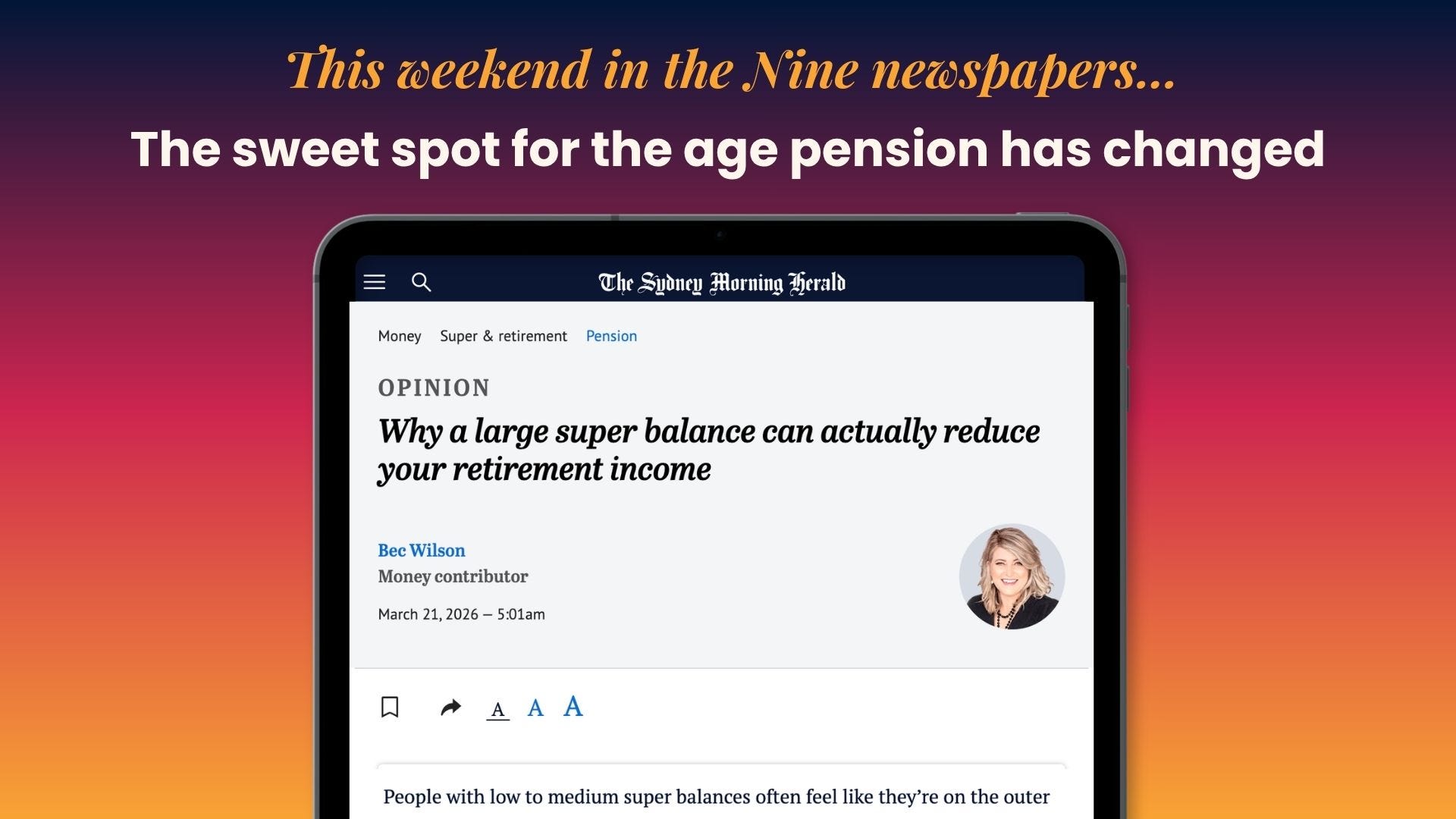
Why a large super balance can actually reduce your retirement income
People with low to medium super balances often feel like they’re on the outer when it comes to retirement. They look at people with $1 million or more in super and assume those are the people who get to enjoy the ‘epic’ version of retirement, while everyone else just scrapes by.
But that is not how the Australian retirement system actually works.
One of the quirks of the system is that there is a sweet spot where super and the age pension combine very efficiently. In some cases, someone with a moderate level of savings can end up with almost the same income, or even more income, than someone with much higher savings, simply because they still qualify for a far more meaningful slice of the pension.
That sweet spot has shifted again from March 20 because the age pension goes up. And we are not only seeing the standard indexation of the caps, we are also seeing our second rise to the deeming rate in a year.
This article was published in The Age and The Sydney Morning Herald on Saturday 21st March 2026. Read the whole article here. Note - it has a sign-up gate but no paywall.

Why FIBRE is your missing ingredient to longevity
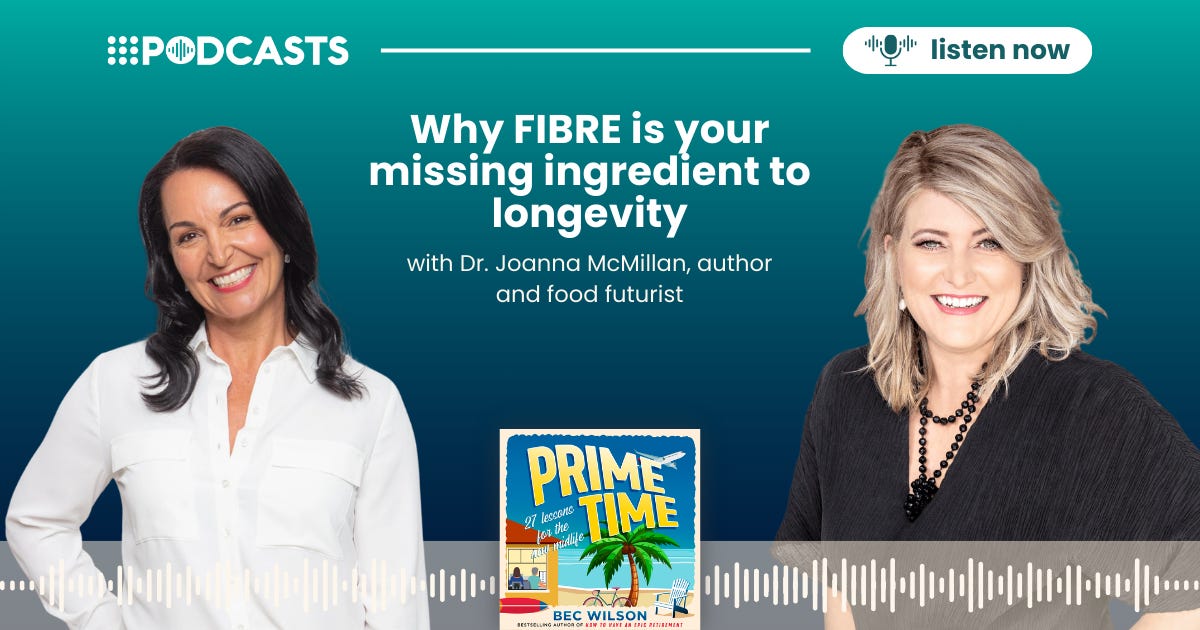
Today I want to talk about something that doesn’t get a lot of airtime, but is becoming increasingly important for your health in the second half of life…
Fibre.
For years it’s been overshadowed by protein trends, low-carb diets and the obsession with calories. But new science is revealing that fibre may be one of the most powerful ingredients for long-term health, influencing everything from gut health and weight to brain function, heart health and even our mood.
So, this week on Prime Time, I’m joined by PhD-qualified nutrition scientist, dietitian, food futurist and one of Australia’s most trusted health experts, Dr. Joanna McMillan, author of The Fibre Factor. You can find Dr. Joanna’s book at all good retailers and online here.
We unpack why many of us are living in what she calls a “fibre famine”, what fibre actually does inside the body, and how simple changes to what you eat can have surprisingly powerful effects on your long-term health.
LISTEN TO THIS EPISODE OF THE PODCAST HERE: