

The retirement plan nobody talks about: when your adult kids still need help
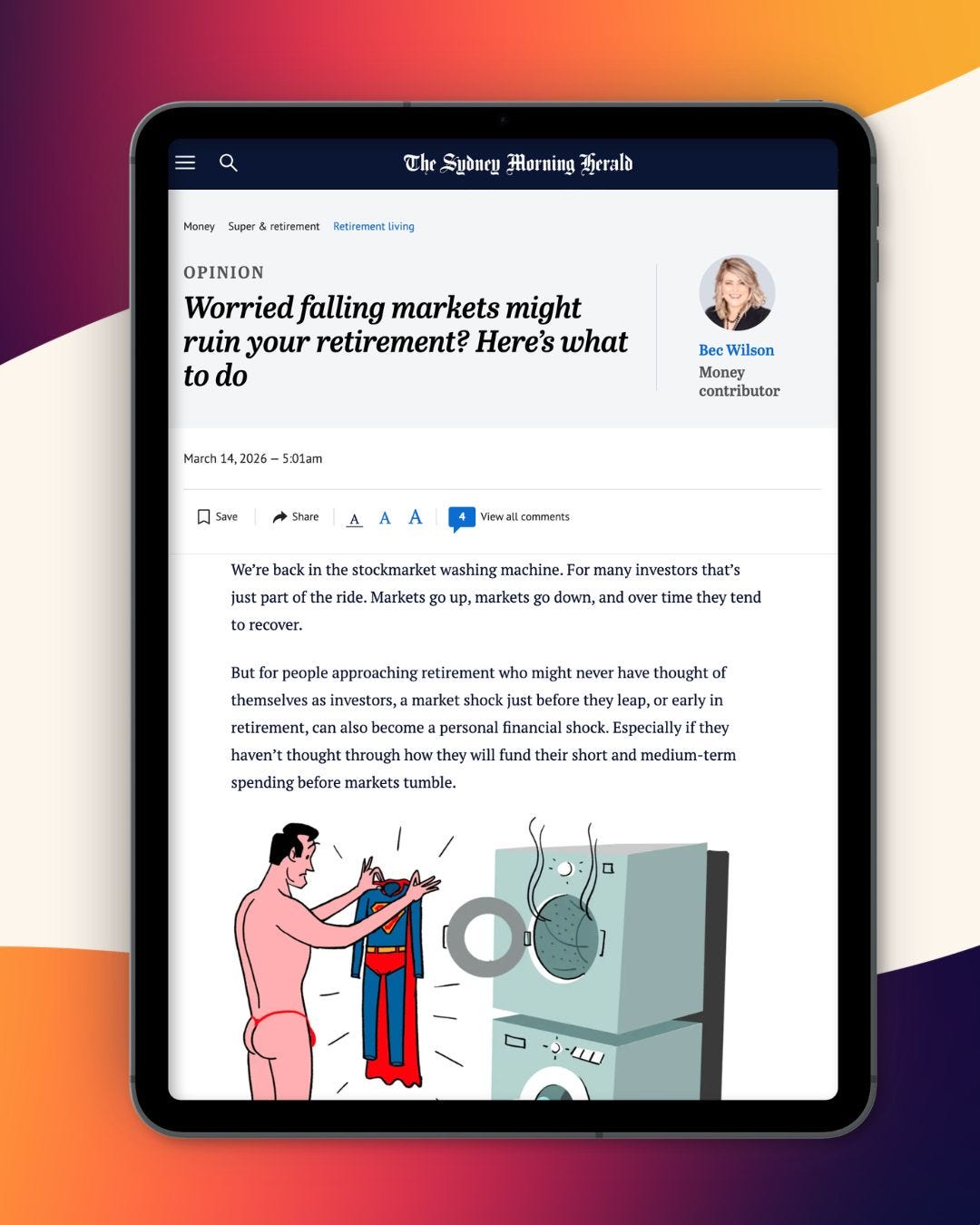
And in this weekend's Nine newspapers: Worried falling markets might ruin your retirement? Here’s what to do

In this edition
Feature: The retirement plan nobody talks about: when your adult kids still need help
From Bec’s Desk: Changing plans on a hairpin
The Age and Sydney Morning Herald: Worried falling markets might ruin your retirement? Here’s what to do
Prime Time: Two shows - ‘How to Salvage your Travel Plans’ and ‘War and sharemarket volatility: what pre-retirees need to know with Diana Mousina’
Ad - Before we start — a big thanks to our newsletter sponsor this week, Viking

Enjoy 8 Days in the Mediterranean from $4,795pp, plus companion flies free*
Don’t miss incredible value with Viking’s Explorer Sale, ending 31 March. Enjoy a more inclusive way to cruise the Mediterranean with one shore excursion in every port of call, all onboard meals included, and wine, beer and soft drinks with lunch and dinner.
Sail on board Viking’s award‑winning small ocean ships, designed for destination‑focused exploration and enriching experiences — no kids, no casinos and no hidden extras. With 24‑hour room service, free Wi‑Fi and thoughtfully curated itineraries, every detail is taken care of.
Use code CFE25 and companion flies free up to $2,500 per booking on 2026–2028 ocean voyages.*

The retirement plan nobody talks about: when your adult kids still need help
For a long time retirement planning assumed a neat sequence. You raised your kids. They became financially independent. Then you focused on your own retirement. But that’s not how life is playing out for many families anymore.
More parents in their 50s and 60s are still helping their adult children launch into the world. Sometimes it’s housing they’re providing for. Sometimes it’s education. Sometimes it’s simply helping them through a tough patch.
And now there’s another factor quietly changing the picture… AI.
Entire industries are evolving as technology changes how work gets done and none of us can predict which career paths will have longevity. Careers are becoming less linear, which can mean retraining, pivots, or periods of uncertainty.
And often, parents end up becoming part of the safety net, something I suspect will only increase in the years ahead.
This doesn’t mean you’re doing it wrong - it’s just a reflection of how much the world has and is changing. But it does mean retirement planning needs to acknowledge a lot more reality.
If you’re in your Prime Time or approaching retirement, it’s worth asking yourself a few honest questions.
How much support might you realistically provide your children over the next decade?Would you help with a housing deposit?
Would you encourage them to move back home temporarily if things became difficult?
Would you help them retrain if their industry changed?
These are not purely emotional decisions. They are financial ones too. And the key is not to ignore it.
When parents quietly fund deposits, cover rent for a while, or help with big expenses without thinking about the long-term impact, it can gradually erode their own financial security. On the other hand, when families talk about these things openly, it’s much easier to set sensible boundaries and establish criteria for the support.
You might decide that helping with a deposit is something you want to do, but it comes from a specific pool of money and requires a certain committment from the child to pay it back.
Or you might decide that your home is always open if someone needs a temporary place to land - but it’s not a permanent arrangement.
Or that you’re happy to help with education or retraining - particularly in a world where AI may reshape our kids’ careers several times across a lifetime.
This is where the conversation about retirement planning becomes much bigger than numbers on a super statement.
Because retirement doesn’t happen in isolation from the hard bits. It happens within families. And increasingly, the financial lives of different generations are intertwined for much longer.
Three helpful takeaways I think are worth doing
1. Decide in advance what help you are willing to give.
Think about the types of support you are comfortable providing over the next decade – a temporary place to live, help with retraining, or assistance with a housing deposit. When you’ve thought about this ahead of time, decisions are much easier when situations arise. (Even if sometimes you’ll no doubt flex).
2. Set a financial boundary around that support.
If you plan to help, decide where the money will come from and what rules you intend to sit with it. It might be a specific savings pool or a limit on how much you’re prepared to contribute, or a requirement for significant committment to repayments, working or study. This protects your own retirement and family ethos while still allowing you to be generous.
3. Talk about it openly as a family.
Many of the problems I see come from assumptions on both sides. A simple conversation about expectations, independence and support can make a huge difference. Clear expectations create healthier financial relationships between generations and a respect for the money and support on offer.
Want to read more, I have two books - How to Have an Epic Retirement and if you’re not ready for retirement, Prime Time: 27 Lessons for the New Midlife.

The markets bouncing around always creates a feeling of chaos. And this week has been as I expected - a little unnerving for those facing retirement and a good time to step up and provide useful education. So we did, bumping our existing schedule for the podcast and recording two really timely shows. First we got Diana Mousina, the Deputy Chief Economist from AMP on the show for a sensible conversation about how to handle the risks that lie ahead of us.
Then, in the same week we got travel expert, Fiona Dalton on the show to explain how to navigate travelling internationally right now. A great listen whether you have trips booked and are worried, or you wonder whether to book trips at the moment.
Our courses are in full swing, with Week 4 kicking off on the two programs currently running: the HESTA Exclusive Epic Retirement Program and the Epic Retirement Flagship Course for Autumn 2026. They really are so much fun, and the feedback from people doing the course is fabulous.
We kick off the UK edition’s course filming this week. That should keep me busy.
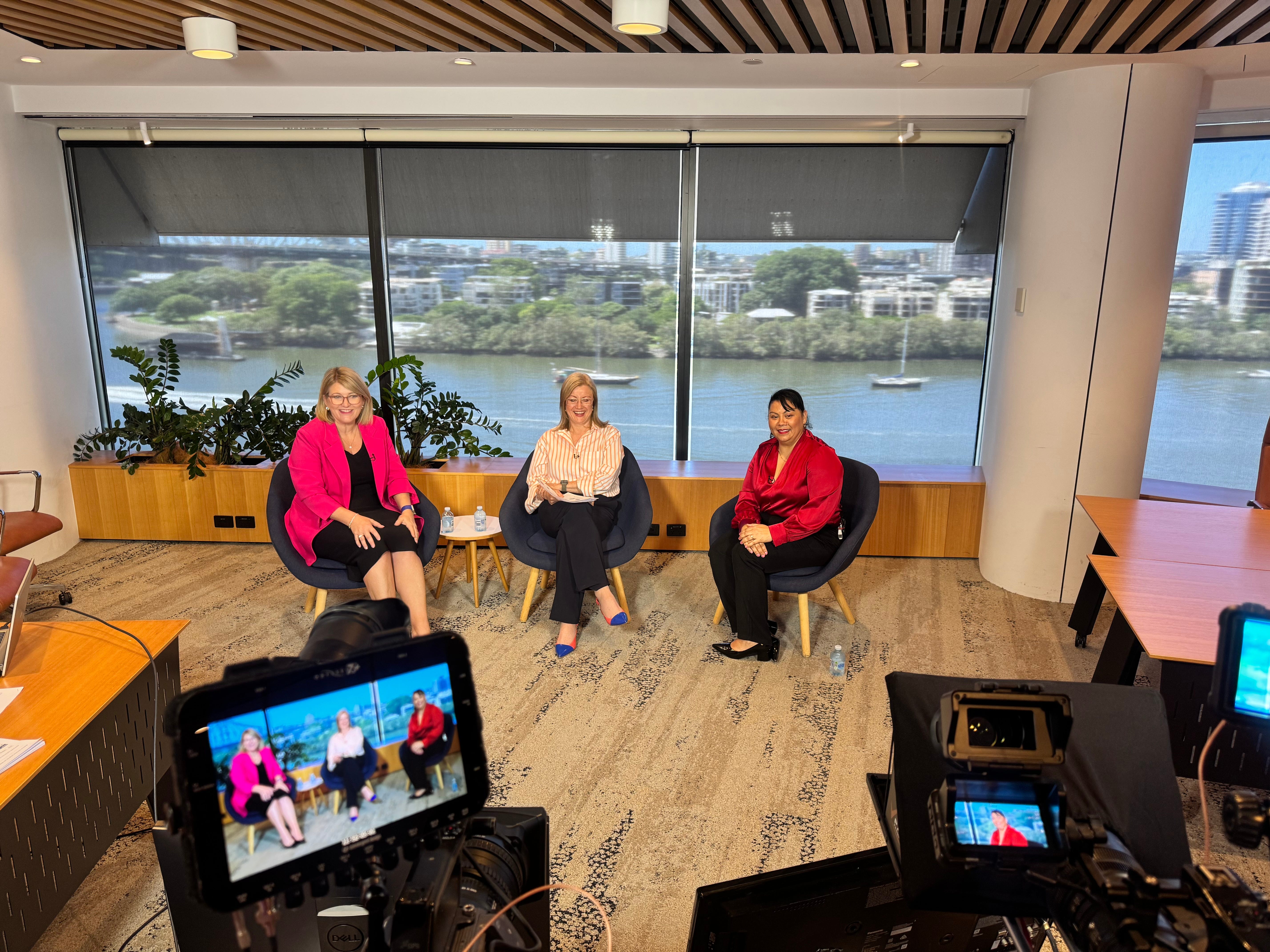
I also spoke at a terrific online event with Brighter Super’s members during the week, for International Womens Day. Hundreds and hundreds of their members came along for a session dedicated to the needs of women of all ages thinking about their retirements.
Don’t forget, if you want to make sure you’re getting my useful titbits throughout the week you can sign up for my Australian Facebook Channel: click here. It means only Aussie content will reach you.
See you in there.
Until next week - make it epic! Cheers Bec xx

Author, podcast host, columnist, retirement educator, and guest speaker

The retirement question most Australians never ask – but should
We’re back in the stockmarket washing machine. For many investors that’s just part of the ride. Markets go up, markets go down, and over time they tend to recover.
But for people approaching retirement who might never have thought of themselves as investors, a market shock just before they leap, or early in retirement, can also become a personal financial shock. Especially if they haven’t thought through how they will fund their short and medium-term spending before markets tumble.
And then they reach that moment, maybe 10 or 12 days into a war, an economic crisis or a market meltdown, when it suddenly looks like this might not be a short-lived wobble.
So they start asking the big questions: Should they sell and sit on the sidelines? Should they move everything to more conservative investments? If I don’t already have a financial adviser, who do I ask? Friends? The internet? The call centre at my super fund?
It’s a tough reality for many this week. So let’s step back and talk sensibly about what’s actually going on, and what your options are.
This article was published in The Age and The Sydney Morning Herald on Saturday 14th March 2026. Read the whole article here. Note - it has a sign-up gate but no paywall.

How to salvage your travel plans

The conflict in the Middle East has disrupted airspace across one of the world’s biggest travel hubs, leaving many Australians wondering whether they should cancel their upcoming trips.
In this urgent episode, I speak with travel expert Fiona Dalton to unpack what’s actually happening with global travel right now, who is affected, and what travellers should do before making any big decisions.
Fiona explains why the disruption is largely centred around Middle Eastern transit hubs such as Dubai, Abu Dhabi and Doha, what options travellers have if their flights are impacted, and why cancelling too early could actually leave you worse off financially.
The key message: stay calm, stay connected to your airline, and don’t rush into cancelling your trip but make sure you understand your options.
LISTEN TO THIS EPISODE OF THE PODCAST HERE:
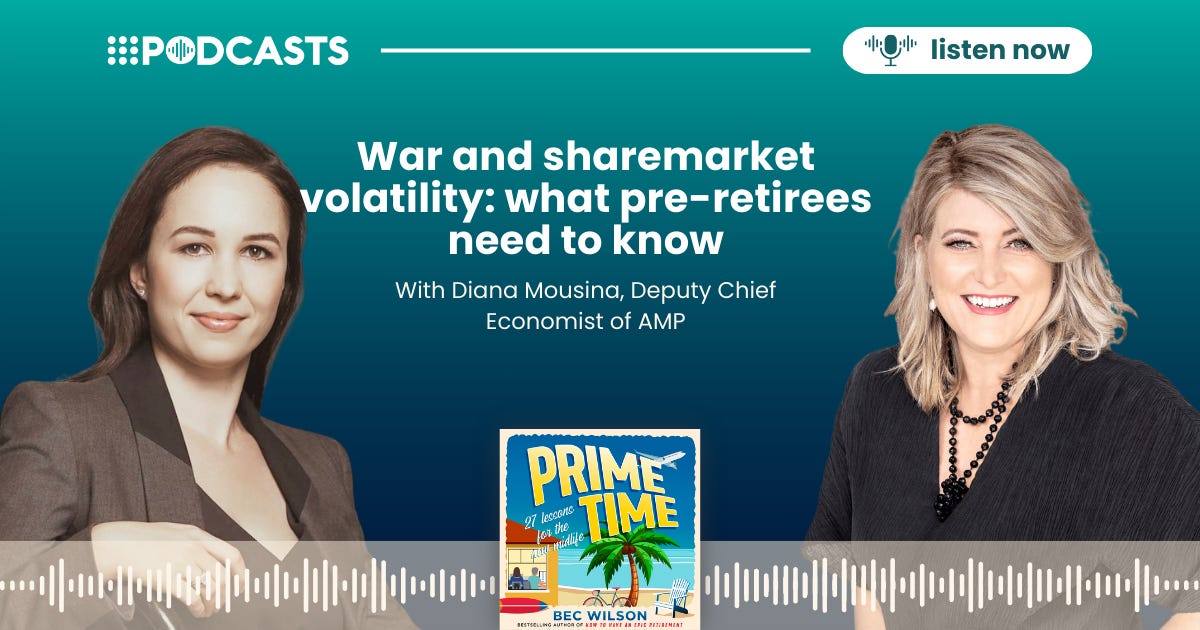
War and sharemarket volatility: what pre-retirees need to know
Markets have been on a rollercoaster this week. Oil prices have surged and dropped, the S&P has swung sharply, and headlines out of the Middle East are making investors nervous.
If you’re approaching retirement or already there, seeing your super balance fall hard in a single day then bounce around all week can feel deeply unsettling .
So what’s really going on? And how worried should you be?
In this episode of Prime Time, I speak with Diana Mousina, Deputy Chief Economist at AMP, to unpack the current market volatility, the impact of rising oil prices, and what geopolitical shocks typically mean for long-term investors and people approaching retirement now.
Diana explains why markets often react sharply to global conflicts in the short term but tend to recover over time.
LISTEN TO THIS EPISODE OF THE PODCAST HERE:
With four adult children, we are so conscious of being fair. So whenever we come up against a decision for one child, we always consider if we can provide something equivalent for all four. If not, but we think it’s important or necessary and we can afford it, the support is a loan or time limited.
I'm 63, with a 7yo son🤣