

Your brain needs a retirement plan too
And, in the Nine Newspapers this weekend "Why are so many retirees still spending like it’s 1991?"

In this edition: It’s a juicy one
Feature: Your brain needs a retirement plan too
From Bec’s Desk: Thousands learning this week
The Age and Sydney Morning Herald: Why are so many retirees still spending like it’s 1991?
Prime Time: Everything you were too afraid to ask about EVs
Ad - Our next Epic Retirement flagship course is booking fast
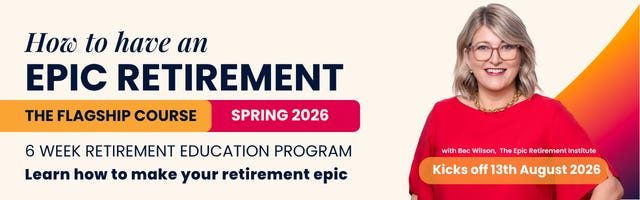
The Epic Retirement Course starts 13 August - book your place
We’ve got hundreds of people booked in for The Epic Retirement Flagship Course kicking off on the 13th August. We’ve just added another allocation of earlybird seats to get us through this weekend - so dive in and take advantage of the 25% off deal before we close it off. It’s already exceeded it’s caps.
The course
Six weeks, running 13 August to 25 September 2026
15 comprehensive modules covering the six pillars of an Epic Retirement, financial, health, happiness, home and beyond
New content drops each week so you move through it together with your cohort, not alone
12 weeks of access to the program in total, so there’s room to revisit anything you need to
What’s included
A 150-plus page printed and digital workbook, mailed to you before kickoff
Weekly live Q&A sessions with me and a lineup of special guests, this round including experts from AMP, Challenger, HESTA and more.
A cohort of fellow course participants to learn alongside
A signed copy of How to Have an Epic Retirement, the book - mailed to you
The offer
$525 per person, with 25 per cent off for the earlybird deal (taking it to $390 for a limited time)
Couples can join on one ticket, with an extra workbook available after registration
If you’ve been thinking about it, don’t wait much longer, the earlybird spots won’t last.

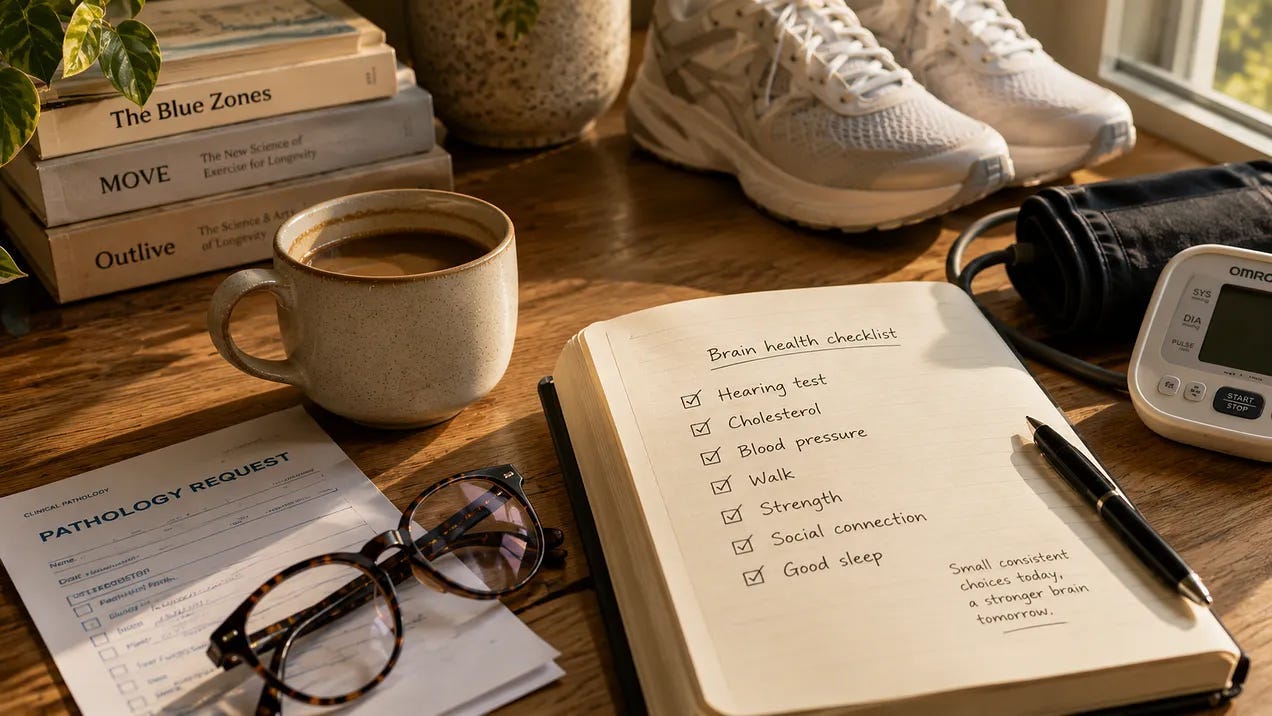
Your brain needs a retirement plan too
I don’t think enough retirement planning stops to ask what the point of it all is if your brain isn’t along for the ride. You can get the super sorted, the income streams mapped, the timing nailed, and still be missing the thing that makes all of it worth having.
The World Health Organization just released the first update to its dementia risk-reduction guidelines since 2019, and it’s worth ten minutes of your time. Not because it’s alarming. If anything, it’s the opposite. The headline finding is that up to 45% of dementia risk comes down to factors you can actually do something about. Genetics don’t get a vote in that 45%, your choices do.
That’s a bigger number than most people assume, so it’s worth being specific about what actually deserves your attention and what’s just noise.
If you had to guess the single biggest modifiable risk factor for dementia, you’d probably say diet, or exercise. The real answer, according to this review, is keeping your cholesterol in check, closely followed by managing your hearing loss. Each one accounts for around 7% of dementia cases on its own, which is more than smoking, more than diabetes, and more than physical inactivity.
Hearing loss is the real sleeper here. When your hearing declines, your brain has to work harder just to fill in the gaps in conversation, and over years that extra strain seems to take a real toll. Only around 17% of people who’d benefit from a hearing aid are actually using one. If you’ve been putting off a hearing test because you don’t feel that deaf yet, take this as your nudge. The WHO now actively recommends hearing aids as a dementia risk-reduction strategy, which is a new and fairly firm addition to this edition.
Cholesterol is less interesting to talk about but just as important to act on. If you’re in your 50s or early 60s and haven’t had it checked lately, or you know your numbers aren’t great and you’ve been meaning to deal with it, this is the moment. It sits in the same category as reviewing your insurance or updating your will: not urgent-feeling, really important, and easy to keep putting off.
Physical activity still carries the strongest evidence in the whole document. Not becoming a gym junkie, just not being sedentary. Walking regularly, gardening, golf without the cart. If you’re already doing that, you’re doing the single most evidence-backed thing available to you.
Social connection is the newest addition to the guidelines, and it matters more than it might sound. In 2019 there wasn’t enough evidence to make a call on this one either way. Now there is: staying socially active is officially linked to lower dementia risk. About one in four older adults globally report feeling isolated, and retirement is often exactly when that happens quietly, fewer work colleagues, kids who’ve moved out, a smaller circle than you had at 45. It’s worth treating with the same seriousness as diet or exercise, not as something that will sort itself out.
Then there’s what the guidelines pointedly don’t recommend, which is almost as useful to know. Vitamin B, vitamin E, omega-3 fish oil, multivitamins: the evidence review found no dementia-prevention benefit from any of them, provided you don’t have an actual diagnosed deficiency. If you’ve been taking a fish oil capsule “for your brain,” the science doesn’t back that up, and that’s money better spent on the hearing test.
The idea that a glass of red wine a night is protective doesn’t hold up either. It’s most likely a statistical illusion: people who already have health problems tend to cut back on drinking, which makes the moderate drinkers left in the data look artificially healthy by comparison. There’s no dementia-prevention case for drinking more than none.
And for women weighing up menopausal hormone therapy, the guidelines are now explicit that it shouldn’t be started or continued specifically to prevent dementia in women 65 and over. That doesn’t change the case for MHT to manage hot flushes, sleep, or bone health. Those reasons stand on their own. It just means brain protection isn’t one of them.
None of these individual actions is a magic bullet, and the guidelines are upfront about that. Managing cholesterol alone won’t dramatically cut your risk. Neither will hearing aids alone, or exercise alone. What the evidence shows most clearly is that tackling several of these together, blood pressure, hearing, activity, social connection, produces the strongest and most consistent results of anything reviewed.
Which is oddly reassuring, when you sit with it. It’s not about finding the one perfect intervention. It’s the same principle as retirement planning itself: no single decision, when you stop work, how you draw down super, when you take the pension, what you do with your time, carries all the weight on its own. It’s the combination that gets you to an epic retirement.
If you want a place to start: book the hearing test if it’s overdue, ask your GP for your cholesterol and blood pressure numbers if you don’t already know them, and take an honest look at whether your social calendar has been quietly shrinking and try fitting in a walk every day or two. None of that requires a life overhaul. It just means treating your brain with the same planning mindset you’d bring to your finances.
Source: World Health Organization, Risk reduction of cognitive decline and dementia: WHO guidelines, second edition (2026).
Want to read more, I have two books - How to Have an Epic Retirement and if you’re not ready for retirement, Prime Time: 27 Lessons for the New Midlife.

We’ve been busy. Our next HESTA 6-Week Epic Retirement course kicked off this week with THOUSANDS of students. Very fun to see so many people in there chatting, participating and learning with so much excitement. This is what I dreamed of when I started the Epic Retirement Institute - building courses that help people and serving them up in a way that really helps. Thank you to HESTA for making that possible for their members!
Our own Epic Retirement flagship course is on track to be the biggest ever too. A frighteningly large shipment of workbooks arrived at my home office this week - a whole pallet of books I had to find space for. And that will only get us through 2-3 courses. It’s the little things that bring us joy isn’t it.
I also co-presented at the Aware Super online event for couples - with hundreds of attendees. Great fun and so much lovely feedback. Thanks for coming and learning - if you were there.
And I booked my next trip to London - for some speaking over there in October.
Our Bec’s Epic Bucket List holidays have been shortlisted to 4 trips we are refining for 2027. We’re looking at cruising Iceland/Norway; Walking in Umbria; A pre-christmas 2027 Xmas markets river cruise in Europe and we’re adding a Kimberley Cruise too - closer to home later next year. But I wont tell you much more - because we need to see if there’s availability on these bucket list trips first. Then we can get serious about it. And, once we lock those, we’ll plan early for 2028.
Also, you’ll see Paris and I have continued our work on An Epic Start. We’ve decided it needs a semi-regular newsletter (probably fortnightly initially) that parents and young adults starting out can follow for the key lessons. So we’ve started one on substack and put up a little explainer. You can follow it here. And join us on Instagram too - here.
Finally, I’ve been keeping up my new gym committments - and I’m getting stronger. Progressive lifting is my goal, and it’s a slow process of learning how to do it. But I’m committed. Gotta practice what I preach - especially when Dementia prevention gives me another reason. How are you going?
And that’s it - have a ripper Sunday!
Cheers - Bec

Author, podcast host, columnist, retirement educator, and guest speaker

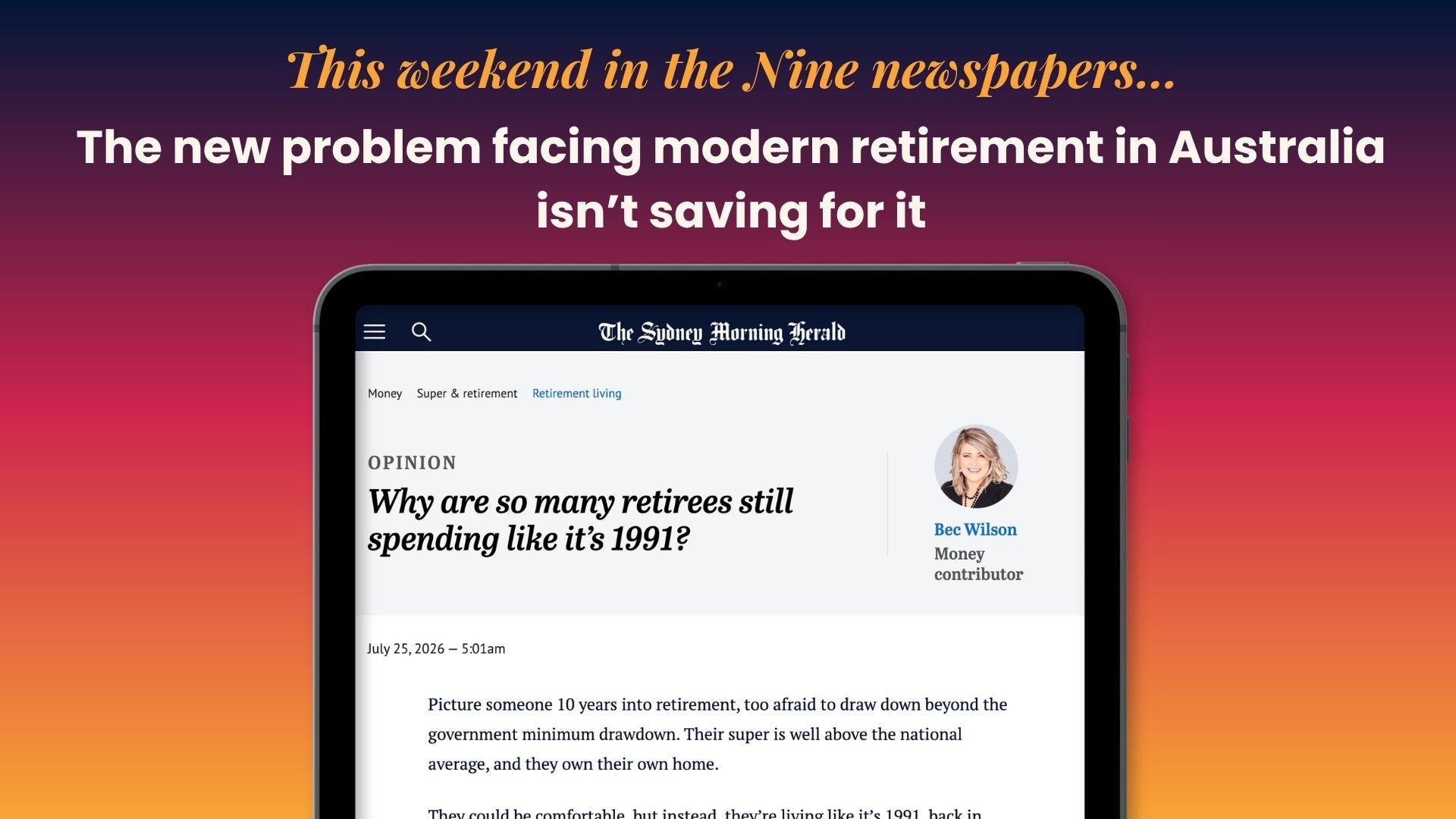
Why are so many retirees still spending like it’s 1991?
Picture someone 10 years into retirement, too afraid to draw down beyond the government minimum drawdown. Their super is well above the national average, and they own their own home.
They could be comfortable, but instead, they’re living like it’s 1991, back in the recession we had to have. They’re skipping the trip to see their grandkids overseas, patching up a car that could have been replaced years ago, and turning the heating down a notch every winter to protect a super balance they will almost certainly never spend.
That’s not a rare story. It’s happening in kitchens and living rooms all over Australia. And here’s the hard part: 33 years ago, Australia launched one of the most successful financial experiments in the world – we forced every Australian to save for retirement.
Most people don’t realise that it worked magnificently – giving everyone who has worked a bucket of savings to deploy when they retire. But we never explained that to the people living it.
In fact, the enormous success of superannuation has created a new retirement problem we don’t discuss enough – people don’t know how to manage their money so they can confidently spend.
Most people in Australia don’t think of themselves as someone who has saved for retirement. You’ve saved almost accidentally. It came out of your pay before you ever saw it, went into an account you probably didn’t check for years at a time, and it grew while you got on with living your life – just like the experiment was meant to work, but better.
We’re a nation of brilliant savers, and terrible spenders, and it’s really not our fault.
You didn’t get a financial plan, or understand what you were invested in. You just didn’t touch it, and it turns out that for most average Australians that will be enough.
Except that now, most Australians are sitting on a reasonable-sized bucket of money, and very few are actually prepared for how to spend it.
This article continues… It is published in The Age and Sydney Morning Herald on Saturday 18th July 2026. Read the whole article here, without a paywall.

Everything you were too afraid to ask about EVs
I’ve been wanting to do an episode on electric vehicles for a long time. Not because I think everyone should rush out and buy one tomorrow, but because there seems to be so much confusion around them. Every time the topic comes up, there are plenty of opinions, a few myths, and surprisingly few people who’ve actually lived with one.
I’ve owned an electric car for seven years now, and while I certainly don’t claim to be an expert, I have learnt a lot along the way. And, I’m even contemplating what kind I want next.
This week I invited Sarah Aubrey from Electrify This onto Prime Time. Sarah spends her days helping everyday Australians understand electric vehicles in plain English, not through the lens of a car enthusiast, but as someone who wants practical answers.
We talk about the real costs of owning an EV, charging at home, battery life, resale values, tax incentives, and whether they’re actually a good fit for Australians in their Prime Time.
Whether you’re seriously considering an EV or simply curious about what all the fuss is about, I think you’ll come away understanding the topic far better than when you started.
LISTEN TO THIS EPISODE OF THE PODCAST HERE: